 |
 The Camera Hunter® When a Half a Stop Makes a Big Difference Photography and Text Copyright Bill Silliker, Jr. What exposure settings should you use for Atlantic puffins? How do you best capture the two extremes of light reflectance, pure white and pure black? Most of you know that slide film hasn’t got the capability to record detail in both blacks and the whites at the same time. Would you believe that digital cameras have even less tolerance?
Slide film cannot properly record more than a "stop" off of a perfect exposure setting. Miss by that much and the colors are either all washed out looking due to overexposure, or too dark to show any detail due to underexposure. Even at a half stop of overexposure, you lose detail, especially in the highlights. Digital cameras have even less latitude, also called dynamic range. And they also have little forgiveness for overexposure of the highlights. One top commercial photographer shooting digitally says that with only 3/10’s of a stop overexposure that you lose detail in the whites. While you’d think that color negative film would thus be the choice for serious and all professional nature photographers, most of them actually shoot chromes because most magazines require color slides to publish from. It’s only recently that some publishers will consider digital submissions, let alone digitally acquired images. Partly that’s because there are several cameras out there today capable of providing digital files that rival film, partly it’s because the editors are catching on. However, that’s the subject for another future column. Let’s instead consider how to meter for a perfect exposure on Atlantic puffins with either slide film or by digital acquisition. The answer is to expose to get detail in the white of these birds. If you don't, you'll blow out their white feathers and the images will look like a marshmallow with an Oreo cookie stuck to it! I set exposures for puffin photography by first metering off of an 18% gray card in the same light as the puffins. All camera meters are calibrated to record the light reflecting from a gray card as an average exposure. Forgetting all the science for a moment and thinking of 18% gray as reflecting an amount of light halfway between the light reflected by an all-white object and the light reflected by an all black object is a good place to start. How do I get the gray card in the same light as the puffins while in a blind? By opening one back window of the blind to let light shine in the blind to meter from. I then adjust the exposure setting to allow one half to two thirds of a "stop" less
That's not to say that all pros carry gray cards. Most rely on their experience at seeing light reflect off of "natural gray cards" that they meter in the same light as their subject. Some reliable natural gray cards include middle toned blue sky directly opposite the sun, middle toned green grass in the spring and summer, and most autumn leaves, either yellow or red. Note that you should look for the middle tones, not the real dark or the real light stuff. I always check the vegetation or rocks when working in a new area, to find natural gray cards that I know I can trust to set exposures from once the action starts. For example, most of the green vegetation on seabird nesting islands seldom reflects light as a gray card does, but typically at a full stop less. And the rocks appear as whitewashed, as they are usually often covered with guano. Test the light reflective qualities of some natural features and learn what you can trust, and more importantly, what you cannot. When you do this test, you need to know how the camera's meter reads the different parts of the picture. Most older meters are center weighted and select exposures from a 10% or so area in the center. On newer cameras you can select spot metering, even down to a 1% spot in the center. Read your camera manual to learn the types of metering it includes. It also matters what length lens you're using. Meter with a center weighted meter behind a 400mm lens and you'll wind up setting an exposure for a very small area, similar to using a spot meter. Evaluative or matrix metering in theory takes into account all the areas of the scene, weighs what you're focused on. It works for average scenes and some trickier stuff, but don't ever believe that it will get you a proper exposure when your target is a black bear in a snowstorm – or a puffin on a “hot” rock. Those wanting to photograph Atlantic puffins on the East Coast of North America should consider a special visit to Machias Seal Island off the coast of Maine. I go there with Captains Barna Norton and his son, John. Barna Norton has operated a puffin cruise to that island for many years and has permits to land folks to use blinds on the island regulated by the Canadian Fish and Wildlife Service. The Nortons operate out of Jonesport; for information see their website at www.machiassealisland.com. Catch yours in the good light. BS-NPN 012 Comments on this column? Send them to the editor.
To see the 2003 dates for Bill's workshops with L.L. Bean and Great American Photography Workshops, slide talks sponsored by Fujifilm Professional and book signings click here. 

|
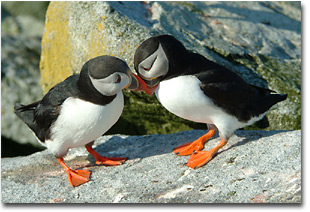 How much light reflectance can film record? That depends on its latitude. Color negative films and black and white films have a good deal of latitude. Because of that, both types of film are forgiving of mistakes in setting the exposure when you take a photograph. A photo lab can pull a reasonable print out of either, even if you erred by as much as two stops of over or under exposure.
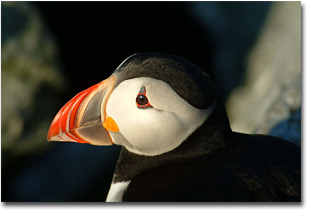 light to reach the film, depending on how bright the light is hitting the puffins. While this underexposes the black, it keeps the white from blowing out.
 Maine wildlife & nature photographer Bill Silliker, Jr. – The Mooseman - has photographed at many wild places in North America, with the results published in magazines internationally and in 9 of his own books. Bill has been an instructor of wildlife and nature photography for L. L. Bean's Outdoor Discovery Program since 1992 and is a member of the Fuji Film Talent Team. He maintains a web site with tips for wildlife photographers at
|
|