 |
 Winter Invaders
Text and photography Copyright Charles Glatzer
At first, I found it quite difficult to discern the differences between the females, males and juveniles of the species, but through careful and constant observation I was soon able to identify individuals through their variations in color and plumage. Females and juveniles are more heavily marked with dark, barred areas than are the males. Adult males can be seen as almost pure white, although they have up to three bands of dark plummage on their tails. Adult females are distinctly barred throughout, and have from four to six bands of dark tail feathers. Immature snowys are heavily barred, and dark spotting may dominate their overall appearance. The dark spotting among the immatures varies according to sex, with the females having the darkest spotting. Juveniles are generally brown overall, with scattered white spots of down showing through. The Snowy Owl tends to be solitary, standing 20 to 27 inches tall, and while it is not the largest owl (Great Gray), it is the most massive weighing 3.5 to 5 pounds, with a wingspan of approximately five feet. It is considered the most powerful of the North American owls. The female is larger and heavier than the male, as is the case, with most diurnal (active in daytime) birds of prey and owls. Its feet are feathered and its talons large and sharp. Snowy Owls can live at least 9½ years in the wild. I often observed the owl(s) out in the open, squatting, close to the ground, presumably to make itself less of a target to predators. Except during hours of low light, its eyes were always partially closed, the suns glare being too intense for their large yellow, nocturnally adapted eyes. However, their sleepy appearance is deceptive, as they remain constantly alert, particularly to sounds. All owls' eyes are fixed in their heads and they must move the head itself to change visual focus. Watching the bird turn its head beyond 180 degrees is quite a site. It can look completely over its back and then some. With the wind always being strong along the open beach front, I could usually find the owl(s) crouching on the ground behind a windbreak, such as in the lee of a small sand dune, patch of dune grass, group of rocks, or more typically behind a drift log close to the dune edge. Creatures of habit, they will use the same perch, rise, log, etc., thus locating the owl(s) became much easier as the months went on. It is also interesting to note the owls are almost silent. I only heard its shrill chirping once when witnessing two owls in territorial dispute. Rarely did I see two owls together, but when I did it was magic. These short-lived encounters proved difficult to photograph, but were well worth the effort when it clicked. It became readily apparent that after every preening or rousing, the owl would immediately look into the camera with eyes wide open. I am sure this was due to its lack of eye contact, and natural feeling of vulnerability. This need for reassurance provided a photo opportunity I could count on. I watched carefully each time the owl raised its front and lowered its back, just before defecating, for this was a prelude to flight. Snowy owls generally make short flights, close to the ground, and usually, perch on the ground or a low post. However, I did watch one owl fly far out over the water on one occasion, returning much farther down the beach. Most hunting is done in the "sit and wait" style, and the same is true for the photographer who wishes to document any behavior. As the sun began to set, the owl became more active. It eyes widened, and, in preparation, for the nights hunt, the owl would stretch its wings, first one, and then the other. Occasionally if I was lucky, it would raise both over its head simultaneously. As with most birds, a slow and low approach is best. By decreasing your silhouette/stature, you become far less threatening to you subject. Take your time; let the owl become acclimated to your presence, inching forward only when the owl looks away. When approaching with another person move in unison, and stay close together. Flanking the owl produces stress, and it will surely move on. With patience and in the company of others, I have photographed the owl at close range for over two hours, thereafter slowly backing away leaving the owl unstressed and as we found it. The welfare of your subject must always remain paramount. Nature photography is no different from any other photo discipline. Once technical proficiency and equipment familiarity are mastered, time spent in the field observing and learning the behavioral aspects of your subject will greatly increase your chances for producing high quality unique imagery. 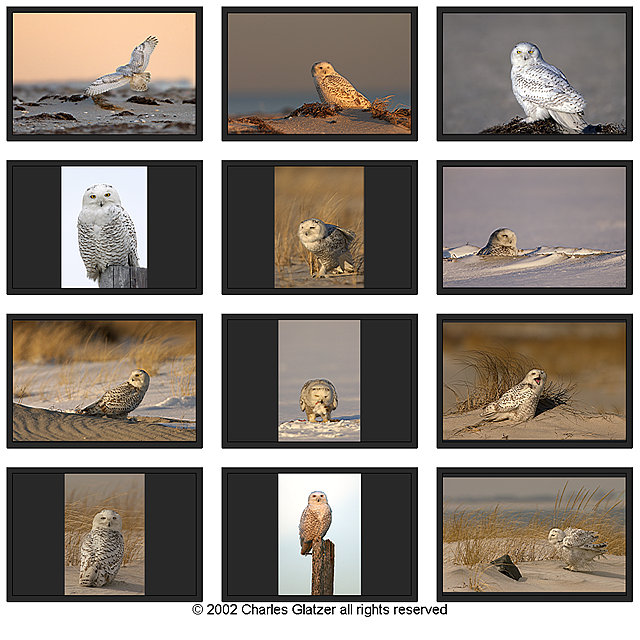 Equipment - D1X, 400 f/2.8 AFS, TC20E and TC14E, SB28DX w/ Better Beamer, Wimberley- shape shifter flash bracket system, gimbal head or sidekick w/ Arca B1, Gitzo 1548, All exposures were incident referenced via Minolta Meters and minus compensated accordingly so as not to block up the white highlights. See you in the field, Chas NPN 002 Comments on this article? Send them to the editor. 

|
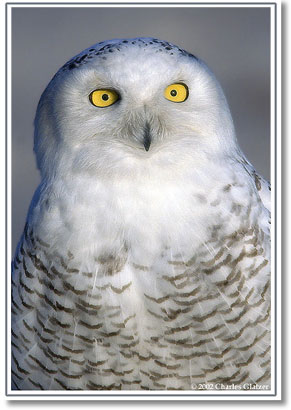 I have been extremely fortunate over the last few months to be able to both observe and photograph no less than five different Snowy owls close to home.
Luckily, the south shore of Long Island, NY continues to be a favorite habitat for Snowy Owls during incursion years. The Snowy, like other artic raptors, is very irruptive in its movements, its migration dependent on the availability of food. It was once believed that Snowy Owl migrations occurred on a regular basis, every three or four years, paralleling the population density of its primary food source, the arctic lemming. However, recent analyses of Christmas Bird Counts show that the numbers of Snowy Owls wintering in various parts of North America fluctuate irregularly from year to year. The Snowy Owl is highly nomadic appearing as far south as North California and South Carolina, mostly along lakeshores, marine coastlines, and marshes. It is usually immature males that move furthest south during these incursions.
|
|