|
|
Just the thought of night diving seems to conger up those primitive fears we were supposed to outgrow as adults. Those mysterious shapes that went bump in the night now move in the inky blackness about the boat. Seas, calm and inviting by day seem colder and foreboding in the darkness. To dive at night is to encounter and observe creatures rarely seen during the day in a world few terrestrial beings can ever imagine. Overcoming your reluctance, you slide into the water and wait on the surface for your buddy to join you. A narrow beam of light is all that guides you through the descent into blackness. Under the cloak of darkness, creatures reclusive in daylight go about their nightly vigil while others appear spellbound, as if transfixed by a force unknown. You are an explorer on the far side of a moon viewing organisms in a world of unparalleled beauty and diversity.
At night, underwater strobes play an integral role in uncovering the kaleidoscope of colors hidden in the ocean realm. As the source of illumination and exposure, multiple strobe units are beneficial. The short camera-to-subject distance requires a second (fill) strobe to reduce the shadow created from the primary
(main) strobe. Flash angle and placement are critical as lighting the suspended material between the camera and subject will result in back-scatter*, making the subject appear as if it were photographed in a blizzard. Focusing requires an additional light, preferably positioned off camera so the hordes of plankton and nematodes attracted to this light source will be out of frame.
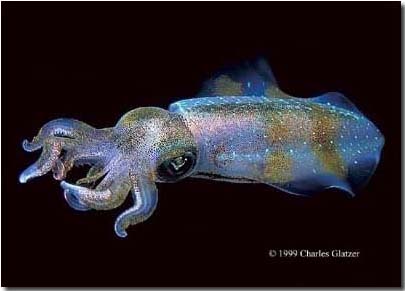
This Caribbean Reef Squid was photographed in Belize, 40 ft. below the surface on a moonless night. I first noticed the squid camouflaged, hovering motionless as if suspended in space just off the bottom. Lights in the hull of the dive boat had attracted plankton and small fish, inviting the reef predators to come and dine. Knowing squid become transfixed in bright light, I trained my flashlight on the cephalopod and slowly lured it off the bottom, providing an open water background of pure black. Concentrating on exposure, composition and lighting, the squid and I drifted about each other in an underwater ballet. Aware that these extremely intelligent creatures can instantly change their color by altering specialized cells in their skin, I remained prepared to capture the phenomenon on film.
The processed roll of film lay before me like a treasure chest of jewels. This living organism of exquisite, priceless beauty had revealed itself in a way I never could have imagined.
*Technical Note -
Backscatter results from the illumination of particulate matter held in
suspension in the water. Since the angle of incidence equals the angle of
reflectence, the greater the strobe to subject angle, the less this
matter will reflect light back to the lens.
|