|
|
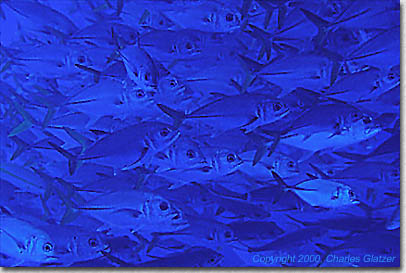 The cast is in motion. The director watching from above said "action" eons ago. As light filters down, illuminating the theater set by clouds, wind, and waves, I become one member in a cast of millions;
an insignificant part of the natural order of life. In every direction is drama, murder, mystery, and intrigue,
without intermission. Survival of the fittest is the law here-eat or be eaten. The replacement or lose of one cast member is insignificant. There is no leading role, only a huge supporting cast with each member playing an integral part in the grand scenario.-CG
Underwater, the only constant is change. What was or was not has now come and gone. I have learned the hard way to always reserve a few frames at the end of the roll for the unexpected. Toward the end of this dive, the nicads powering my underwater strobes ceased. Good timing, I thought, as I slowly started to ascend. Making my usual safety stop 15 feet below the surface, I hung weightless, decompressing, but continuing to scan the sea in every direction. After a brief lull, fish began to appear and take up residence in the shadows under the dive boat. Within minutes they arrived in mass from every direction. I soon found myself surrounded by several thousand Jacks.
A 60mm micro in my housing with no strobe power would not have been my first choice of equipment. As another day in paradise was coming to an end, the light was fleeting, and with my film of choice for macro, Velvia ISO 40, in the camera, taking any photos would be difficult. I had to focus on the fish with the aperture wide open to achieve a shutter speed of merely 1/60th. Underwater we try to use wide-angle lenses to eliminate as much H2O as possible between the lens and subject. A 60mm micro used with a flat dome port underwater means shooting through considerably more water than desired. It seemed the conditions were all wrong, but by the results, I thought, Murphy was on my side.
The Velvia helped add contrast and color saturation to what should have been a soft, flat image, and the "wrong" lens turned out to be the right ticket, compressing the image and allowing me to document the school in a way I would have not otherwise considered.
The moral of the story-Negatives can be positive, it's all in how you look at it.
CG-NPN
|