|
|
 Vision is bestowed to us, seeing is intuitive. Our experiences play a significant role in our ability to perceive the world around us. This gift allows each of us to be unique. People choose to be positive or negative, film merely exists. It is a non-entity until we decide to make it otherwise.
We, as photographers, are afforded with every frame of film we expose, the unbelievable opportunity to be creators; masters of our domain. The instant you press the shutter, you alone decide what is to be. Remember this when creating new images. View the frame with diligence: subject, background, and foreground do not exist until you decide they do. Slow down, analyze what it is you want to communicate to the viewer. It may be the fear in an animal’s eye as it is being preyed upon, the gentleness with which an alligator helps its young to the water, or perhaps the ferocity she exhibits in their defense. It is easy to freeze a moment in time by simply pressing the shutter release: it is yet another story to elicit an emotional response. The success of an image lies in your ability to stimulate the viewer.
Photographic technique and composition, whether it’s applied at a zoo, game park, in the wilds of one’s backyard, or on safari in Africa, are still the essential elements in photographic design. In truth, we all try to go to the places where our subjects gather in abundance. We feed birds in our backyards, go to public ponds where ducks are unwary of our presence, and to zoos for practice, and to photograph those animals that some can only dream about photographing in the wild. Regardless of where the same holds true: An Outstanding Image is one with Visual and Emotional Impact. Composition, lighting, exposure, selective focus and other techniques, all come together by our hands to invoke a response (pleasant or not) whereby the viewer is transcended from his world to the world we have put before him.
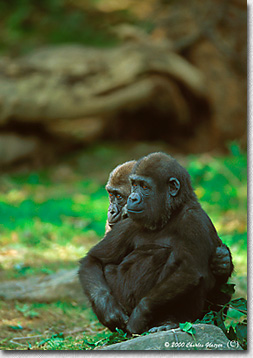 My role as a Nature Photographer is to raise public conscience. I have a friend whose career is rooted solely on the acquisition of images taken at zoos, aquariums, reptile houses, etc. When an endangered species or rare animal is required for publishing, it is from those files that flora or fauna is chosen to help educate and heighten public awareness. Is this not our primary goal as communicators? Some of you may be altruists, and if so, is the use of a slow shutter-speed to impart motion a contradiction, or does it offer an interpretation of the real world not seen by the naked eye? We need to reward creativity wherever it is achieved. Shooting in captive situations requires the photographer to have a discerning eye, one that will scour every part of the frame. Producing an artistic image while isolating the subject and eliminating man-made distractions from the field of view is, in itself, creative. Using the different techniques at our disposal, selective focus, depth of field, rear sync, image panning and others, can result in dramatic images that one would find nearly impossible to replicate in the “Wild”. Photographs taken in zoos, game parks, or rehab facilities can be marked with a “c” to indicate “captive images.”
Regarding digital enhancement, I suggest that the image be marked with a “de” for “digital enhancement,” along with an explanation of the alterations. As the owner of a custom color lab, I have burned, dodged, altered color, cropped, and manipulated prints for some of the best image creators in the business. Is this not enhancement? Have you ever tried to take an over-exposed slide and create a digital masterpiece (junk in = junk out)? I am not suggesting that digital be a save all, but rather a tool to enhance your unique vision. As an artist, I say embrace technology and expand creativity, but be truthful. International Photographic Competitions have specific categories for digitally enhanced images. As a judge and competitor in these contests, I have learned digital is here to stay.
All images should be clearly marked and judged accordingly.
-CG
|