 |
 On Location with Charles Glatzer...
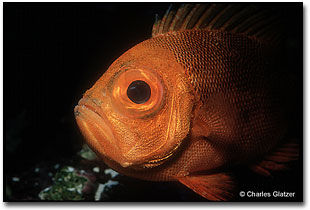
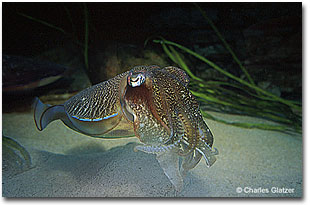
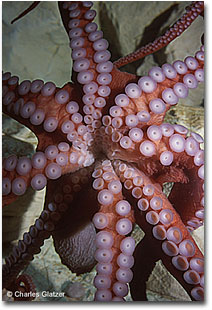
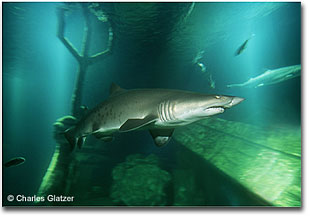
Achieving quality images when photographing aquatic subjects in an indoor aquarium environment can be relatively easy. Here are a few simple techniques to get you started. I recommended the following equipment; a SLR camera with a wide-angle lens (for larger subjects, and those against the glass), a 50 or 105mm macro lens or a short wide-angle/macro zoom, and a TTL flash with a dedicated off-camera cord. Flash is usually required as most tanks will not have the sufficient light intensity necessary for you to freeze subject motion with a medium ISO film. With the dedicated off-camera cord attached, set your flash to TTL operation and its manual zoom setting to its widest coverage, holding the flash against the glass and above the lens or slightly to one side for modeling. Slow shutter-speeds (you can use aperture priority) with sessile subjects will help reduce the shadow cast from your single strobe. If you choose to vary the position, always orient the strobe so that it's pointed towards the fish's face (dual strobes are better, but more complicated to work with in a crowded arena). Look for a section of clean, unmarred glass, positioning the camera lens as close to the glass as possible to avoid reflections (wear a black or dark shirt). Shoot subjects that are close to the glass, as reducing the amount of water between lens and subject will result in better clarity and contrast. It is important you shoot straight through the glass, as any deviation will usually produce distortion. Wide-angle lenses work well with reef system tanks, or tanks containing the larger aquatic species. Drag the shutter on Aperture Priority (rear sync. works well) but be careful of ghost images at slow shutter speeds. It's better to lose some DOF with the wide-angles by using a higher shutter speed, thus avoiding the potential motion blur. Additionally, I have regularly found a minus 1 flash exposure compensation will result in a better wide-angle subject exposure. The 50/60mm and 105mm macro/micro lenses are very effective for isolating small subjects. The light is all TTL strobe so shutter-speed is irrelevant. Be careful not to exceed the strobe's capacity (guide number), as this will result in under-exposure (too small an aperture for the strobe-to-subject distance). Watch the flash-ready or exposure confirmation light. Note -Most reef tanks are cool (blue) in color temperature, while fish tanks are generally daylight balanced. Happy shooting! Chas-NPN About the images... Bigeye - 105mm micro against glass, one SB28 manual zoom (35mm) TTL w/ SC-17 cord held off camera, Velvia Cuttlefish - 60mm micro against glass, one SB28 manual zoom (35mm) TTL w/ SC-17 cord held off camera, Provia 100F Shark - 18mm held against glass, two SB28 strobes manual zoom (20mm) on stands, TTL SC-17 cords, -1 flash comp., slow sync., aperture priority, manual focus, Provia 100F Octopus - 24mm positioned close to glass, one SB28 manual zoom (20mm) on TTL w/ SC-17 cord held off camera, Provia 100F Editor's Note - Charles' extensive list of corporate clients includes Atlantis Marine World, where he is the principal photographer.
His images can be seen on Atlantis story boards, postcards, in editorial print, and advertising
media including the web, movie theater screens, posters, brochures, billboards, and more. |
 Aquarium Photography - Shooting Through Glass
|
|