 |
 On Location with Charles Glatzer...
Chance Encounters The more time we spend a field, the more likely our chance of witnessing the natural behavior of flora and
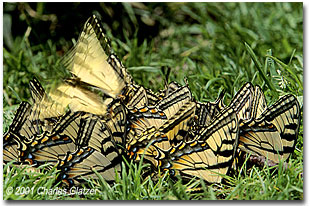
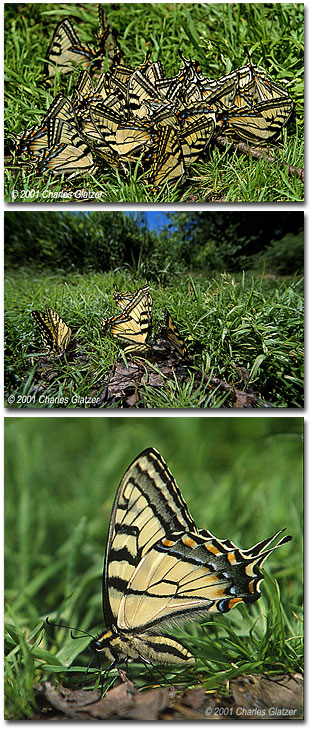
fauna. I recently had one such encounter while instructing a Shoot the Light Workshop in Maine. While looking for moose, we came across an aggregation of twenty to thirty Canadian Tiger Swallowtail (Papilio canadansis) butterflies clustering atop damp leaves with minute puddles of liquid .On closer inspection, it appeared they were probing the liquid with their proboscis. I assumed they were drinking, or as the pungent smell was quite evident, lapping up some mineral salts they required from the moose urine. I had read about this puddling behavior in books whereby photographers would actually urinate on riverbanks to attract butterflies. However, I had never witnessed it first hand, nor had I ever tried to attract butterflies in a similar fashion. When photographing behavior, visualize the image(s) as part of a storyboard. What specifically do you want to show, and do the images convey this to the viewer? Chance encounters are exciting, and unexpected by definition. Make the most of them, have fun, and consider yourself lucky. Mother Nature has many treasure chests; the more time you spend in the field, the more jewels you will collect. My first thought was how would I go about documenting this behavior while presenting the subject in an aesthetic fashion. By using a variety of lenses, I could emphasize the subject in its environment from different perspectives. As the butterflies were in full sunlight, I choose a 22" Photoflex soft yellow reflector to fill in the shadows, as opposed to a translucent diffuser, as this would maintain consistency of lighting from foreground to background in all of the images. A Nikon F5, 80-200 AFS with TC20E was used for the close-up images. The MFD of the prime lens remains unchanged when using a teleconverter, thereby providing an increase in magnification. Additionally, this combination allowed me to effectively isolate the subject (blur the background) with a focal length longer than my current 105 micro, while affording a reasonable camera-to-subject working distance. Documenting the single butterfly required the setup be as low as possible. To maintain DOF throughout the image, the camera needed to be oriented parallel to the subject. I continually adjusted both my position and the reflector relative to the butterfly. Fill flash, and rear sync, combined with a slow shutter speed allowed me to capture the butterfly in motion. A Nikon 14mm at MFD allowed me to capture the butterflies up close puddling behavior and environment in one image. See you in the field. Comments on this column? Send them to the editor. Editor's Note - Charles' extensive list of corporate clients includes Atlantis Marine World, where he is the principal photographer.
His images can be seen on Atlantis story boards, postcards, in editorial print, and advertising
media including the web, movie theater screens, posters, brochures, billboards, and more. |
|
|