|
|
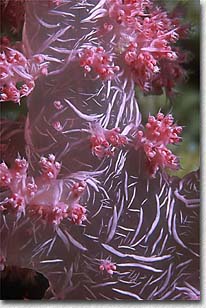
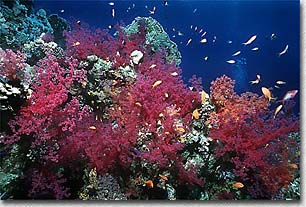
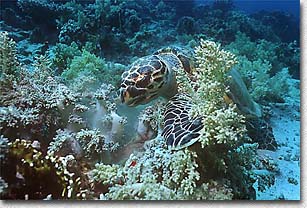
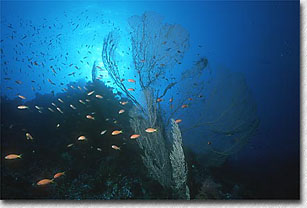
The Red Sea contains one of the most diverse ecosystems on earth; it
borders the Sinai in Egypt, a most desolate place. All images were
photographed while diving from the Wildcat, a Luxury Liveaboard Diveboat
operating out of Sharm El Sheik, Egypt. Thank you, Adham and the
wonderful crew of the WILDCAT for an unforgettable experience.
Equipment
Nikon F4s bodies with DA-20 Action Finder and MF-23 Data Back in Aquatica housings.
Lenses -16, 18 and 20mm Nikon AF for wide angle work, 60mm and 105mm Nikon AF for close up
and macro.
Nikonos V with 15mm and 20mm lenses.
Strobes - Sea & Sea YS 300 and Sonic Research SR2000 slave strobes, with
TLC and fabricated arms.
Film - Fuji Velvia ISO 40 for all Macro, Fuji Provia F ISO 100 for Wide
Angle.
Exposure - In Macro or Close-up, the main strobe is a wide angle beam and
exposure is determined by the maximum f-stop for the strobe-to-subject
distance. TTL is often used. The fill is a fixed guide number slave
strobe with a narrow beam and diffuser to widen and warm up the color temperature
slightly, and it is placed so that the ratio is approximately 2:1-3:1.
According to the subject, the slave can be positioned to
alter the ratio. Using two strobes enables me to position the strobes at
greater angles to the subject, resulting in less backscatter and more
modeling in the images. With wide-angle images, the ambient light is
always assessed first. Backgrounds are typically a half-stop darker than the
strobe-illuminated foreground and subject. Strobe power is adjusted to match
the desired f -stop (full, 1/2, 1/4 power), while shutter speed controls
the amount of ambient light recorded.
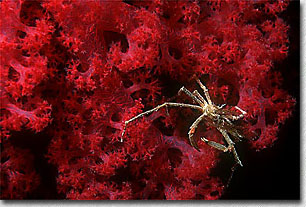
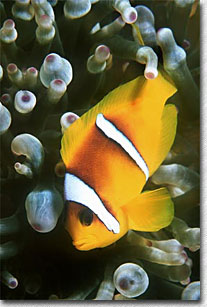
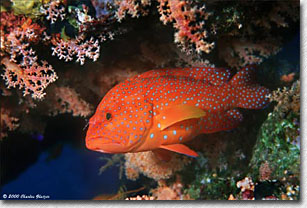
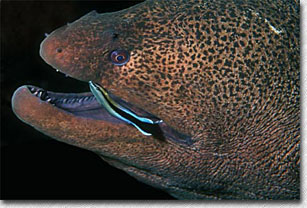
The diversity of life and color found on coral reefs is astounding. I
hope these images motivate you to view the world beneath the waves for
yourselves.
CG-NPN
|