Gallery: Macro & Close-upPosted June 27, 20081,531 views6 comments
Nikon D2Xs
Sigma 150 f/2.8 macro
1/100s; f/8.0; ISO 250
Park Cronesteijn, near Leiden, Netherlands.
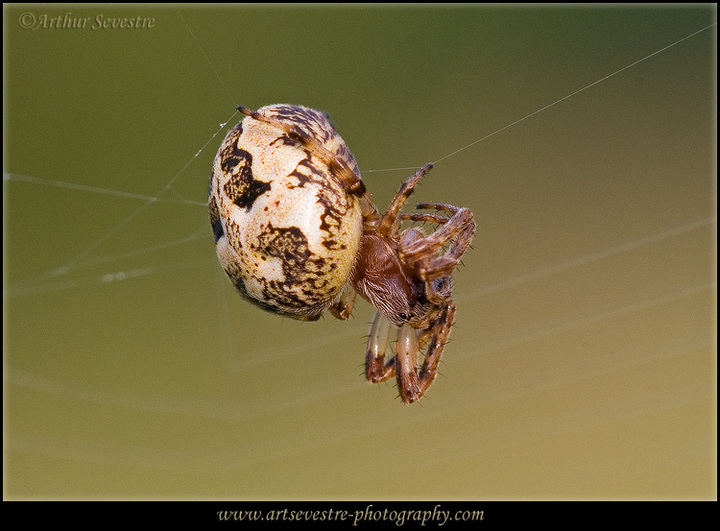
A Larinioides cornutus weaving its web.
Comments
6 comments
Comment posted by William Brozy on June 27, 2008 at 11:39 AM
This is not an easy image to pull off Arthur - and you accomplished this task wonderfully. Orb-Weavers always fascinate; I wonder/ponder what is the evolutionary benefit of carrying around such a large abdomen? Anyone care to enlighten?
This is sweet!
Registered on November 9, 2003, 559 Posts, 2929 Comments
Comment posted by Robert Ganz on June 28, 2008 at 1:24 PM
This is an exceptional shot to get, and you have isolated everything nicely. You can see the legs doing their thing getting the web spun out where it should be.
Nicely done.
Registered on November 1, 2003, 339 Posts, 759 Comments
Comment posted by Ronnie Gaubert on June 29, 2008 at 10:06 PM
Excellent details Arthur. The background colors are very complimentary to the spider, well done.
Registered on November 1, 2003, 810 Posts, 3495 Comments
Comment posted by Marsel van Oosten on July 1, 2008 at 3:12 AM
Well done Arthur - congrats on the EP.
Registered on March 9, 2004, 285 Posts, 2277 Comments
Comment posted by Arthur Sevestre on July 1, 2008 at 5:58 AM
Thank you alll, I'm extremely happy with the EP!
Registered on November 1, 2003, 275 Posts, 888 Comments
Comment posted by Arthur Sevestre on July 1, 2008 at 7:16 AM
Will, your question about the abdomen is interesting. Indeed it seems strange to carry so much bulk and then in such a strange way: as a huge bubble hanging on to the rest of the body with just a tiny tubular attachment.
The reason for the size is that there are many organs in that abdomen. Here you will find the heart, the booklungs, sexual organs, a large part of the digestive system, and the spinners and protein-producing glands. The last two take up a lot of space and likely more in species that use them a lot. All spiders use their spinners, but species that use it in a complex way to catch prey, be it by weaving a web or by catching them by casting a net, produce more silk and usually more kinds of threads too. There are seven kinds of glands and all spiders posses a few of them, but never all together. The seven glands help produce sticky threads, non-sticky walking threads, stuff to attach threads to each other, threads to encapsule prey, thread for cocoons, and adhesive threads. Then there are the spinners, which are attached to the glands with tubes (between 2 and 50.000 of them). Most spiders have three pairs of spinners, but it is possible to have one, two or four pairs.
In short, that abdomen is packed to the brim with survival equipment and its size corresponds to how much of that equipment the species needs and on how large its organs have to be. Interestingly, sometimes there is a noticable difference in relative size (apart even from the absolute size difference) of the abdomen between the sexes too, because they live in different ways.
The reason for the tiny tube connecting the abdomen to the rest of the body eludes me for now, but it must be the most efficient way. More species have this of course. Look at wasps, ants and the like for example. If animals of our size would have such abdomens, it would never work just because it would become way too heavy, drag behind us and the connection would break pretty soon. But on the small scale that these animals are built, these problems do not occur. Their large backsides don't bother them and apparantly the connection is strong enough to hold under pretty demanding circumstances sometimes if you think about how quick these animals can move.
Cheers!
Registered on November 1, 2003, 275 Posts, 888 Comments

Comments
6 commentsThis is sweet!
Nicely done.
The reason for the size is that there are many organs in that abdomen. Here you will find the heart, the booklungs, sexual organs, a large part of the digestive system, and the spinners and protein-producing glands. The last two take up a lot of space and likely more in species that use them a lot. All spiders use their spinners, but species that use it in a complex way to catch prey, be it by weaving a web or by catching them by casting a net, produce more silk and usually more kinds of threads too. There are seven kinds of glands and all spiders posses a few of them, but never all together. The seven glands help produce sticky threads, non-sticky walking threads, stuff to attach threads to each other, threads to encapsule prey, thread for cocoons, and adhesive threads. Then there are the spinners, which are attached to the glands with tubes (between 2 and 50.000 of them). Most spiders have three pairs of spinners, but it is possible to have one, two or four pairs.
In short, that abdomen is packed to the brim with survival equipment and its size corresponds to how much of that equipment the species needs and on how large its organs have to be. Interestingly, sometimes there is a noticable difference in relative size (apart even from the absolute size difference) of the abdomen between the sexes too, because they live in different ways.
The reason for the tiny tube connecting the abdomen to the rest of the body eludes me for now, but it must be the most efficient way. More species have this of course. Look at wasps, ants and the like for example. If animals of our size would have such abdomens, it would never work just because it would become way too heavy, drag behind us and the connection would break pretty soon. But on the small scale that these animals are built, these problems do not occur. Their large backsides don't bother them and apparantly the connection is strong enough to hold under pretty demanding circumstances sometimes if you think about how quick these animals can move.
Cheers!