"Creativity involves breaking out of established patterns in order to look at things in a different way."
-Edward de Bono
Photography is a creative art and we're all trying to be original in our own way. In wildlife photography however, it is difficult to come up with refreshing images as our subject matter doesn't really change. For fashion photographers, architecture photographers, photo journalists and sports photographers, it's a lot easier in that aspect - their subject matter changes all the time. Most animals look the same now as they did 25 years ago, yet we still photograph them again and again, and the result is that there are millions of pictures around of most of the more common animals and a lot of them simply look or feel the same. To take a good photograph of a lion today that doesn't look like all the other zillions of good photographs of lions is not an easy task to say the least.
What I usually do when I go on a trip to photograph a specific species, is a lot of research on what kind of pictures have already been taken of it. I use (photo) books but also the internet to see what's been done already and if there is anything that I can come up with to create something different.
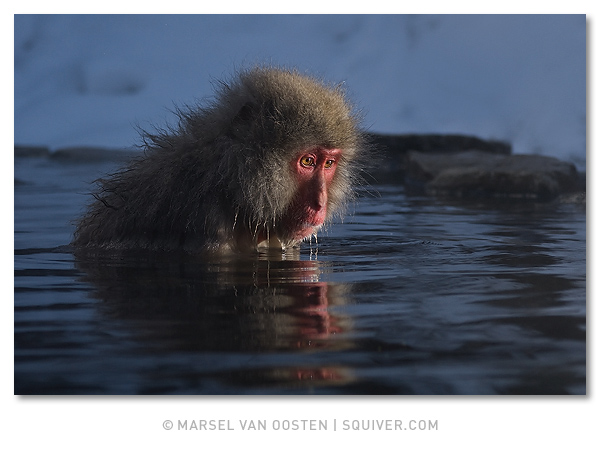
For my trip to Japan last winter I looked at thousands of images of snow monkeys for instance and noticed that most of them were done with on-camera flash, mostly to brighten the face and the eyes and to compensate for the low light levels. During my visit I used flash as well, but I decided to choose a different approach. Instead of keeping the flash on the camera, I positioned it at a distance and to the side of the subject (with a radio controlled remote) to create more three dimensional side-lighting. I underexposed the ambient light for extra mood and to emphasize the lighting, and eventually came up with this shot. I'm very happy with it as it is an original take on a much photographed subject, which is what I was after. I would like to add that my wife/lovely assistant was holding the flash for me, and I would not have been able to take this shot without her help - thank you honey!

Comments appreciated as always.
D2Xs, AF-S 28-70/2.8, 1/250 @ f/5.6, ISO 100, SB-800, remote 
Comments
23 commentsI like what you have done here with off camera flash, having the flash light coming from a different direction definitely gives a completely different feel to the image. Can you remember what your flash settings were? Do you use manual flash settings in a situation like this?
Many images of these snow monkeys really had a big impact on me mainly due to the expressions and characters of these monkeys and the misty atmospheric environment. For example your diamond head image I find stunning. IMO this image is very very good but somehow does not have the impact snow monkey images can have.
Btw thanks for bringing up interesting discussion topics
You truly did a great job at capturing a unique shot of this monkey... The position of the flash (which I would have never guessed was a flash) made all the difference in the world compared to what I belive it would have looked like otherwise.
Really great shot!
@ Vincent: Glad you like the shot. I don't remember what flash settings I used, but I think I underexposed the ambient light by two stops and set the flash to manual output at something like 1/8.
It's interesting to hear that you prefer the Diamond Head image, which for me is much more ordinary compared to this one. I prefer this one because of the mood, the pose and the lighting. And because there's no other snow monkey shot like this around, which I guess makes it extra special for me.
thank you very much for sharing not only the image, but also your photographic aproach. I consider it very helpful for many of us.
I am honest, I like the image very much, but would have preferd not to have the "shoreline" crossing directly at the head level. That is something I try to avoid, but I know also, not always possible...
True, but in wildlife photography the subject most of the time is a concrete specimen of a certain known species. A shot of an African elephant will therefore always be a shot of an African elephant. In landscape photography there's much more variety in terms of possible subjects and subject combinations. People tend to look at a landscape photograph and see a landscape, not just a mountain or a tree or a creek - they see the sum of all parts. When they look at a wildlife photograph, they see the animal, and therein lies a big difference imo.
Thank you for your feedback.
[Quote] "I am honest, I like the image very much, but would have preferd not to have the "shoreline" crossing directly at the head level. That is something I try to avoid, but I know also, not always possible..."
I agree Cay-Uwe, but sometimes there's just no other way. In this case I could have gone higher up to move the shoreline above its head, but that would have given a terrible perspective. I could have gone two inches lower (I was already shooting at water level), but then I would have lost most of the reflection.
Thanks for your comments.
(So enormous amazingly nice, I love it.)
it's amazing shot!