...My Salmon?
In my last post (a very dark black bear portrait) I promised something "sunnier" next - so here it is...
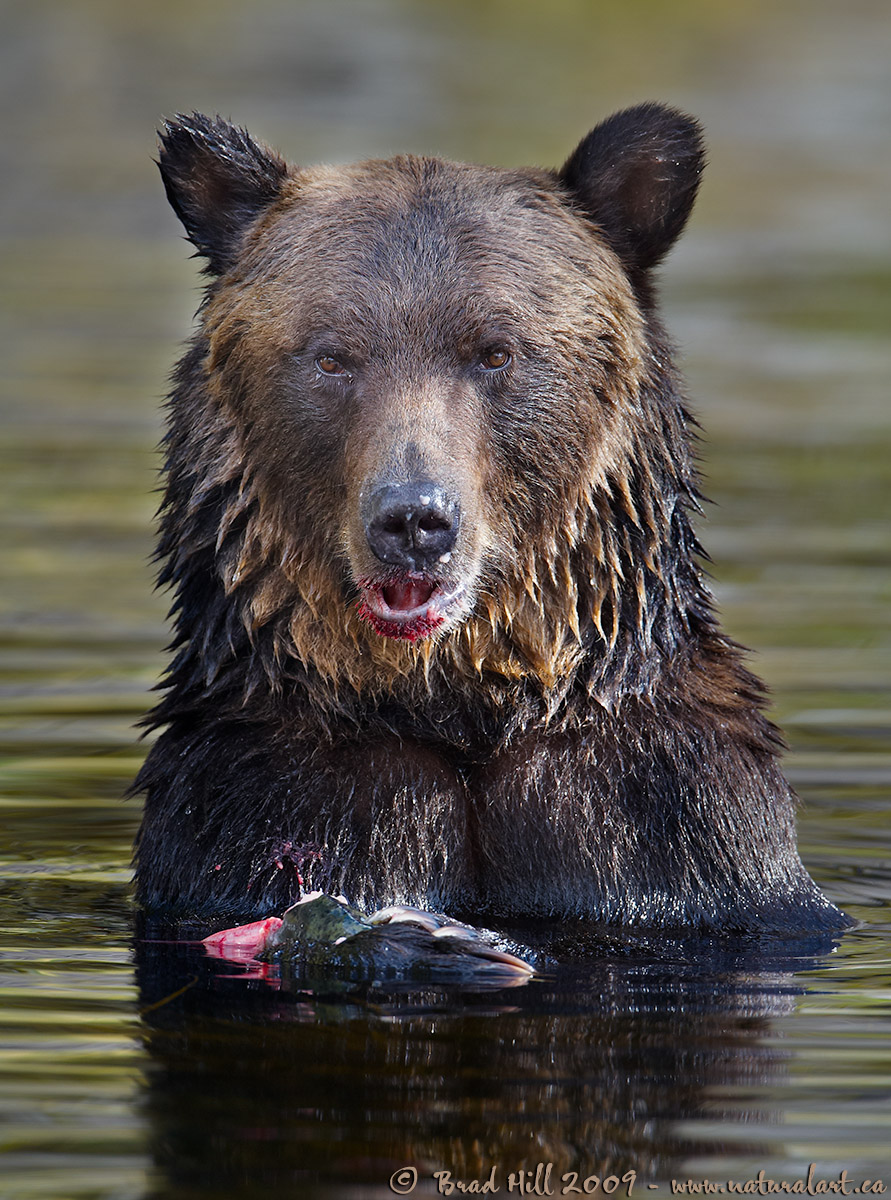
This female grizzly bear is a young mother with a cub and one of the most attractive grizzlies I have ever seen or photographed. Like her cub she has a very dark face that sets her rusty brown eyes off just so well! I shot this portrait of her as she sat in the shallow water of an estuary in the Great Bear Rainforest. She very kindly cleaned herself up (by dunking her head in the water) just before I shot this image, but it would appear that her skill at applying lipstick still needs some work (I believe she uses the "Salmon Blood" colour from Faberge). But it wasn't just her good looks that motivated me to shoot this image - it was the absolutely trusting look on her face that won me over - to me she looked like she almost wanted to share that salmon cradled in her claws! I know that female grizzlies with cubs have a reputation of being both fearsome and highly dangerous (and her cub was just out of the frame of this image) - but I guess this proud mother hadn't read the book on how ferocious she was supposed to be...
If this image works, it's partly due to the detail in the image (much more of which is visible in the larger version). Which leads to a couple of technical comments about image detail...
First, when working up close with wildlife while using medium to long telephoto lenses it's real important to keep your depth of field AND focus point in mind. Like many photographers, I often like using a shallow depth of field to isolate my subject from the background. But there's a risk in doing this - if you're not very careful important portions of your subject will be outside your zone of sharpest focus. So...it's critical to know how much depth of field you have in FRONT of your focus point and BEHIND your focus point (and to position your focus point just right). Many books and online guides state that depth of field is distributed with 1/3 in front of the focus point and 2/3 behind. While this is often true with short focal length lenses (like wide angles), it's simply wrong with lenses at 200 mm and above. With virtually ALL telephoto lenses you have 50% of your depth of field in front of your focus point and 50% of it behind your focus point (at all apertures). Here, I focused about 2/3 the way up the snout (but still in FRONT of the eyes) to ensure that both the snout/mouth region AND the eyes were in focus. Oh...and by the way - the nose isn't out of focus, it's just covered with gooey salmon slime that looks pretty much like vaseline!
Second, when processing images of animals with wet fur - go very easy on the sharpening (both during raw conversion and when prepping the image for output) as wet fur acquires that "over-sharpened" look really fast. In this image there has been NO sharpening applied to the region of the bear near the water or on most of it's face (I did very finely sharpen the eyes and the hairs just above the forehead).
Subject: Female grizzly (
Ursus arctos) snacking in the shallows
Location: Northern BC Coast (Great Bear Rainforest), Canada
Camera: Nikon D3
Lens: Nikkor 600 mm f/4G ED-IF AF-S VR lens - handheld from floating zodiac. VR on and in "Normal" mode.
Exposure: 1/250s at f5. ISO 200. -0.33 stop compensation from matrix metered exposure.
Crop: Very minor - this is about 95% of original capture
All the contextual information surrounding this shot (field notes, all camera settings and processing details, conservation, etc.) can be found at:
http://www.naturalart.ca/galleries/latest/detail_2.html.
Comments and feedback greatly appreciated...probably better to view larger version prior to doing so...
Cheers all...have a good weekend...
Brad

Comments
13 commentsCover page material, I love the comp, the low angle. Do you think, to make a magazine cover, you need some more space on top (to make space for the title) ? :-)
The open/moving jaw and blood are big plusses. She appears to be in a pensive mood, but that claws remind me of what she can do :-). The high res image is stunning, thanks for all the lovely information, great to know/use in the field.
A great image Brad, and it portrays mom perfectly. She was definitely a bear that liked the water. She spent a large part of her time just like this, sitting in the water scooping up fish from the bottom and eating them. I think she did this because everytime she would bring one to shore the cub would come and take it which obviously irritated mom most of the time.
Thanks for reminding us about DOF and how to use it. Instinctively (yet wrong) I would have focussed on the eyes here (and also used a larger aperture at this close range btw).
Jagdeep Rajput