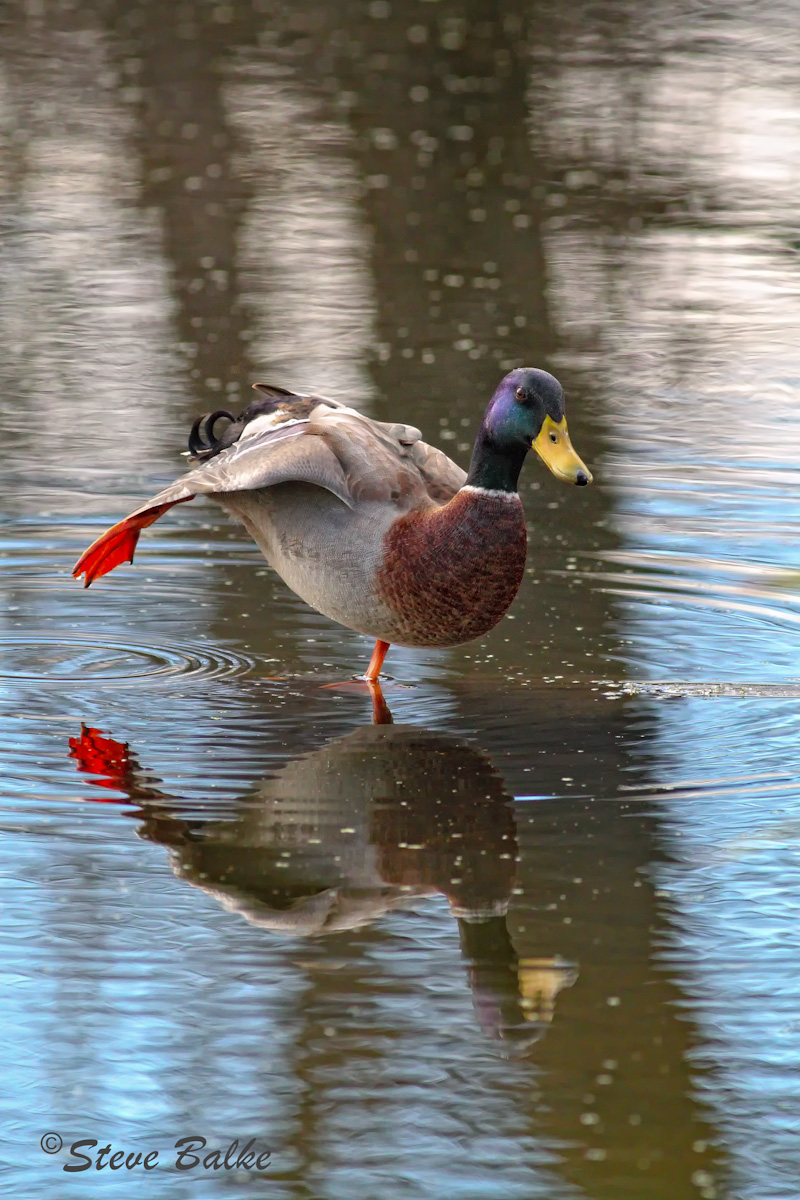
Pirouette (iso 2500)
by Steve Balke
This mallard looks like he’s about to twirl…but actually he’s just stretching. Not too much bird variety around here these days: winter seems pretty close.
On this partially cloudy Fall day when I set a conventional iso it was shady; the sun appeared only at high iso settings…providing some rather short exposure times at high apertures, as is the case with this image. However, I think I am becoming a bit spoiled by high iso too. The thought of using ordinary exposure times and being concerned about motion blur is less and less attractive as I become more confident that pleasing high iso images are possible with this camera. We shall see.
I hope that you will tell me what you think of this one.
EOS 7D, 400 mm f/5.6 L: iso 2500, f/5.6, 1/2500 s,
Image is 3299x4949 pixels (=16 MP or 91% of full frame for the 7D).

Comments
11 commentsCarlette Bragg
i. Yes, I used noise reduction (NR) processing. For more details please refer to my previous posts in this gallery and the topics on the 7D in the discussion forums. Briefly: I prefer to shoot in the raw file format and then have the flexibility of deciding on processing rather than letting the camera do all the processing. I consider post-processing a necessary part of digital photography and analogous to chemical development in film photography. Also, NR is only part of the processing. It’s closely coupled to any other software applications too, especially sharpening: when you change one application’s settings you can affect the results of the others! I’ve started using the Nik software suite as smart filters in CS4 because each software application appears as a layer that can be accessed and re-tuned again and again until the final image is satisfactory. You don’t need to start fresh and do everything all over again each time if you change your mind about how much NR is required, for example. Also, the Nik software control point method avoids the CS4 subject selection process while allowing selective application: I’m still not very good at selecting very finely divided edges in subjects using the CS4 tools.
ii. I agree with those of you who pointed out the need to decrease my aperture diameter with a higher f value. Since some of the bird is very sharp and since the exposure time is so low then any blur that you see is likely due to DOF. [However, I must point out too though that the image that I see before compression and posting as a jpeg looks slightly better than the web version.] Previous to using high iso settings, on cloudy days I generally set the aperture as open as possible (usually f/5.6 with my 400 mm), set the camera on aperture priority and hoped for enough light. Increased confidence in the high iso settings will let me step down to a higher f stop.
iii. Regarding autofocus: I have not yet experimented with the many options available in the 7D. I set it on “AI Focus mode” and use the center AF point. The focus is very fast and seems to be quite accurate. It’s interesting to compare the location of the focus point on the images (visible using the supplied Canon software) with the image sharpness. I did capture some images of flying gulls that were as sharp as any of my stills.
So far, I’m very satisfied with this camera. It will take time to define its limitations. However, I can see that there is enough capability to satisfy me…..for at least a year…