Hello all,
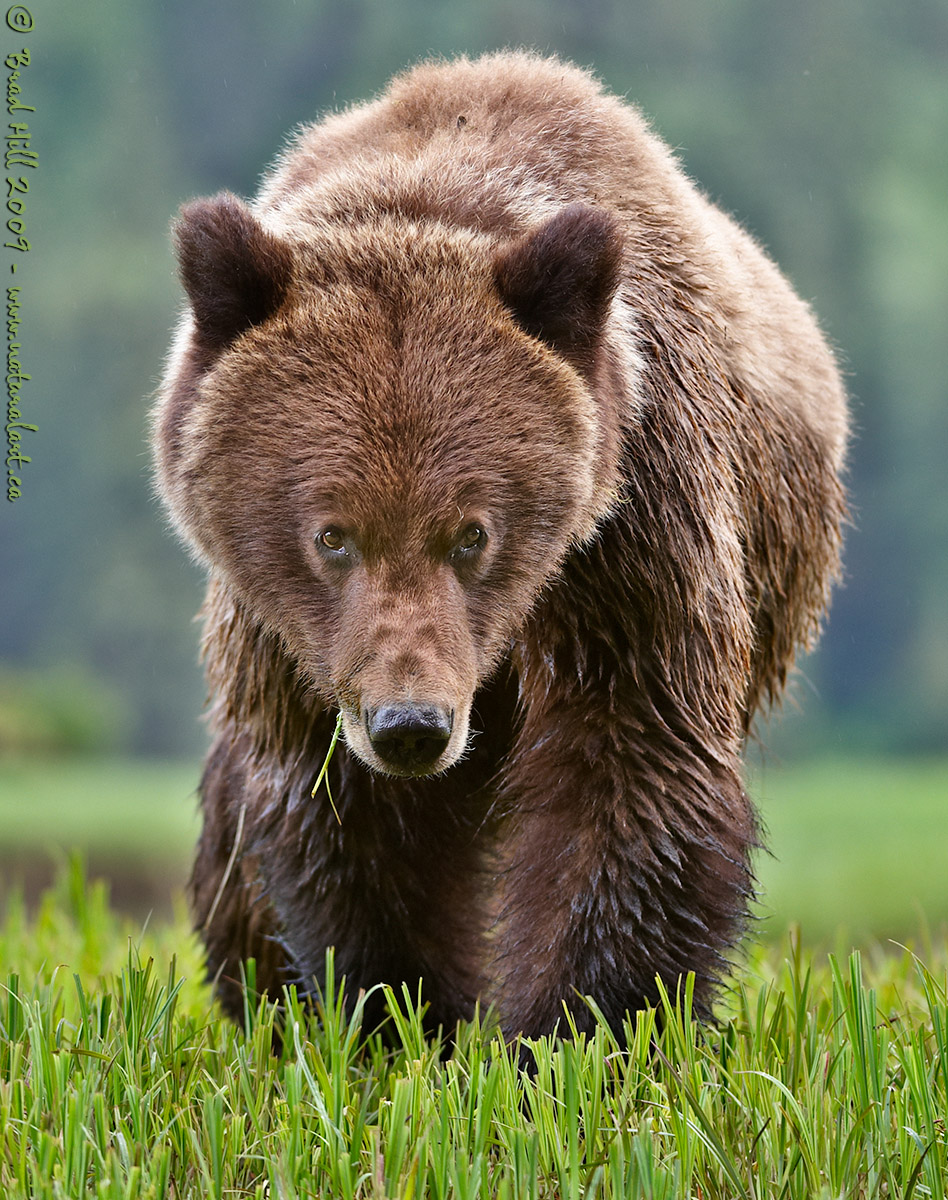
I shot this "active portrait" of this sub-adult grizzly in the spring of 2009. The bear made by job easy by coming at me at the exact angle to the sun to produce maximal detail in the facial and eye region. While side-lighting is usually my favourite light, it's usually too harsh for producing wildlife portraits, especially if you're not willing or able to use flash-fill (which I personally won't use on wild bears). In this case the bear was front/side-lit - with the sun at a 45 degree angle to the line formed between the bear's eyes and me. I shot the image while on my knees - which is a very convenient position in a situation like this because it allows you to quickly switch over to praying immediately after the photo is captured! ;-)
I've cropped this image tighter than I'd normally prefer for aesthetic regions simply because I wanted to make sure the exact direction of the bear's stare was visible here - which is the topic of this commentary...
It's pretty much universally accepted among wildlife photographers that effectively capturing an animal's eyes, especially when they contain those bright sparkles known as "catch-lights", can be a big asset to a wildlife shot. But where should the animal be looking? I know of photographers that love to have the subject staring directly at them - I've heard it referred to as "full eye contact" and "direct eye contact" and even "perfect eye contact". But...I know of image BUYERS that immediately reject shots where the subject is staring directly at the photographer for exactly that reason - the animal is staring directly at, and thus interacting with, the photographer. In other words, the animal's behaviour is being directly affected by the photographer and is, thus, "not natural". Then there are the situations where the animal's eyes are fully visible yet clearly not looking directly at the photographer - close, but not quite. The image above is an example of this - the bear is actually looking slightly above and to my right (I can't recall what this bear was looking at when I shot this - I was probably hoping it was something more appetizing than me!). And then there's the "eye-visible-but-looking-into-the-distance" style where the animal can appear to be looking almost pensive.
I have to admit I have no clear-cut favourite eye-direction myself - I find it varies with what I'm trying to accomplish with the image. I have some bear portraits where the subject is staring so intently at me it appears to have a deep intelligence - I know of no other way to convey this feeling without having the subject looking directly at me. But, I have a number of other shots where the bear is looking into the distance in what looks to be a contemplative stare. And, I even have a few shots where the eye direction says a lot about the relationship between multiple subjects. The eyes can say an awful lot!
The take-home lesson? Probably just that if you have the chance (when you're working closely with a wild subject) try to capture several different types of eye contact - not JUST that full-on stare. It could make the difference between selling an image and having it end up in the "reject" pile!
All comments and feedback appreciated. I'm particularly interested in what type of eye contact you prefer to shoot in your images or see in a wildlife image. As always, probably better to take a look at the larger version first...
Subject: Sub-adult male Grizzly Bear (
Ursus arctos) at close range
Location: Khutzeymateen Inlet, Northern BC Coast (Great Bear Rainforest), Canada
Camera: Nikon D700
Lens: Nikon 200-400 mm f/4G ED-IF AF-S VR lens @ 200mm - supported on Gitzo 1348 carbon fibre tripod with Wimberley head. VR on and set to "Normal" mode.
Exposure: 1/250s at f5. ISO 450. -0.33 stop compensation from matrix metered exposure.
Crop: A little more than normal - this is about 80% of original capture
As usual, all the gory details behind this image (field notes, all camera settings and processing details, conservation, etc.) - and an even more closely cropped version of the image - found at:
http://www.naturalart.ca/galleries/latest/detail_2.html.
Cheers...thanks in advance for feedback on the image or commentary...
Brad

Comments
16 commentsThe things I like most about this photo are the blades of grass coming out from the mouth, the wet legs and the narrow crop which makes it look like the bear is trying to make itself skinny to fit. Well done
I've never known anyone who has had the ability to go into the details, the why's and how's for success in this avocation, like you. I, for one, learn something from each analysis you make. I try to get my photographers to "see" when they look. I know that in the heat of the moment, training and instinct take over, but being able to connect all the dots comes from this kind of interaction. Thanks!
As to this image? I really like the way there is only 1 focus change. The foreground being sharp really helps the impact of the bear and the OOF background isolates the bear. Very Nice!
Thanks for sharing your image and you expertise!
Neil
What an intense image though!
Love the shot! Up close and personal time! I like the foreground and the bear being so in focus. It makes you feel as if you could reach out and touch the bear. I like to have the eyes looking somewhat toward me, but even that is not always important. I think the picture needs to tell a story, and yours does!
Nice photo. One thing bugs me about it though: there's nice contrast in the bear's fur all around the head. However, the head lacks similar contrast, appearing flat. Could be the direction of lighting, but the rest of the bear had direct lighting too. Otherwise, I love the stare along with the sharp grasses and bear.
Personally, I also look for images with different types of eye contact. Like you said the eyes can say an awful lot and they can change the character of an image completely. For that reason it is also always so important to get the eyes tack sharp.
Even a straight eye-to-eye contact image can be extremely powerful and really emotionally move a viewer. Yes it does show interaction with the photographer, but only if you think 'photographer'. You could also think 'prey' or with a cute subject like Rick Gomez' Owl monkeys last week 'how sweet, he is looking at me'. In other words, if you are after interaction with the viewer of the image, you need direct eye contact. If you want to portray a scene whereby the viewer is not there, but merely an onlooker, then obviously not. Lots more to say about this topic and I am looking forward to more comments about it.
Thanks for the feedback on this image and commentary topic. A few specific responses:
1. To Neil and Ajit: Thanks! I used to get rude spam (from a non-NPN member) anytime I posted one of these longer commentaries, so it's nice to hear they're appreciated by some. Fortunately (for me) I can type fast!
2. To Lon: I was waiting for a question about the clipped grass! I was surprised it took so long for someone to ask about it (but not surprised it was you who noticed it). The bears are solely responsible for the clipping - if you watch them closely they clip them all at virtually the identical height. These are tidal flats and the bear is on a small island that is submerged at every high tide. The grasses and sedges grow amazingly fast and only days after one island is trimmed right down it's ready for clipping again. Actually, despite the high number of bears in the inlet, ultimately they can't keep up with the grass growth and by mid June the grass is long enough to conceal the bears (which makes things real "fun" in there!).
Cheers all - thanks for the feedback...
Brad
I have a tendency to like eye contact just slightly off instead of direct eye contact. To me it gives no hint that the animal is looking at you and more towards just behaving naturally. I really started to lean that way after participating in the Avian gallery and prefer a bird looking away than directly at you.