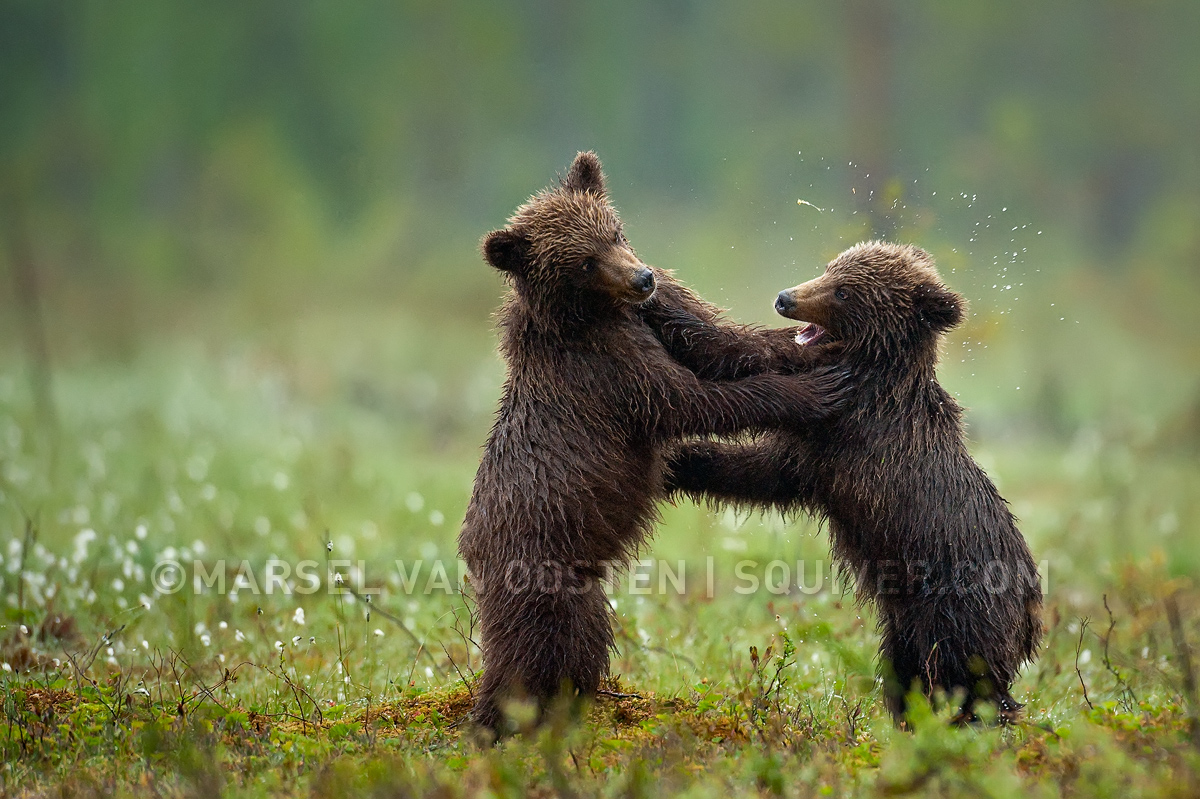
The December issue of National Geographic (Dutch edition) features three pages of the brown bear images I shot in Finland. This is one of the shots that they selected, showing two playing brown bear siblings, just after the rain had stopped. The one on the left hit the one on the right on the head, causing a spray of drops from the wet fur.

The image was shot from a hide in an open swamp area, close to the Russian border.
Photographing bears in Finland is very different from photographing them in Alaska or Canada, even though they're basically the same species. In Finland you can hike in the forest for months and never encounter a single bear. One of the reasons for this is that there are simply fewer brown bears in Finland - an estimated 840 bears, compared to over 30,000 bears in Alaska. I once witnessed a scene in Alaska where 26(!) brown bears were simultaneously fishing in a salmon infested river - something not very likely to ever happen anywhere in Europe. Another reason is the fact that killing bears is the favorite hobby of many Finnish men, so bears prefer to stay away from people as much as they can.
To be able to photograph a European brown bear therefore takes some extra effort. We used a couple of hides (so that the bears couldn't see, smell, or hear us) that were put in an area with a relatively high bear density. We then had to attract the bears to this open area in order to actually get to see them. For this we used pellets of pressed vegetable matter, a responsible little bite that doesn't ruin their appetite nor impact their normal feeding routine. Most of the times this proved a succesful strategy, although there was still no way predicting what would happen.
On our first week the weather was pretty bad - heavily overcast and constant rain and drizzle. Not good for shutter speeds, but very good for bear activity. On one of the nights we saw a mother with three cubs crossing the swamp. Mum was just walking around, checking the surroundings, but her kids were playing as if their lives depended on it. Especially these two really gave a great show. I've got quite a few shots of brown bear cubs, but it's not very often that you get to see this kind of activity, so I'm very happy with the shot.
A while back someone asked me what I preferred: photographing brown bears in Finland or in Alaska. That's actually not an easy question to answer. The main advantages of photographing them in Alaska for me are; it's easier - there are more bears, you have a constantly changing scenery, changing backgrounds, you can adjust your position (up, down, left, right), and you can work with the light. When you shoot from a hide, you're stuck in one place and you just have to sit and wait. The nice thing about that though is that it makes it very exciting, and there's the fact that the bears don't notice you when you're in a hide whereby they sometimes get very close without any danger for either party. So there's something to say for both.
Hope you like the shot!
Nikon D3, AF-S 600/4.0, 1/400 @ f/4.0, ISO 1600, Wimberley II 
Comments
36 commentsI appreciate your explanation about the shooting conditions as I think there is some misunderstandig with Non-European photographers about Finland.
I don't want to be a downer, but I've got to be honest with you - I do have some ethical reservations when it comes to baiting animals with food for photography, whether you're in a blind or not.
The action, the water droplets, the opened mouth, the composition, the flowers, everything comes together for that perfect image, so it it's no surprise that NG is happy to display your photos. Thanks for giving us a sneak peak.
Great interaction but the water spray puts this at nother level! Very nicely done!
No problem Guy - I feel the same when it's done in an irresponsible way. In this case however, the pellets are healthy, the amounts are small, way too small for the bears to become dependend on it, they remain in their natural habitat, it doesn't impact their social behavior, and it doesn't cause them to be in any danger. They are free ranging natural subjects, completely wild.
Like I mentioned in my post, I've seen 26 brown bears in one spot, all at the same time, fishing for salmon in Alaska. Now that's a situation where (a ridiculous abundance of) food causes massive impact on social behavior and geographic distribution of bears. A few pellets really don't.
Nature has always been influenced by man, and will always be influenced by man. How much or how little our influence should or should not be is often purely subjective and not based on any scientific data. One look at the history of Yellowstone NP and you know what I mean.
I'm all for responsible nature photography and conservation, but we must avoid fundamentalism - the world is not black and white.
I hope this better explains my views on this matter. Thank you for your honest response - much appreciated.
just went through the brown bear pics and videos from finland on your website ! they are amazing ! With so many brown bears posted from finland, i though that their numbers were high. Sad to know that its not the case.
Anand
By the way, something totally different; I saw your recent book here in the local bookstore! Big congrats Marsel, it is as professional as coffee book tables come. I was highly impressed, but not surprised.
on the opportunities the way you do!! I can't begin to count on how many times I've blown opportunities at amazing moments in nature!? Every so often I get lucky, but if I don't get any better soon, I WILL need therapy!!
Don (Wags)
The word 'baiting' works like a red flag on a raging bull, but there are many, many shades of gray. If I decide to put specific plants and flowers in my garden to attract butterflies or birds, is that unethical (i.e. necessary)? If not, if I plant my subject's favorite berry bush in front of my hide to attract it to me, is that still ok? If I buy those same berries at the local grocery and put them near my hide, is that bad? Is the use of bird feeders unethical to attract birds? If I collect some nuts from the forest and put them in the perfect spot for a nice squirrel photograph, is that unethical? And if so, unethical for whom? For the squirrel? For me? For my fellow photographers? Is sport fishing unethical? And does it matter whether life bait is used or not?
Man and beast, we are all part of nature - it belongs to all of us. How we use it is up to us, but asking yourself 'is it necessary?' is not going to get you anywhere. Is it necessary to eat meat? Is it necessary that your shoes are made of leather? We all know it's not. Is it therefore unethical to kill an animal for these purposes? Is putting some nuts out for your squirrel shot in the same category as killing a cow?
Man influences nature, but nature also influences man, and itself. If half of the elephant population in Kenya died because of yet another terrible drought, that surely wasn't necessary, yet it happened. People will just accept this, because, well, it's nature. But that's not really an answer. Apparently, for nature it is totally ok to act completely random and destroy plants and animals that did not need to be decimated in the first place. At the same time we do everything in our power to preserve nature, and we do so by greatly influencing the natural order of things. The yearly burnings in Africa are just one example. Is it really necessary? Can't we let nature run it's course? And if not, why not? And where do you draw the line of what is necessary and what is not? Who decides what is good for nature and what is bad? I already mentioned Yellowstone NP, a fine example of constantly changing insights on what is the good thing to do regarding nature conservation.
Anecdote: during our leopard workshop in South Africa, an large bull elephant had wandered into the adjacent camp. This particular camp was fenced, so the elephant had no place to go - it was trapped. After a while it got agitated and thus became a severe safety threat to the guests. Guides tried to herd it towards the exit, but that didn't work. The head ranger of the park was called in to help with the situation. At first it seemed to go allright, but then at a sudden the elephant charged the ranger - and it was not a mock charge. The ranger had no other option than to shoot the elephant - a very sad ending. The elephant was then dragged outside the camp to an open area so that other wildlife could feed on it. We happily took advantage of this situation, resulting in many cool vulture shots and rivaling hyena clans. The elephant obviously didn't die from natural causes, but by the hand of man. Was it unethical that we used the elephant carcass as bait for predators? Or wasn't it because we didn't shoot it ourselves for the purpose of photography? In other words, is it unethical if you find a dead animal and drag it somewhere to photograph whatever comes to feed off it?
As you may have noticed, I have posed a lot of questions. You may find some of them easy to answer, but I'm sure there are quite a few that are not so clear cut. The bottom line is: we should not hurt or harm others, whether it be fellow human beings or animals. But what is necessary and what not, and what causes harm and what not, remains highly subjective. My bear photographs create a lot of awareness for this magnificent animal and for instance influences public opinion on matters such as bear hunting. How can that be unnecessary?
This isn't just about bears, it's about any form of human influence on nature, for whatever cause. Experts are useful, but opinion is not always based on hard facts or peer reviewed scientific research, and exactitude is not truth. We're all convinced that global warming is really happening, yet it is colder in Antarctica now than it was during the last two ice ages. I have spoken to biologists and bear specialists about this, and overall my impression is that this whole issue is not worth even half the amount of words I just spent on it.
Sorry for the ramble, but it's better to debate a question without settling it, than to settle a question without debating it. I come in peace.
Glad you like the book. You did buy one, didn't you?
Anyway, you've already explained your stance on this in detail, so to each his own! Great shots!
No worries - I'm from The Netherlands, we're not easily offended.
My point is that it is actually not that easy to precisely define why it supposedly is unethical, hence the large number of questions I posed that are extremely closely related to this issue.
Yes, but that's in the black and white world, where all bears live close to villages and cities, where all bears get food either directly from people or from campgrounds and waste bins in people's back yards, and where people and bears constantly run into each other. In those specific circumstances you can get big problems.
Here we're talking about bears that never get any food directly from people, bears that live light years away from the nearest village, and bears that already run off when you're still a mile away. Zero incidents, ever, prove my point.
Nature is not math; what applies to an area on one side of the world doesn't necessarily apply to an area on the other side. There are many factors to consider before you can judge a specific situation. That's all I'm really trying to explain.
And I'm not trying to pick on you here.
Ken Archer
And thanks for the discussion on baiting - you raised many good questions to consider, as you say, it's a gray area. I do think agencies that promote wildlife photography need to be ever more cognizant about the practice, as I have seen occasions where IMO the line was clearly crossed. In your case, it sounds to me like you considered the situation very carefully, and made a sound judgment call.
By the way, congratulations on again garnering well deserved recognition. Fine photo!
First off, thanks very much to sticking to the EXACT letter of the law re: image posting guidelines - you stated clearly the "set-up" you used to make the shot AND it was admirable that you mentioned that bait was used (which, in the manner you used it, is NOT specifically against the image posting guidelines OR anything listed in the under NPN's ethics resources). I think open disclosure is so critical in nature photography and you passed that test with flying colours. Well done.
Second, it's a great shot! The single thing which puts the image over the top for me is the water droplets flying off cub's head. It's reminiscent of a number of shots I've seen of boxers who have had their "bell rung" by their opponent and sweat is flying off their head (tho' I'm well aware this is not sweat). Very well done!
Third, I have to say that you make a present a lot of points in your commentary as fact even though many of them are highly debatable - using phrases like "...responsible little bite..." makes it sound like there IS such a thing, which is open to debate. On the issue of the ethics of baiting bears for the purpose of photography - I think we'll just have to agree to disagree on this one, and this gallery isn't really the place to enter into such debate - we're here to critique images (so I won't take the bait
And finally, the most important thing - my tiny little nit in the image - don't you just hate it when the only orange-ish vertical line in the image happens to be right behind the main subjects head? Just pulling your chain Marsel - it's obviously a GREAT image! Take care...
Brad
@ Brad: Thank you for your feedback, much appreciated. I don't think I have presented a lot of points in my commentary as fact though, quite the contrary I'd say: I have tried to raise as many closely related questions as possible in an effort to demonstrate how many nuances there are that are often so quickly and easily overlooked or ignored. The world is becoming increasingly more black and white, and I just like to keep my eyes open for all those different shades of gray.
Anyway, it's all very interesting and I'd love to continue this discussion some other time, some other place.
@ Ron: Thank you for your input, I appreciate your valuable contribution to this discussion.
While I still want to avoid getting into this here, all your comments about the shade of gray in this argument refer to the ethical issues and philosophical issues, not the hard science and biological facts (including a host of peer-reviewed scientific papers) about the detrimental effects of supplementary feeding of wild ursids. There is even a cogent biological argument concerning why there is a qualitative difference in the negative effects of engaging in supplementary feeding for some taxa (such as your butterflies) and not others (with the end result of the BIOLOGICAL differences between the species being that not too many fast-reproducing and non-endangered butterflies are destroyed after they form a food association with humans...but the same can't be said for bears). Even if you remove the potential for future human interactions that have been influenced by supplemental feeding of bears (which I don't believe you can, but that's not important here), artificially increasing the concentration of ursids has been shown to increase the risk of mortality to cubs (via predation by adult males) AND increase the stress levels of bears (as demonstrated by heart-rate telemetry studies). And this is only a sample of the biological facts that can be assembled against the "careful baiting of bears is OK" argument. Don't worry, you'll see the whole argument laid out down the road.
Sorry, but biologically there's no debate here.
Regards...
Brad
With all due respect Brad, but there is always room for debate, also biologically.
I won't get into it here and await your paper.
A-Ok! But back to the ethical and philosophical issues (which are always complicated by an infinite array of shades of gray) - your commentary and the ensuing discussion have made me think of a very interesting question (and I don't have the answer to it!):
Just how much can we rightfully expect a photographer to learn about their chosen subject (including the specifics and nuances of their biology) before engaging in acts which intentionally change the behaviour and/or distribution of a subject for the purpose of capturing an image? After all, most photographers are NOT biologists and/or research scientists themselves and thus tend to rely on "authority statements" of others.
I don't have the answer to this, but it does motivate me to get that paper out quicker (it just leaped up several notches on my to-do list).
Cheers...and it's still a GREAT image!
Brad
I like this a lot - the soft light is great, but it's the negative space and the small white blooming flowers that really makes it happen, for me.
On the issue of baiting, I'm not sure it's reasonable to post a baited image of a wild animal and then suggest the discussion of that process should be taken elsewhere - I think perhaps such discussions, if they're honest, are of most value when they're in context, not abstracted elsewhere.
One of the reasons I say that is because I tend to agree with you - there's no “comprehensive protocol” for nature, nor should there be for our dealing with nature, beyond respect. There's no other “catch all” answer to this kind of question, it's entirely contextual. If baiting an animal for wildlife photography can be done respectfully and reasonably, I don't think it's the atrocity that many like to proclaim.
The issue is mostly one of scale; I might sit in the woods in the world's largest wilderness and bait an animal to make a photo and consider it to be immeasurably different to, say, baiting an animal in a heavily visited National Park or similar, or to leading a group of photographers to some setup and shooting together - that snowballs and the dynamic changes.
That said, a couple of points; there are many places in Alaska that are miles from any village or city (way further than anywhere in Finland, believe me), and the “Fed Bear = Dead Bear” mantra is still generally followed - one of the reasons is because bears can and do travel enormous distance in their quest for food. Another is there's simply no way to ensure the bears don't associate that food with people, regardless of how careful you might be, or how strongly we feel about it.
Interestingly, Charlie Vandergaw fed bears for 20-30 years at his 'bear haven' and never had a problem either. State F&G dept fined him $75 000.00
This statement "My bear photographs create a lot of awareness for this magnificent animal and for instance influences public opinion on matters such as bear hunting" doesn't justify anything, in my opinion. Zoos use the same argument, and I feel strongly that it's a ruse to justify the exploitation of animals for profit.
On track, I think, as I said earlier, the issue is one of scale. And I'd say doing something like this, as a wildlife photographer, in the wild, alone, isn't terribly troubling. If someone was doing this running workshops or phototours, etc, then I think it likely becomes problematic, because the scale inevitably changes, no matter how hard we try to keep things small.
Cheers
Carl
The decision to not continue this discussion here was made with both moderators - the image forum is not considered to be the right place for such a discussion. I am more than happy to continue this debate somewhere else on this community, as I feel it is both interesting and important to see the full perspective. Brad is currently working on a paper and I'm sure he will post the results in the appropriate forum. We can then continue the discussion.
My prediction is that we will not reach a concensus. The field of ethics is very complex and highly subjective, and in these cases one side is hardly ever able to convince the other. Try to convince a communist that making a profit is not unethical. Even from a purely scientific perspective it will be close to impossible to prove that what applies to one species in one area, applies to that same species in all other areas, at any scale. But I'm looking forward to the discussion.
Oh, I've been around this forum long enough to know the general protocol is not to discuss stuff like this here, but go to another forum - which, to me, is simply sweeping it under the carpet. As I said earlier, the value of such discussions, whether they lead to consensus or not, is only when they have some context. I also think trying to have a “critique forum” without discussing the ethical considerations of how an image was made is kinda like trying to discuss Christianity without using the word God, for fear of offending anyone.
:)
Cheers
Carl
Sorry to contact you this way - but you have no email address listed so I have no choice. Marsel is totally right that it was the moderators who suggested this discussion should be migrated away from this forum. I am guessing at this, but I think Marsel would have been fine with going on with it (i.e., don't blame him). Feel free to send me an email if you want to hear the full rationale for it.
Cheers...
Brad
Sure, like I said, I've been around this forum nearly since it's inception, so I'm well aware of the protocols for the various forums. I think they should be changed, but that that's not my decision to make, so it's no big deal to me.
Are you really serious that with all the literature listed beneath my name here you can't find a way to contact me off the forum?
Cheers
Carl
I really appreciate the accomplished photographers posting and participating here.