Scooting Coot
by Mia McPherson
Fulica americana
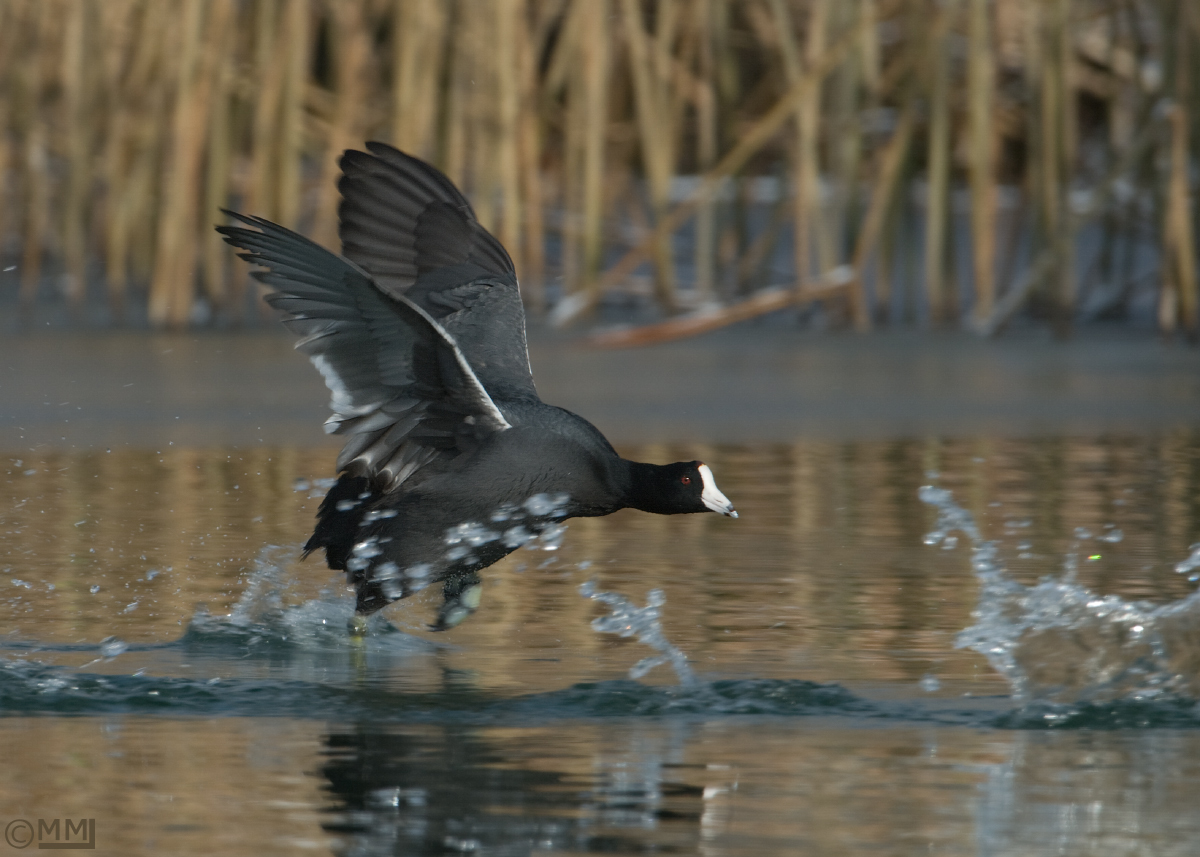
Taken on 12-06-09 at a pond near the house while the tempertures were in the teens, the coots were busy on the bits of open water chasing each other around. This one was chasing after another coot in front of it.
I could have switched to shutter priority and probably froze the action, but I like the motion blur in this image. I also like how the coot seemed to be looking at me.
Taken at the edge of the pond where I could have laid down for a lower angle but has some concerns that I might slide down the snowy slope and land in the pond with my gear, so I opted to place the camera on my tripod instead with the legs low.
D200, Gitzo CF tripod, Black Widow, f7.1, 1/640, ISO 250, 200-400mm VR f4 with 1.4x TC at 300mm, natural light, 59% of original image, cropped to decentralize the coot some.
I know that coots aren't everyone's favorite bird, but I love how animated they can be and I also enjoy the challenge of exposing them properly. They were loads of fun, so much so that I didn't mind the cold temps, but eventually my legs went numb.
As always, I sincerely appreciate your comments & critiques, thank you for looking.

Comments
18 commentsNot your typical sharpness level (though the head is pretty much spt on ). I love the action and these are one of my favorite Birds (who could dislike a COOT?!), I do wish the motion was stopped a little more so their unique feet were better illustrated.
- Luke
Steve, there wasn't any more of the reflection to be had as there is ice below where I cropped it.
Luke, the head is sharp as are other parts of the chest, back and wings, the motion blur caused by panning has some thing to do with the other areas being oof as well as the speed at which these coots move when they are chasing.
Thank you for your comments.
This IS a low angle shot. Given that this is an action shot and that the lower elements constitute the blurred strong-sense-of-motion-evoking part of the image, I don't think getting lower would have added much. Great exposure; nice detail in the black regions of body and wings. Good eye contact and I like seeing the habitat of the bird. From this angle and with the feet in this position, an appreciation of the lobed, rather than webbed, feet would not be obvious, even if the motion were frozen. The manner in which the feathers of the bird's wing are folded during this phase of the wing beat is something I haven't noticed previously.
I'm a little ambivalent about seeing the splashes of the bird in front, without also seeing the bird. It does tell a story, but I think I might like the image even more if I saw only the splashes produced by the bird we see or if we saw the front bird too.
It's a terrific capture.
I don't see how that would have made a difference. With the 1.4x your 200-400 f/4 lens becomes an f/5.6 lens, so you had less than one stop to give a higher shutter speed. If you went to shutter priority what shutter speed would you have set anyway?
You'll get the highest shutter speed (and best motion stopping ability) by staying in aperture priority mode and opening the lens to the max aperture of f/5.6 - the camera meter will set the shutter to the highest speed possible for that aperture and the prevailing light.
cheers
Rob
May
- Luke