The Art of Hiding...UNmastered!
No claims about this being a great shot (or even a good one!) - but it serves well to illustrate a point I want to make (surprise, surprise!).
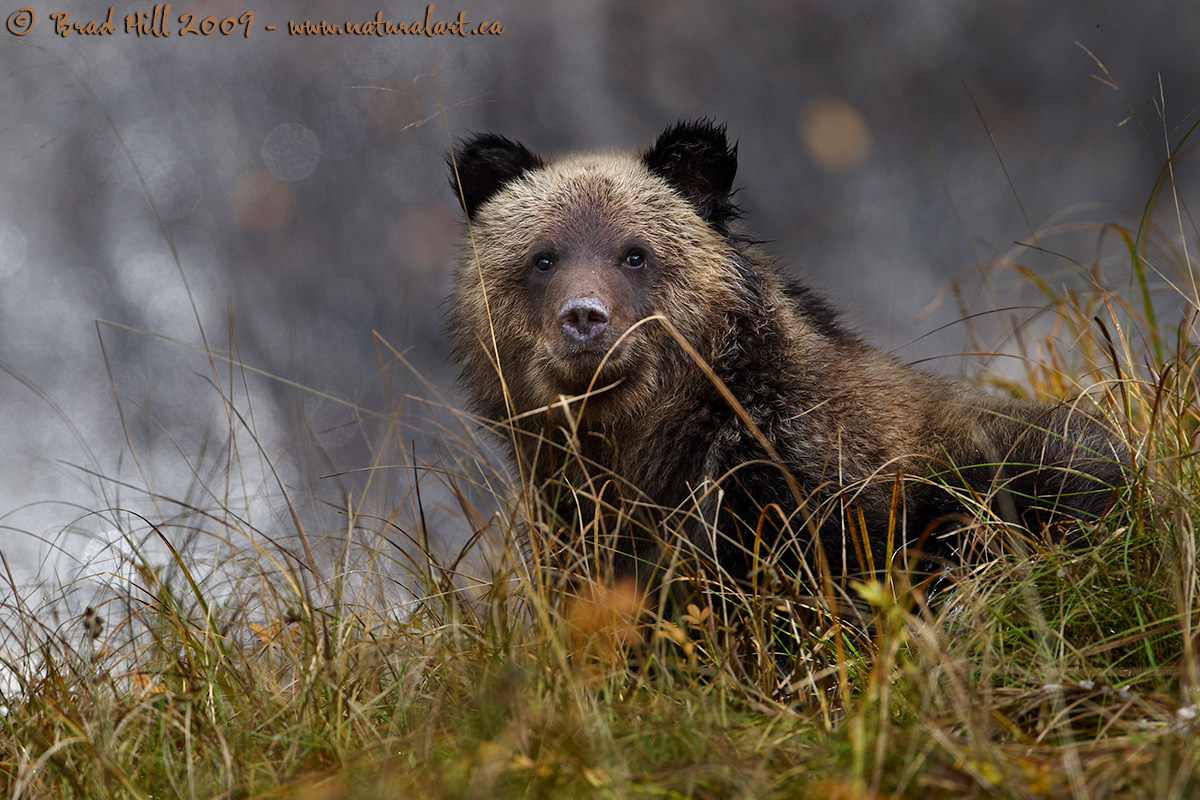
This cute little grizzly cub-of-the-year was only about 6 months old when I shot this image. He/she was clearly still figuring out how the world worked and when it came to hiding, its inexperience showed! This cub (and its mother) were initially quite shy and elusive, but after a few days with us around they had calmed down considerably. Yet even when fully relaxed, this cub always kept track of just where we were. I also noticed that while it was keeping tabs on us it always seemed to put some obstacle between itself and us - in this case some thin grasses. At first I thought it was just coincidence that there were always grasses or other things directly in front of the cub's face, but when I looked up and down the shoreline I realized that there were so few obstacles that the cub must have been selecting them (to hide behind) in a non-random fashion! So this little beast had already figured out the concept of hiding, but hadn't really worked out all the details (like how big he/she was and how small and thin the grasses were!).
When it comes to processing images, I'm very reluctant to pull out Photoshop's cloning tool to clean up on nature (tho' I do NOT hesitate to use it to remove artifacts of the photographic process, like removing blotches that are the result of dust specks on my image sensor). I simply don't believe that the sanitization of nature (especially in wildlife photos) is all that necessary. And, in some cases, it's my opinion that using the clone tool to "sanitize" an image can actually detract from it, even if it's well done. For example, consider this image - I'm NOT a Photoshop guru, but I'm adept enough with it to easily remove the grasses that overlap the cub's face in only minutes. But, in this case, the grasses are critical in understanding the little bear's behaviour. Without the grasses, this is just a shot "of a" bear (albeit a cute bear). With them (and a well-chosen title or a little explanatory text) you have an interesting insight into the development of a reasonably complex behaviour (and a cute little story). There ARE ways to get around using the cloning tool!
By the way - about all the bear photos: I'm in the midst of a long-term project (with bears) that has conservation implications and also currently processing a backlog of images from my photo tour from this autumn - so my bear shots are "top of mind" when I'm thinking about what I want to do (soapbox-wise) with my posts. I do shot a LOT of other subjects (including a LOT of bird shots, which may be heresy for a moderator of the fauna gallery to admit

).
Subject: Grizzly Bear (
Ursus arctos) cub-of-the-year in grasses
Location: Great Bear Rainforest, Northern BC Coast (Great Bear Rainforest), Canada
Camera: Nikon D3
Lens: Nikon 600 mm f/4G ED-IF AF-S VR lens - handheld from floating Zodiac. VR on and set to "Normal" mode.
Exposure: 1/500s at f6.3. ISO 200. -1.0 stop compensation from matrix metered exposure.
Crop: Minimal - this is about 85-90% of original capture
All the gory details behind this image (field notes, all camera settings and processing details, conservation, etc.) can be found at:
http://www.naturalart.ca/galleries/latest/.
Cheers...thanks in advance for feedback on the image or commentary...
Brad

Comments
16 comments"No claims about this being a great shot (or even a good one!)"
I think its a pretty good shot, and I'd certainly be happy with it if I were you! As for the topic of your post, cloning, I happen to agree with you. I am always reluctant to "clean up" an image, even if it does make the image look better. With my first post, the horse, cloning out the post in front of its face certainly would have improved the image, but it would have completely changed the scene.
Thanks for sharing this photo (even if you don't like it!), and your opinion on cloning!
-Cam
Oh, I LIKE the shot - actually quite a bit, and probably more than it deserves because of my attachment to that cub (I just loved it). But I certainly don't think of it as one of my best bear shots (by quite a stretch). And I will definitely use it in a few ways in the future!
Thanks for the feedback - I had the feeling you were a reluctant cloner as well.
Cheers...
Brad
In terms of cloning I do more now having joined NPN than I ever would have before. In my heart I think I agree that nature rarely needs to be cleaned up. It is what it is. However, I am guilty of being swayed by the opinions of others and am far less hesitant to clone now than before. I don't know whether in terms of the art of photography that is growth or loss of identity. This discussion has given me something to think about which is always a good thing.
It is, at the very least, a good image and probably better than that if it needs to be graded. I know that wasn't the point of the post, however.
I'm with you 100% in not believing in the sanitization of nature. Not that I'm opposed to clean shots, I don't think everything needs to look like it was set up in a studio. I get my fill of that doing what pays the bills here. I see the cloning used or suggested frequently, more in avian than fauna, but usually find little need for it. Taste is a funny thing and I guess thats why they make vanilla and chocolate.
I've been helping DWR trap some semi ferrule turkeys for relocation this morning and will post an epilog on the whole situation soon when time permits.
If there is anything I can contribute to your bear conservation effort, please feel free to ask.
Friend in the lens.
Neil
Thanks for explaining to us that there are ways to get around using the cloning tool. In fact I see no need for the clone tool in this case at all as the way those grasses are overlapping the face are not distracting in any way but merely complementing; even without your explanatory write-up about this cub. If they were overlapping the eye, yes then of course they would be distracting.
One think strikes me and that is that you dialed in -1.0EV. Of course I wasn't there and know the actual lighting situation, but it just looks a bit too negative to me to keep the BG highlights from blowing. In RAW processing the bear then has to be brightened up, with the risk of noise introduction. I am just curious because in my experience it is always better to overexpose (without really blowing the nighlights of course!) then to underexpose when the objective is maximum IQ (which I know you are always after).
I wondered who would pick up on the -1.0 compensation. Long story short - lucky screw-up! I deal with a longer explanation of it on my website (hit the link above and then click on "In the Field" tab if you're interested). Regarding noise introduction - yes, this can definitely happen when "pushing" the RAW file to retrieve shadow detail. However - this was shot at ISO 200 on a D3, and you can "push" that at least 3 stops (and sometimes four) before noise becomes an issue. Turns out that I have "more properly" exposed shots of the cub (in this same situation) and it didn't work nearly as well (in THIS case only) to darken the background (compared to lightening the cub in this image).
Cheers...
Brad
Of course you realize you're driving me crazy with these photos. What's that Carly Simon song, "Anticipation"?
I like this a lot. I'm with Sally when she talked about cloning out objects because other people don't like them. I know I'm going to be busted for them so I have even cloned against my taste and cloned even before getting called on it. No more!!! This is a nice couch. When's my next appointment?
Cliff
Congratulations
D&L
I'll take your "not so good shots" over most of my "good" shots anytime. Of course, that's probably why your currently able to earn a living at this while most of us have to be content to keep it as a hobby. I'm particularly impressed that you got this hand holding a 600mm lens from a Zodiac! Even with "VR" that's a pretty neat trick. javascript:%20x()
I really liked your discussion on cleaning up nature shots and totally agree. Nature isn't clean and the context tells the story. Looking forward to your next post and thanks again for all the great advice and information.
Best Regards,
Joe
Very well said in regards to the cloning issues, I couldn't agree more! How boring would it be if every wild subjuct was posed out in a clear field without any habitat being displayed! Take a look at the 'Master' wildlife artisits today and they always incorporate the animals habitat into their art!
Regards,
Jim
In your image, I think I can see where the grass improves the image, emphasizing the behavior and even bringing out the eyes.
I love your photos, but even more I appreciate your efforts at teaching in this forum. Please keep it up.
I agree that the sanitization of nature is not necessary. Photography is an art form, and in art nothing is necessary - except triggering a response from your audience. In the end, as always, it's just a matter of personal taste. Some people like to show nature as it is, some people like to show nature how they'd like it to be. There's no right or wrong.
I'm already spending way too much time in front of my computer, so I try to prevent any cloning as much as possible and make sure I get it 'right' on location. Usually, by changing position/lenses/perspective/view point/etc. most of the 'distracting' elements are taken care of. If there's still something minor in the frame that distracts from my message, I remove it. As long as you are not shooting for forensic evidence, scientific research, reference books or the news, there's nothing that should keep you from being creative.
In this specific case I have no problem with the grasses, because there's not just one but there are many of them. Had there been just one single piece of grass on the head, I would have found it very distracting I'm sure. Many grasses: part of the plan, one grass thingy: accidental - that's how it often works.
I agree with you regarding post process sanitization. In this situation, obviously you want to have the grass in the shot to illustrate the behavior you describe. Regardless, I'm not as bothered as some when I see such natural features in a portrait. Unless you're assigned to capture a pure portrait that says "this is a grizzly bear" for a textbook, I see no big problem with including environmental features. I think it tells a more interesting story.