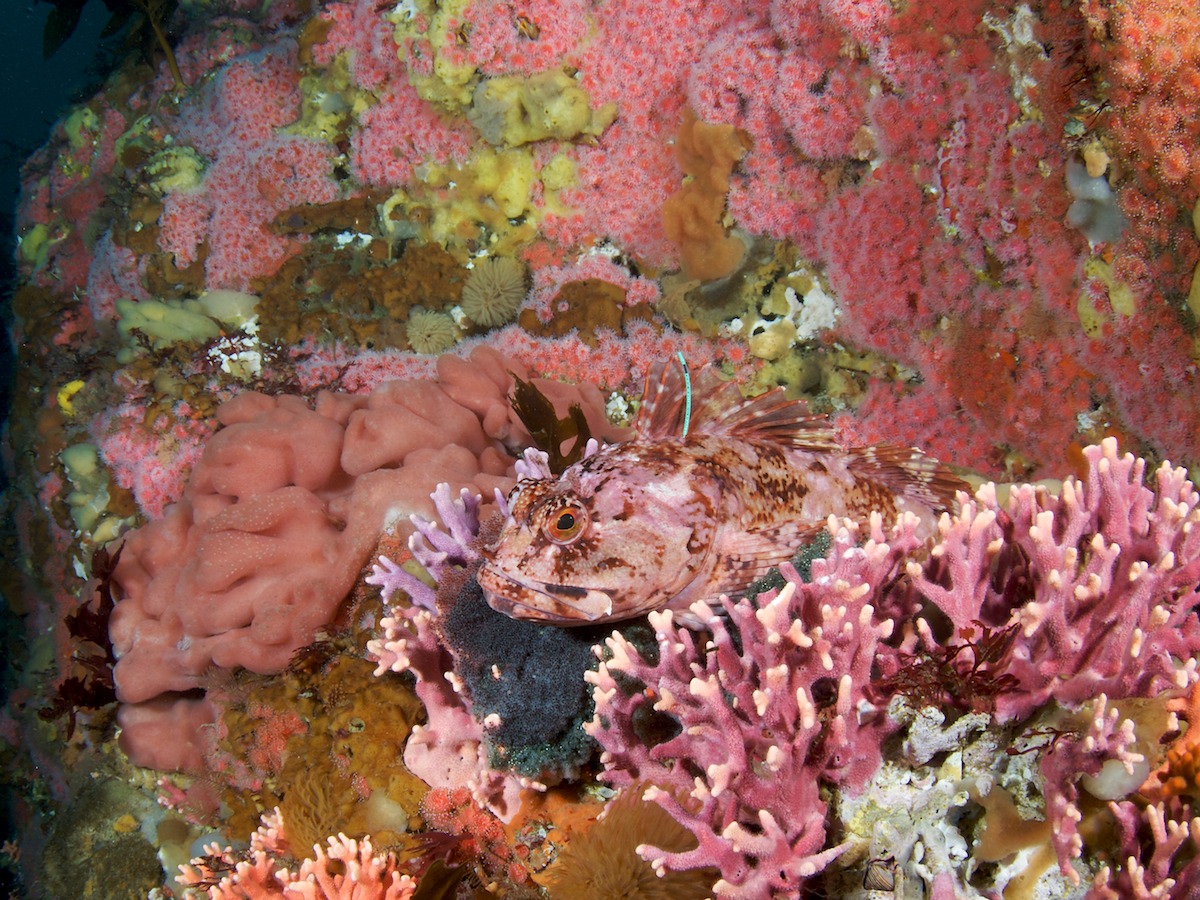
This probably isn't one of my best images from an artistic standpoint but there's a lot going on in this picture that should make it fun to talk about. This is a male Cabezon (
Scorpaenichthys marmoratus) sitting on a nest of eggs at the Outer Pinnacles in Carmel, California. I took this image in January last year.
The Outer Pinnacles are now a no-take marine reserve which was established by California's Marine Life Protection Act. This fish has been tagged by the Department of Fish and Game as part of an effort to see how much fish move in an out of the reserves. DFG was quite happy to get this picture as there is just enough detail to read the tag and identify the fish. They don't usually get updates on fish this way!

As it turns out this fish had barely moved since it was tagged. Cabezons tend to laze around on the bottom anyway but this individual is sitting on a nest and thus not going anywhere at all. Cabezons spawn in the winter and early spring with the males tending and fairly aggressively defending the nests. They will even attack divers who get too close.
Taking this picture was a bit of a challenge. I normally like to get some water in the background for wide angle shots like this but I couldn't figure out how to get the right angle. Getting low enough to shoot up was awkward given the topography and I could only shoot the left side of the fish. The fish's right eye was injured and possibly infected. Otherwise the fish seemed to be healthy enough but the milky eye didn't look so good for a portrait.
Making life even more complicated was the big swell we had that day. The hydrocoral the fish is nesting on tends to live in narrow channels with lots of water movement. I was being pushed back and forth more than 10 feet every time a wave went overhead. Another complication is that (as is usual in central California) there wasn't much available light. I shoot a D200 and don't like to go above ISO 200 so to get water and kelp in the background properly exposed would have required something like 1/20th and f6.3. That wasn't going to make for a sharp image as I got swept back and forth so I gave up and ended up just shooting the fish and the reef without the background.
I've cropped the image a bit - mostly on the left side which was just particulate filled water with a few random bits of my buddy Nick. I think I had at one point been trying to get an image of him looking at the cabezon but given the surge it wasn't happening. Otherwise I think the only other thing I did to the image was a bit of sharpening and mild contrast/levels adjustment.
Nikon D200/Subal Housing/Tokina 10-17 Fisheye Zoom at 17mm/Dual Sea and Sea Strobes.
ISO 200, f11, 1/40th, strobes at full power (I think).

Comments
5 commentsMy only suggestion would be to lose the dark border area on the left, even if it meant cropping all sides a bit.
Nice explanation of the fish and area, too-
Sandy r
Lots to look at here, and thanks for all the details about the image. As one who knows very little (like nothing) about underwater photography and the unique challenges posed by it, I found it very interesting to read. And, given the conditions you describe it looks to me like you did a great job in capturing this Cabezon.
I like how the fish blends in (mostly colour-wise) and how you've positioned the fish in the frame. The biologist/ecologist in me instantly wonders if the coloured tag could have an impact on the effectiveness of the camouflage and hence the predation rate on these fish. But, I'm saying this with no knowledge of what preys on this fish and how they hunt so I might be barking up the wrong tree. But just seeing the camouflage being interfered with triggers the question...(and I know it's likely that there's no information out there to really answer the question).
Cheers...thanks for sharing the image and all the background info!
Brad
Not sure the color of the tag is a problem for the fish. In this picture all of the color is coming from artificial light. The water filters out most of the red light. Also cabezons are just as likely to be greenish in color as pink so it probably doesn't stand out too much. I suppose if the tag fluoresced (ie converted ambient blue light into some other wavelength) it might be more problematic. I don't remember how obvious it was in natural light. Meanwhile I'm not really sure what eats cabezons. Sea Lions and Harbor Seals probably. Cabezons themselves eat all sorts of mollusks and crustaceans (especially abalone) but most of those probably don't have eyes that would help them see the tag.
Regarding high ISO - it depends on the application. With macro I guess it might help a bit by allowing me to use a lower power setting on the strobes and thus getting more from the batteries and shorter recycle times. I'm not constrained by that currently though.
For wide angle where you're balancing ambient and artificial light it can be important. In cold water I'd really, really like a stop or two better performance but if it required going to full frame I don't know what lens I'd shoot. The Tokina 10-17 fisheye zoom is the underwater photographer's best friend and there isn't an equivalent full 35mm lens available. For tropical water where there's more ambient light I'm going to be shooting ISO 100 by choice. Even then if I'm shooting in the sun I'm often at f22, 1/250th so I actually worry that cameras with a base ISO of greater than 100 might actually be too light sensitive. Better sensitivity would be great for big animals or other natural light situations. Since a new housing would cost about a 200-400 VR, plus the price of the camera I think for now I'm going to stick with the D200.
BTW - Brad don't know if you realize this but some of the best and most photogenic diving in the whole world is right in your backyard at the north end of Vancouver Island. If you ever decide you need another way to spend lots of money on bulky gear that requires you to be cold and uncomfortable to use it...
Clinton
Just a suggestion fwiw: how about either vignetting the right side of the image to match the darkness on the left side or cropping quite a bit tighter?