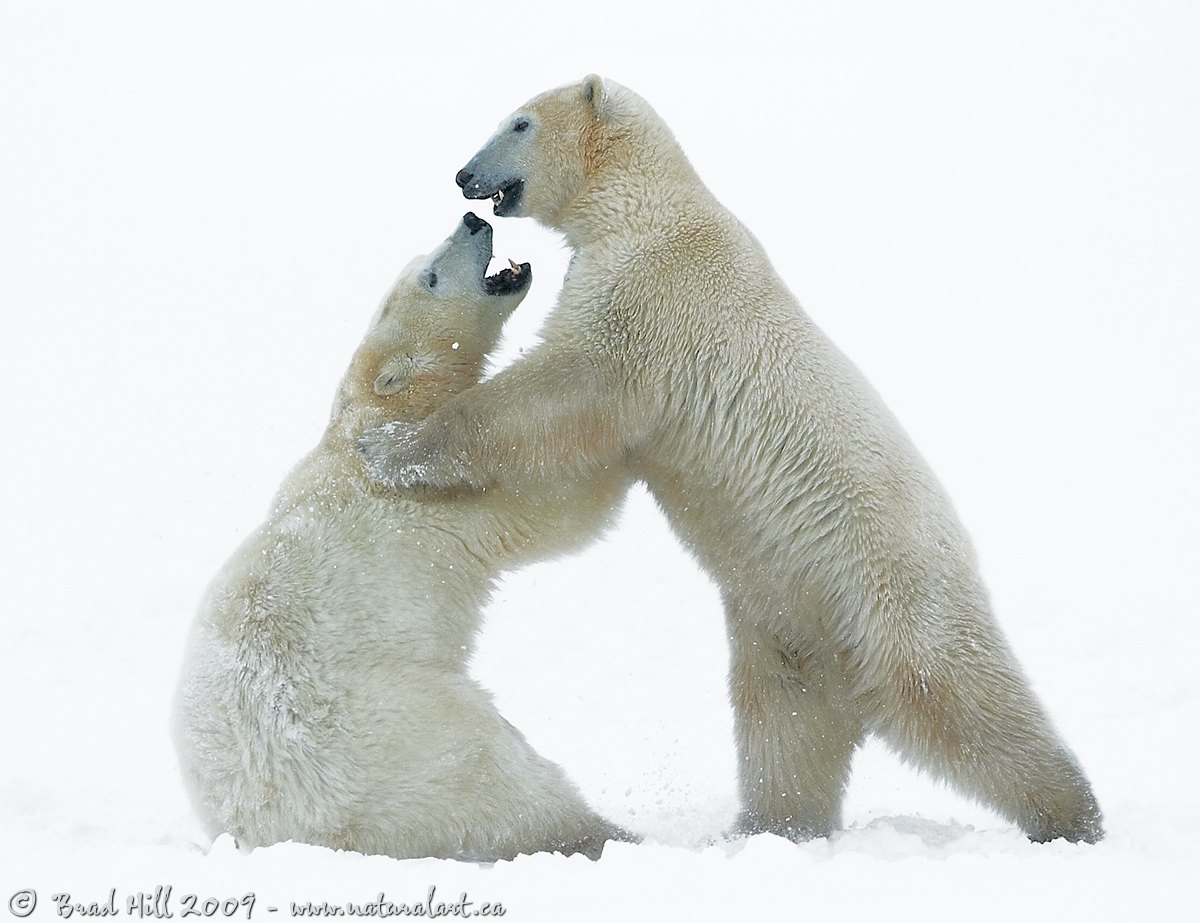
An "ancient" image (in digital years - it was shot back in 2004), and this one is for Lon - his comment about geometric patterns in another post last week, along with the snow and cold outside my office right now, made me think of this shot...
It's my experience that one of the most critical (and difficult) things to do in wildlife photography is to fall slightly out of awe (or love, I suppose) with the animals you are shooting and remember to treat them simply as photographic subjects. And of course, to remember that to portray ANY subject most effectively one has to apply basic compositional principles. For instance, when you're watching sparring polar bears, it's totally easy to get completely wound up in the action and, in some respects, relax your "photographer's eye". In this case, I had been freezing my butt off for a good twenty minutes (outside of the warmth of our tundra buggy) watching and photographing these bears sparring when I started to notice the interesting geometric patterns their bodies were forming while mock battling. Suddenly I had something "new" to watch for and, before long, the bears gave me - for a brief instant - this interesting series of triangles. Because I was watching for it and was ready to shoot, I managed to capture the instant. Interestingly, when I was reviewing my images on my laptop that evening, about half of my companions who were doing the "peeking-over-the-shoulder" thing instantly noticed the triangles and exclaimed "cool" (or something of the sort). Others who have seen this image over the years have often said they liked it, but didn't know why. When I show them similar images, but without the strong triangular shapes, they're usually less interested in them. Shapes, lines, and other compositional principles matter in ALL photography, regardless of the strength of subject matter. And this is true even if the viewer knows NOTHING about "composition" or why they like an image.
By the way - the background in this image is NOT "blown out" - I shot this in a blizzard and the background was absolutely featureless and very, very white!
Subject: Polar bears (
Ursus maritimus) sparring
Location: Cape Churchill, MB, Canada
Camera: Nikon D2H
Lens: Nikon 200-400 mm f/4G ED-IF AF-S VR lens (@ 360mm) - supported on a beanbag. VR on and set to "Normal" mode.
Exposure: 1/500s at f5. ISO 200. +1.0 stop compensation from matrix metered exposure.
Crop: Minimal - this is about 85-90% of original capture (crop off sides only)
All the gory details behind this image (field notes, all camera settings and processing details, conservation, etc.) can be found at:
http://www.naturalart.ca/galleries/mammals/bears/detail_34.html.
Cheers...thanks in advance for feedback on the image or commentary...
Brad
PS: I'll be around over the holiday season but may not have the time to post any more images until after Christmas - season's greetings and best wishes to all Fauna Gallery regulars (and to any guests...).

Comments
25 commentsAnd this was with the "old" matrix metering - less compensation needed with the newer cameras (as per our recent discussion).
Cheers...
Brad
Thanks for that little lesson in composition, which is far more important than we realize when we are beginners. During the past year or so, I have tried to do exactly what you recommend: move away from the "awe" that so easily trips the journalistic impulse/shutter, and approach the subject as part of an overall composition.
I employed this technique after a friend suggested I photograph ducks on ice, in flat light, last winter. The subjects weren't particularly interesting until I started looking for patterns as they moved about or I shifted my frame of reference. The shoot got much more fun and interesting at that point.
Ken Archer
I think it is noteworthy that there are the triangles and angles created by their bodies as the bears engage in play battle, but there are also those created by the photographer! Note, for instance, the negative space triangles created by the framing of the image, as in the very large white triangles in both the upper right and upper left corners of the frame. When one studies both the negative space and the bears themselves, it is possible to come up with lots of geometry, including triangle within triangle.
I am constantly working to remain conscious of the truth in your statement, "one of the most critical (and difficult) things to do in wildlife photography is to fall slightly out of awe...with the animals you are shooting and remember to treat them simply as photographic subjects." It is SO hard, and so important.
Jack
First of all, what an amazing image! Just spectacular! It was funny, just as I was reading about how viewers with little art background can pick out the images with the best comp, my sister walked in and started oohhing and aawwing over it! I guess you're right!
I know as a photographer I am always trying to look for geometry and comp (not always successfully!), but it amazes me how some "photographers" seem to lack that skill. In my AP art class at school I find that many students simply point and shoot at something that interests them, and they lack any composition at all. This is more problematic with digital cameras than film, because they end up shooting hundreds or thousands of these crappy images in a weekend! My teacher is always harping at me for not taking more photos, but I think less is more in this case!
Sorry, I got a bit off track there!
Happy Holidays!
-Cam
I KNEW you'd notice all the other geometric patterns here! The triangles formed by the subjects themselves are fairly obvious, but those created with the negative space (and I did crop to make them more obvious) may not have been caught by everyone else (without your keen eye and commentary pointing them out). Thanks!
Cheers...
Brad
Thanks once more for another educational commentary Brad. I am convinced that the regular Fauna gallery visitors appreciate these greatly and will benefit from them. Have a great Christmas!
Whites in white simplify the frame, making it very-very effective.
Jagdeep Rajput
Regards
D&L
~ja
Very nicely handled and the interaction is great.I think all the triangular comps....even in the dead space, come together very nicely to create a very powerful image. I do believe succesful images have many of these patterns many times we just sometimes take them for granted or don't even realize them. In this image they are very clear to see.
Cheers, James