Captured as a RAW image back in 2004 and first processed in early January of 2010 - who says I have a slow workflow??
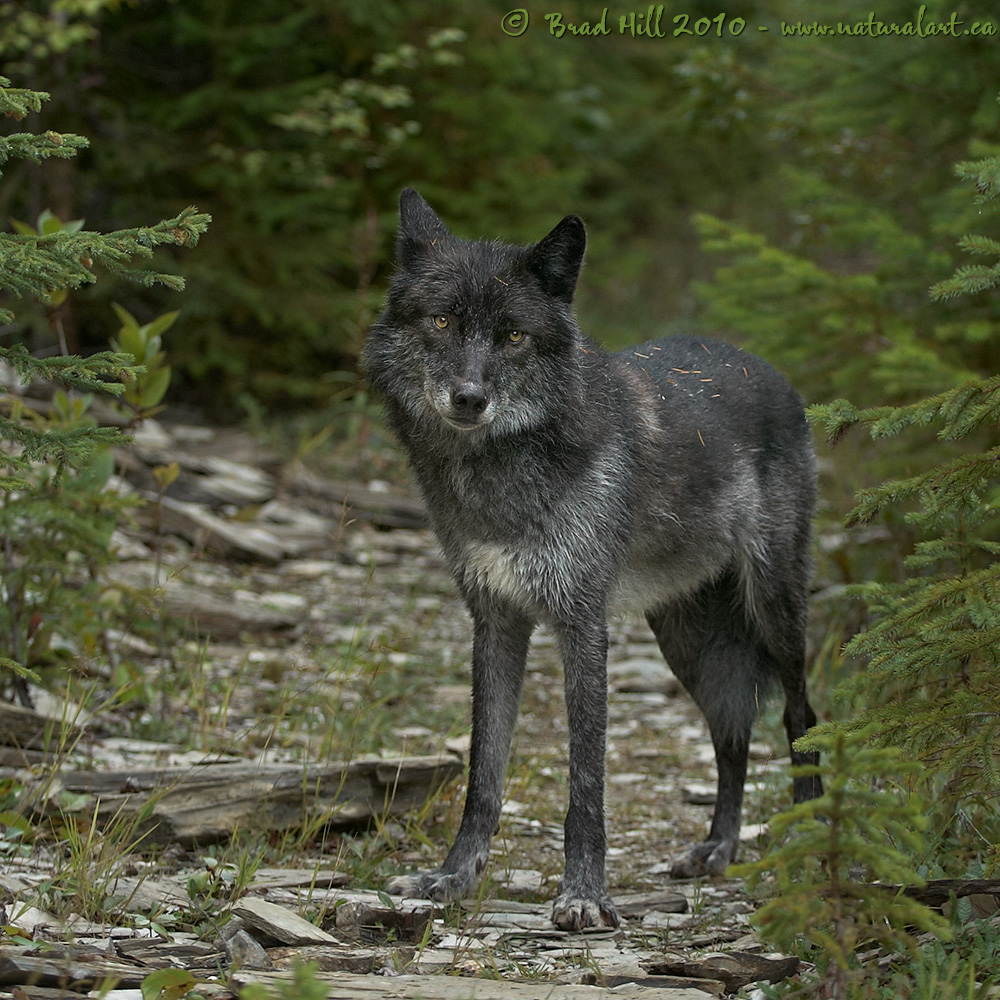
I photographed this gray wolf along a rocky trail in a thick and very green sub-alpine forest in the northern tip of the valley in which I live. In a way this is an exceptionally simple image - just a wolf standing in the forest. But to me the image represents so much, including what wilderness in North America is supposed to be (and what it's supposed to contain!). The wolf was obviously very aware of my presence and shortly after I shot this image it trotted away.
One of my personal goals when photographing wildlife is to go beyond what I call "of a" photos. "Of a" photographs are those which when viewed often illicit a response like "Oh, that's a nice picture of a wolf" - i.e., they feel the need to add the qualifier "of a wolf" rather than simply saying "What a beautiful photograph". In a way "of a" images are akin to what we also think of as "documentary images", as opposed to wildlife art. Finding a way to avoid capturing "of a" images with wildlife is always a huge challenge. One approach is to find a way to show personality or emotion in your subject. This, of course, is definitely easier said than done, especially when photographing hard-to-find subjects like carnivores! One thing that I find helpful is to carefully watch the animal's eyes and postures - when they illicit an emotional response from ME I know it's a good time to press the shutter release! When this wolf gave me this fleeting glance I was instantly struck by how innocent (and almost forlorn) it looked, and I almost instinctively released the shutter. There are those who would think that calling a very large wolf (this guy easily ran over 100 lbs) "innocent" is a tad inappropriate, but that's definitely the emotion I felt when I captured the image. And, this very simple wolf image has become one of my personal favourites (of those in my own collection) and every time I look at it I'm struck again by the apparent innocence of the wolf.
IMPORTANT NOTE: Please don't misinterpret this commentary as suggesting documentary images are of lesser value or easier to capture than images some think of as "Wildlife Art" - it is simply what I prefer (or strive) to shoot. Of course, I'm almost never successful at it!
Subject: Gray Wolf (
Canis lupus) in forest
Location: Columbia Valley, BC, Canada
Camera: Nikon D2H
Lens: Nikon 70-200 mm f/2.8 VR lens (@ 90mm - EFL of 135 mm) - handheld. VR on and set to "Normal" mode.
Exposure: 1/320s at f8. ISO 200. -0.67 stop compensation from matrix metered exposure.
Crop: Cropped from top and bottom (original capture vertical) - image viewed here about 75% of original capture
NOTE: When photographed, this wolf was free-ranging in a natural environment and not restrained in any way. However, it was/is NOT a fully wild wolf - it inhabited a nearby wolf education and rehabilitation centre and was released from captivity not long before this image was taken and was still quite habituated to humans.
All the gory details behind this image (field notes, all camera settings and processing details, conservation, etc.) can be found at:
http://www.naturalart.ca/galleries/mammals/wolvesandkin/detail_8.html.
All comments welcome - including those calling it a photo "OF A" wolf!

Brad

Comments
26 commentsThe education component didn't refer to the wolves - but to the public (displays, lectures, etc.) - so this dude didn't attend school!
This beast wasn't handled by folks but obviously less terrified of them than most wild wolves I've encountered (tho' I did run into a totally approachable but fully wild one last summer).
Cheers...
Brad
I have been feeling a bit heartsick about my vision of fauna photography. Although I can see the beauty in many animalscapes they almost never elicit emotional responses from me that images that may be referred to more as a "of a" images do. From this site I can see that many people appreciate animalscapes much more than I do. I hate seafood in all forms (and don't tell me I just haven't had it cooked right or fresh enough) too so I guess in many things I do not share the same taste as the majority. I try to shoot what I enjoy the most, which are images where the subject is close enough you can see the eyes (like the shot you posted here). I don't know if this is the kind of place you meant for this discussion to go but it is always interesting to see how differently we all see the same things.
You asked:
No, unfortunately not. If I had to guess I'd say it's likely gone by now (sadly). Wolf mortality rates are very high in this part of British Columbia - pushing 40% per annum (meaning that in any given year any wolf has a 40% chance of dying). Below 1100 meters (3600 feet) elevation it's open season year 'round on these guys (and one doesn't even need a wolf tag to shoot them). Those wolves above 1100 meters don't have it much better - they get a 6-week annual holiday from hunting pressure only. And, in the majority of the "management units" there is no longer a bag limit - so if someone with a gun sees a pack in the open they can shoot until there's nothing left standing. And there are a number of active traplines in the region as well. So...each wolf more-or-less is continually running a gauntlet. That they survive at all is a testament to their tenacity, intelligence, and wariness. Shameful and senseless situation - makes me embarrassed to call myself a British Columbian...
Sorry about climbing on the soapbox, but if folks don't know about this (and even many British Columbians don't) it will never get changed, so I try to never miss a chance to speak out...
Brad
Over here we now have the discussion about wolves returning in the coming years (for the first time in ages). They are approaching the border from Germany and now people are in a stir about it, I do hope we'll not resort to hunting them again, but I fear the worst.
You asked:
If I'm hand-holding a lens - yes. I normally shoot a burst of two or three frames (only). I do find that not uncommonly the second or third shot is a little sharper than the first. If I'm shooting off a tripod I often shoot only a single shot and shoot bursts less frequently.
RE: your comment:
Thanks for the positive feedback. I see no reason to keep "tips and tricks" secret and have always wondered why some shooters feel it's necessary to do so. Insecure, I guess! BTW, I used to get spammed/abused every time I made an "instructional" post (by a non-NPN member who tried to remain anonymous) but I think I wore the the spammer down!
Cheers...
Brad
It really is a spectacular shot! The eye contact and expression are amazing, he does look innocent to me! Of all wild animals, I feel it is the easiest to read expressions on canids, perhaps because of humanities long history with dogs.
I am really upset to hear about the hunting policies for wolves in BC. Similar to Palin's crazy reward for dead wolves in AK (not a political opinion, simply an environmental one). I hope both the BC and AK governments will come to their senses soon. There aren't wolves left in NY, and over the past century the NY deer population has skyrocketed. It is no longer a balanced ecosystem.
I'll follow Kurt's lead, and thank you for your tips, critiques, and thoughtful responses. Have you ever considered a career as a writer?
Sorry for the excessively long comment!
-Cam
Ken Archer
Another wonderfully evocative image and discussion! I saw this image on your site some time ago and lingered with it for some time. The emotional capture of the viewer may be stronger than that of the wolf and I can't explain why. Perhaps it's the historical relationship between man and wolf, Little Red Riding Hood and all.
Here in Utah, one of our legislators is introducing a bill to "shoot on sight" any wolf that may enter the state. The likelihood of it passing constitutional muster is pretty slim, but the overall sentiment in the state is what will prevail unfortunately. Myopic!!!! Seems to be the vision of choice in many places around the world.
Neil
Thanks for all the feedback and positive comments (especially about appreciating the commentaries - always wonder about that!). A few more specific responses:
1. Cam - you asked:
One of my past employment lives...and one that keeps rearing its head no matter how much I try to repress it!
2. Neil - you said:
Nope, must have been another wolf shot as this one was just processed a few days back (which is when it went on the website). Anyway...as much as I'd LOVE to really speak up here about wolf conservation, probably not the best place to do so (I always try to keep others to photography so better do so myself). I guess I should post another wolf shot in the Environmental PJ gallery...will do so later this week or early next...
Cheers...thanks again...
Brad
Your right, is it a different shot of the same wolf that I saw?
Neil
Wonderful image of a wonderful animal. You really captured the "essence" of the Wolf here which to me is the essence of the North American wilderness. Wolves are what got me into wildlife photography when I saw my first one in Yellowstone in 2005. The look in his eyes makes the shot and to me epitomizes what fascinates me about these animals like no other in North America. With most animals you see they are looking at you but with wolves they seem to look into you. You can tell they are working things out, sizing you up, thinking things through. You captured that here beautifully! Another winner in my book.
Laura Stafford
Enjoyed browsing your website!
Brett