The "perfection" part of this image title refers to the predator, not the image itself!

In a recent post Jagdeep mentioned the value of re-working some "old" digital images with newer software (and new skills). This is one I shot way back in the digital dark ages (2004) but never got around to processing in early 2010! Yep, slow workflow...
Anyway...I'm posting this image for a reason (surprise, surprise!). I've been closely watching the images posted in the Fauna Gallery for quite some time - both from an individual AND from a collective ("big picture") perspective. When I look at the images from a big picture perspective one thing really sticks out to me - the vast majority are shot with direct, frontal lighting. There are some notable exceptions (like Dave Courtenay's recent - and excellent - recent backlit image of an opossum entitled "Night Opossum), but anything but front lighting is quite rare in the gallery.
Some "famous" photographers (like, for instance, bird photographer Arthur Morris) actively encourage the use of front-liighting (and it is relatively easy to "handle"), but (very interestingly) whenever we DO see well-done back- or side-lit images in this gallery they tend to stand out and are almost always very well-received. This is especially true of common species, such as deer or elk. What am I driving at? Well...I think many (most?) great images lie in the realm of unusual or atypical lighting and I'd encourage y'all to take that bold step away from direct front lighting whenever possible...
Non-front-lit images can be tricky to capture and process...here's a few things to keep in mind:
1. Many back and side-lit images end up with bright highlights in them. While there's almost a mantra out there to "shoot to the right" (of the histogram) with your RAW captures, when working with "atypical" lighting you often have to expose the image to JUST retain highlight detail - how much you should "blowout" the image varies with how well your RAW converter can retrieve apparent "lost" highlight detail as displayed by your camera's histogram (that histogram is based on a JPEG preview of the image, NOT the raw data).
2. When processing back and side-lit images you often have to retrieve shadow detail (especially if you shoot to retain highlight detail). How much shadow detail you can retrieve varies with the quality of your camera's image sensor (something you CAN'T change) and the ISO you captured the image with (which you CAN change). Bottom line - you can more successfully extract shadow detail (without introducing noise) with lower ISO's than with higher ISO's - so keep that ISO as low as practically possible...
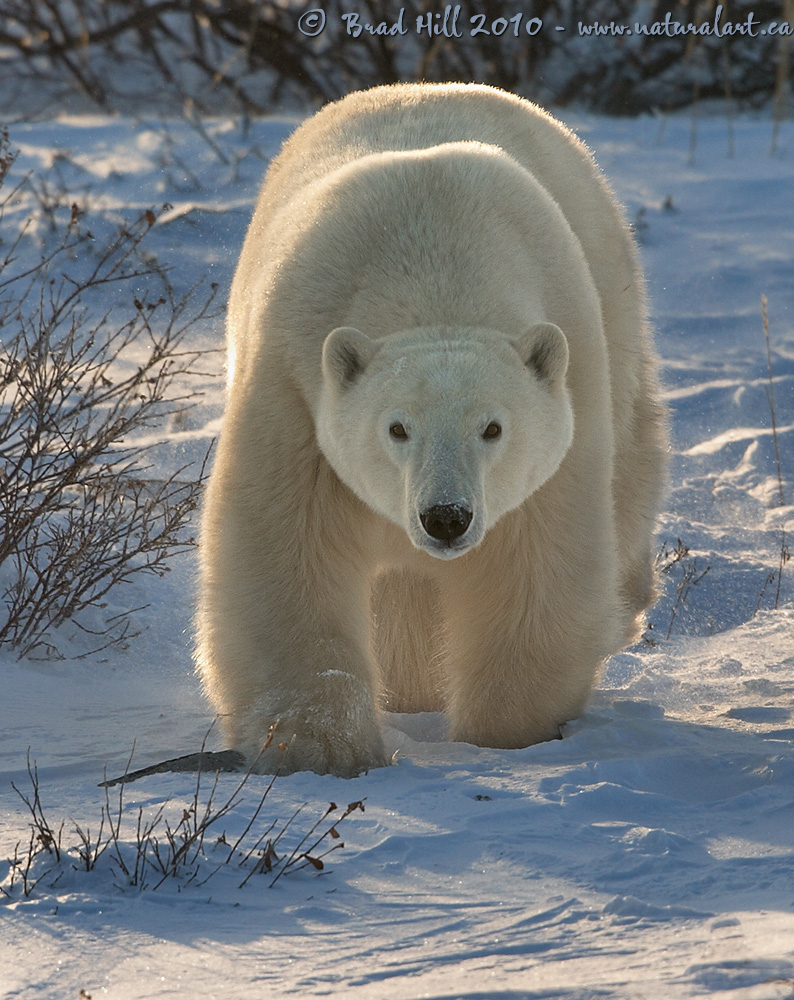
About this image: Being the subject of a keystone predator's pursuit is a thing that elevates your feeling of well-being, assuming you live through it! This adult polar bear circled almost completely around me before approaching with the sun at it's back. The toughest challenge in capturing was to remind myself to keep exposing for the highlights while most of my mind kept thinking distracting self-preservation thoughts! But it WAS a fantastic moment and not one I'll soon forget...
Processing the shot required a lot of balancing of shadow and highlight detail and ensuring that the final resultant image had enough shadow detail for visual interest but not so much that it appeared unnatural (like it was filled with flash).
Subject: Polar bear (
Ursus maritimus) checking out a dumb photographer...
Location: Cape Churchill, MB, Canada
Camera: Nikon D2H
Lens: Nikon 200-400 mm f/4G ED-IF AF-S VR lens (@ 400mm - EFL of 600 mm) - handheld. VR on and set to "Normal" mode.
Exposure: 1/200s at f6.3. ISO 200. +0.33 stop compensation from matrix metered exposure.
Crop: Substantial - this is just over 50% of full frame
All the gory details behind this image (field notes, all camera settings and processing details, conservation, etc.) can be found at:
http://www.naturalart.ca/galleries/mammals/bears/detail_81.html.
All comments welcome - as always, probably best to have a peek at the larger version before commenting...
Brad

Comments
26 commentsMoment caught well.Nice work.
Congrats:lstván
Very well done.
Dave
Yes, it was from the same encounter. This one was shot about a minute or so later - the polar bear was moving in really slowly and with measured steps (I guess I look like a ringed seal, but don't tell anyone). I actually desaturated the colour quite a bit on this one - to me it looked almost artificial and I THINK this one is truer to what I saw in the field (but that's a guess based on a wobbly memory of an event 6 years ago).
Cheers...
Brad
Thank you very much for all the details you share with us (I appreciate this very much also in your Web site, that I visit regularly).
Regards
D&L
cheers,Luca
Thank!
Sandy r
Amazing you were able to capture this while this creature was "bearing" down on you (sorry, I had to). I agree with your assessment about lighting and some of my backlit photos are my favorite. One thing that can really take a backlit shot over the top (and it's evident here) is where small details are illuminated. In this photo the from the bears movement is visible and really shines. If the light was directly on front, it either wouldn't be visible, or wouldn't be noticed. Thanks for sharing/educating. I'll have to go through my files for some non-traditional lighting.
Excellent exposure and processing on this image, It's a beauty!!!
Ken Archer
He looks like he means business. What is the bear story you referred to in the link you gave us. Were you alone and on foot or was there a vehicle nearby? Obviously you survived but what happened next. I would really be a bit tense If I was completely circled by a giant predator like this.
Just a short bear story - I WAS the subject of this stalk which took place over about 10 minutes. I was outside of a vehicle but just outside of it. The bear saw me and walked in a circle around me (with a radius of about 100 meters). It did a full half circle (180 degrees) and when the sun was almost directly behind it (and in my face), it started a slow approach. When it was about 15 meters or so away (a second or two after I shot this) I decided a strategic re-positioning of my person was in order (I jumped inside the vehicle). The bear came right in (to within a couple of meters), looked in the vehicle, and then slowly walked off. Of course, for all I know the bear was just curious, though to call it an "interesting experience" is just a bit of an understatement!
Cheers...
Brad
Thanks for the bear story. In a previous post (Jorne de Bruin's wolves) you spoke of how you like the excitement and challenge of tracking wolves and other animals and I was wondering if perhaps you were out on foot and came on the bear. I had the impression that most of the bears in Churchill were photographed from tundra buggys and that it was unsafe to photograph the bears on foot so I was curious about the details.
Arthur Morris has a formula for success that he is willing to share, but I won't drink that Kool Aid. Alas, I don't have the skill to drink that Kool Aid anyhow. Then again, I'm an amateur and what do I know?
Pete D.
I never consciously realized that Arthur Morris advocates the use of front-lighting though and am actually surprised if he does as these are not the ideal conditions for really creative photography.
Thanks for the educational write-up, but also for the exciting bear story!
Almost forgot, nice image, but a bit of a heavy crop for your doing Brad.
Really agree with you on the fact that back or side lighting can really give images that 'special' feeling. Now If you could provide me with the remote for the sun so I can position it just right next time I'd be thrilled
I really like the head-on position of the bear here, really gives you an in the face feeling. Like I said I like the sidelighting here, but if I go nitpicking I do see a slightburnt-out highlight patch on the side (but that also might be my crappy uncalibrated work monitor).
In response to...
Yes, much of the photography around Churchill is done by carefully regulated commercial outfitters who use tundra buggies. I am unaware of any who allow humans to leave the safe confines of the tundra buggies. BUT, if you hook up with the right guides, you can go further out in the tundra and there are locations where venturing outside the confines of a vehicle is acceptable. But, for the sake of yourself (and the sake of the bears) you definitely want to be extremely careful and you don't want to be walking around all by yourself. Bears in this region have "always" (for at least a few thousand years) been exposed to humans and already know what they are. Baiting the bears in, or enticing them towards you in any way, is, of course, a very bad idea and it's definitely a breach of ethical standards (of most photographers). Not good of the bears, not good for the humans.
Cheers...
Brad
Vincent, Arthur Morris very much preaches of front lighting your subjects. And who said he was a proponent of creativity? I have always disagreed, I love side-light if I can handle it.
This shows how no-front lit subjects have more depth and are shaped by the light. I like how the shoulders are separated by the highlights from the body.
Ron
Max
Its been a while how are you. This is another belter from you sir, just love everything about it, one day one day.
Danny