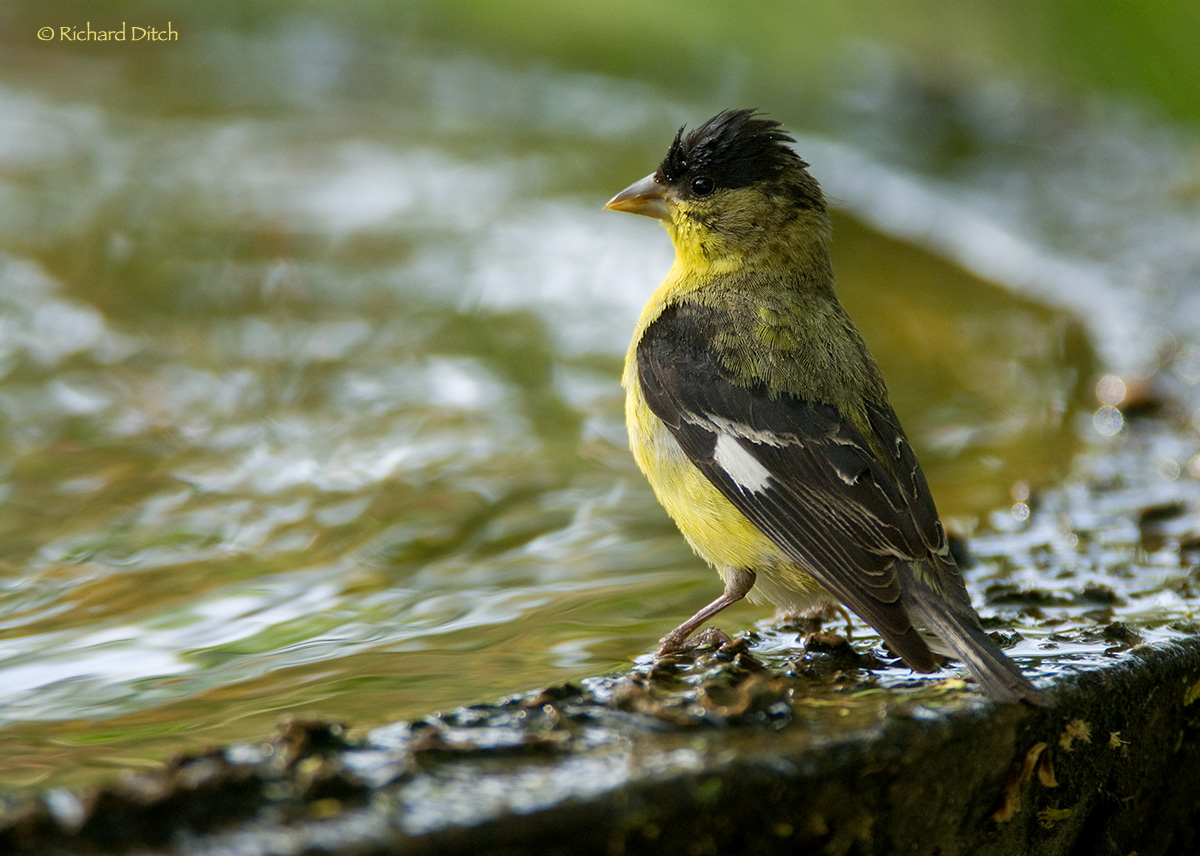
Lesser Goldfinch
by Richard Ditch
Lesser Goldfinch (Carduelis psaltria)
Place: Boyce Thompson Arboretum, Superior, AZ, USA
Date: May 18, 2010
Equipment: Nikon D200, Nikkor AF-S 300/2.8, TC20E (2x), G1325, RRS BH-55, Sidekick
Exposure: Aperture priority spot metered, ISO 400, 1/200th, f/5.6
Raw, PS CS3 on Mac G4, modest crop for balance
I haven't been able to spend much time out shooting lately, but I did squeeze in a couple morning hours last week.
As always: honest critiques requested; all comments appreciated. Larger image provided to verify IQ.

Comments
10 comments- Luke
Often times the thing I like most about your images is the mood that you create with them, and this one is a fine example of that. I like how Gary described it with the "grotto" sort of feel. Love the pose of the bird, its wetness and the light. Fine technicals even under tough conditions, which I have come to expect from you.
A very appealing image as posted.
Terrific shot in tough conditions. Excellent detail in the bird and I really like the smoothed flowing water in the BG. The spot metering allowed you to "expose for the subject" and the selection of f/5.6 in aperture priority mode gave you a shutter speed that smoothed the water. I'm just thinking out loud here trying to imagine your thought process when you were taking the photo.
Actually, not much thought process involved when I'm shooting. I'm pretty much on auto pilot, concentrating on the subject and not on the gear. I set my ISO when I start each morning, usually at ISO 400 since I know I get good image quality if I expose correctly at this value. Wide open at f/5.6 since that maximizes my shutter speed. Aperture priority auto exposure because that's how I've always shot my Nikon cameras since the days of the Nikkormat EL. When I've got tricky light or am worried about bright areas in the background I pull in the spot meter - I've got the programable button on the front of the D200 set to that function and I often just use it without even thinking any more.
I keep my eye to the viewfinder and watch the subject, making sure I've got my focus point where I need it. I can see my shutter speed in the viewfinder so I can tell if I need to adjust the ISO.