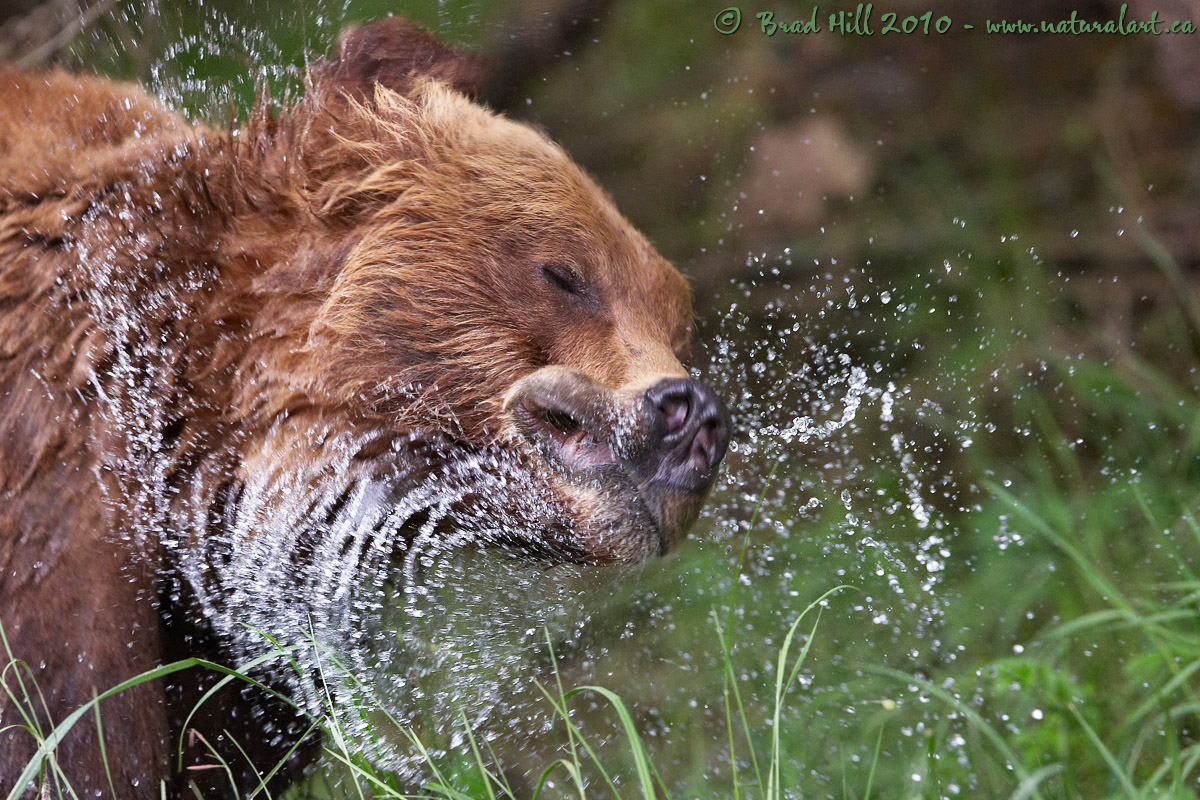
From my June trip to the Khutzeymateen Inlet of northern BC, Canada. There were no electrical outlets for this bear's blow-dryer so it did the the next best thing!
Anyone who has read even an introductory book on photographic composition will be aware of all the standard guidelines of composition: the rule of thirds, the power of leading lines, the strength of diagonal lines, etc. These guidelines are always worth keeping in mind, but I like to layer another principle on TOP of the standard compositional guidelines in my own photography. The principle I'm talking about is based on my belief that our visual system (and that of most animals) is designed to instantly detect
visual contrast in a scene - simply put - if something is different it sticks out and our eye is drawn to it.
For a photographer, this visual contrast can take on many forms, such as: A) standard light/dark contrast (think about how a light subject on a dark background - or vice versa - sticks out OR think of the drama of the light/dark regions created by shadows in a strongly side-lit scene); B) contrast in focus (sharp subject, out-of-focus background); C) contrast in motion (or in motion blurs - with some element of an image in sharp focus with other elements blurred); D) contrast in colour (think of a single orange flower in a field of green grass), etc. If you stop and think of it, you can probably come up with many more "photographic devices" that all boil down to one simple thing:
visual contrast. So, when I'm in the field I'm always seeking out scenes (or subjects) where I can find a way to layer the principle of visual contrast on top of basic compositional principles.
Back to this shaking grizzly. When I was getting ready to shoot this image I was thinking about where to position the bear's eye (vertically) in the frame (i.e., the rule of thirds) and to ensure the bear's head was still entering the frame by leaving a little more in front of the head than behind it (using the standard principle of giving the subject "room to breathe" or "room to move" within the frame). But I also wanted to exploit the visual contrast in the scene. I did so in two ways. First, I chose a fairly wide aperture to ensure that the background was much more out of focus than the subject I was focused on. Second, I chose a shutter speed that was fast enough to absolutely freeze some elements of the image (in this case the bear's eye, face, and tooth) while leaving other parts of the image blurred by motion (e.g., the ear region, the nose, the fastest moving water droplets). You know - go for that old (and tricky) "freeze-blur" combination. In this case slowing down the shutter speed just a tad (to the 1/250s or the 1/350s range) may have worked a little better (produced a more pleasing image), but given the proximity to the subject (I was pretty darned close - this is close to full-frame), halving my shutter speed could have easily led to everything simply being a blurry mess.
The take home lesson? Well, for me it works to always being looking for ways to maximize (or - more correctly - optimize) the amount of visual contrast in a scene while keeping the tried-and-true standard compositional guidelines in the back of my mind. And I try to do this regardless of the type of image I'm shooting - wildlife, landscapes, portraits, or whatever! Just remember that visual contrast can take on many, many forms...but is almost always visually interesting.
Subject: Grizzly Bear (
Ursus arctos) shaking as it exits a channel in estuary
Location: Khutzeymateen Inlet, BC, Canada
Camera: Nikon D3s
Lens: 400mm f2.8 VR - hand-held (VR on)
Exposure: 1/500s @ f4; ISO 5000; no compensation from matrix-metered exposure setting of camera.
Crop: This is about 85% of full-framed image
All the contextual information surrounding this shot (including processing details) can be found here:
http://www.naturalart.ca/galleries/latest/detail_2.html.
All comments and critiques welcome, but probably better to view larger image first.
Cheers...
Brad

Comments
13 commentsAnother insightful "novella". I like this image for its action elements and uniqueness but the motion blur doesn't do it for me. While the eye is sharp, it's closed so for me the only sharp part of the image lacks interest and doesn't keep my attention. I have used this technique (usually on accident) on birds many time, and it often works better because motion blur in the wings is to be expected whereas a shot like this might take some getting used to. I appreciate the creativity though.
- Luke
Another photo with lots of character. I might try to tone down the highlight on the bridge of the nose. Other than that an excellent photo and great tutorial to go with it.
I feel it's great that you are willing to share thoughts that others might keep as "secrets of the trade" Your lessons are very thought provoking and have already helped me in how I approach photographing a subject. You're posts are making me think more before pressing that little shutter button.
Thanks, and hopefully, here's to many more posts to come!
Richard
Your post are always a pleasure. Always well crafted visually and your dose of thought provoking insights are a treat. Few are able to articulate concepts as you do on a regular basis. Well done on all accounts!
Knowing how spontaneity plays a role in all animal behavior, especially freeze/blur, shots. I think this would work better if the nose was sharper because the closed eye, but thats from the outside looking in with an appreciation for the fluidity situation. Cool shot however you slice it
Thanks for kicking the can down the road.
Neil
You asked if there was any noise reduction applied to this image. Just the default (and very minimal NR) that is automatically applied by my preferred raw converter (Capture One Pro) - none after that in Photoshop. Don't want to make this sound like an ad or promotion of a particular brand or model, but the D3s is absolutely amazing and a VERY big step up from the D3 (which was no slouch by anyone's standard). I have an image in my gallery (entitled "ISO WHAT??") shot at ISO 12,800 with no noise reduction on it (except during raw processing) - check it out if you're interested.
Cheers...
Brad