About B&W
by Vincent Grafhorst
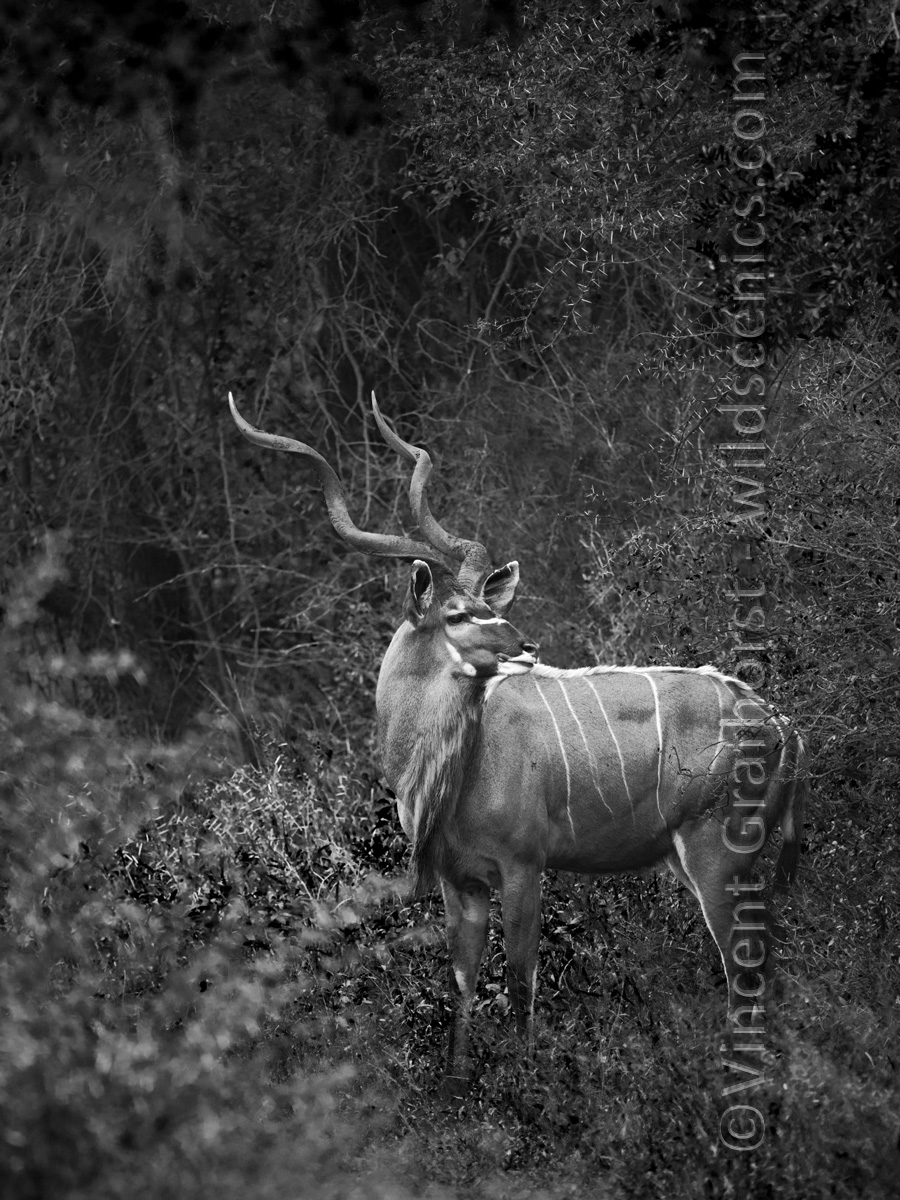
"Magnificent Bull"
Although Kudus are about the most common antelope species around here, they are not at all that easy to photograph, let alone the impressive prime bulls. Being browsers they are always amongst thick bush. Their defensive strategy is to stand still in dense vegetation and only move until spotted. Their cryptic camouflage helps them being invisible. I was lucky to get a near unobstructed view of this prime bull. Using a long lens it did not even know I was watching it and I could isolate it at least a bit from the busy habitat. Taken in low and flat light this made an ideal candidate for a B&W conversion, through which process I could make the animal stand out much better from its environment. And that is actually the point of this post, to bring up the use of B&W in wildlife photography. In what situations/conditions do you think it works? One of the things I like about B&W, and I must admit that I do not do a lot of conversions and in general do prefer color, is that it offers a lot of creativity. Once you convert to B&W, there are so many ways you can convert. Photoshop’s B&W tool has several presets which already show you the different effects, which mimic the traditional filters and film types. The ability to fine-tune these to your personal preferences makes this even more flexible, creating endless looks to your images. Combine that with the endless other PS tools and effects and applying these selectively, and you can imagine that going B&W opens up another dimension. When converting to B&W, I suggest you do so in a layer, leaving the color background intact (and certainly not in-camera!). That way you can still play with the colors (below the B&W layer) with tools such as saturation/hue, selective color and color balance, which all have an effect on the B&W conversion. Often for example, extreme saturation, which would look horrible in color, can actually enhance the B&W conversion. If you haven’t done so yet, I suggest to go and play with B&W some time, you might be amazed by the results.
Just a FYI: I had heard many stories about Kudus jumping fences as high as 2 meters and always thought they were slightly exaggerated until I witnessed them clearing a fence at least 2.0m high from stand still myself! My jaw dropped and of course I was not ready with my camera…
Ever so now and then I get the question thrown at me: “what is your favorite animal?”. A question I do not really know how to handle as I do not have one specific favorite. Yet, the common but magnificent Kudu is certainly one of my favorite ungulates, even though they are bloody hard to photograph (IMO).
Greater Kudu Bull (Tragelaphus strepsiceros)
Backyard (sort of…)
Camera Model Canon EOS-1D Mark IV
Shutter Speed 1/200 Sec.
Aperture Value f/4
ISO Speed 800
Lens EF500mm f/4L IS USM
Cropped to 4:3

Comments
6 commentsSimple, effective and very well executed. Thanks again for sharing.
Nice full body view. I always assumed they had legs and hooves.
I'm a big fan of B+W because its abstract. We see and think in color and B+W is "outta the box" as they say. Funny how it was the norm for such a long time and used sparingly now. My favorite technique is using the channel mixer in monochrome, but recently I've begun using TK's luminosity masking to gain even greater control. I'd be interested in what others like to use.
Cool shot!
Neil
Altho' impossible to say definitively without seeing the original colour version, it does look to me like your B&W conversion has made the kudu stand out from the background quite nicely. I like the head turn the bull is giving you. I'm not 100% convinced that vertical is the optimal format for this image - but again this is a little hard to say without knowing what is on the sides (outside the frame). I do find the OOF vegetation in the lower left corner a little distracting, but based on what you say about photographing these guys, it sounds like that would always be a problem when working with kudus.
RE: B&W conversions - you ask: "In what situations/conditions do you think it works?"
I look for scenes that have a wide tonal range, including "true" blacks and whites. Invariably I bump the contrast, either through the use of adjusting the tones of the individual colours or through using more traditional methods such as curves and levels. I normally do my conversions in Photoshop (I used to use the Channel Mixer, but now like using the Black & White Adjustment Layers approach). Commonly I'll do my final tweaking and tonal adjustments in Light Craft's Lightzone, which has an interface and workflow based around Ansel Adams zone system. I like using Lightzone in that its controls seem to encourage a more thorough exploration of the potential of the image - it's good for visual "brain-storming".
Cheers...
Brad
Really like the result here, and that's saying a lot. B&W conversions of animals usually fall short IMO.
I especially like the distinct white trim/markings of the kudus, they draw your eye immediately.
Well done!