Hey all,
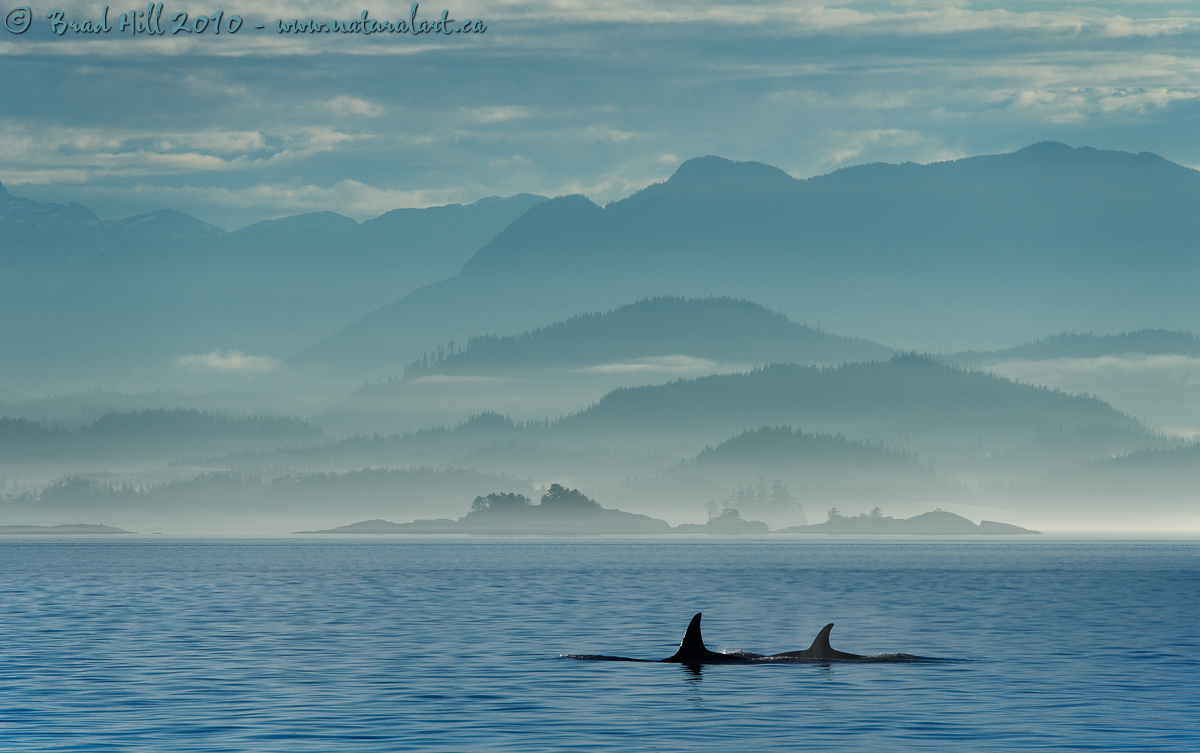
I recently captured this image during my first (of - hopefully - many!) trips to the Johnstone Strait region near the northern tip of Vancouver Island on the central Pacific coast. The region is known for its biological richness, which partly manifests itself in the form of a large number of resident Orcas (aka Killer Whales) and other aquatic mammals (including Humpback Whales, the occasion Gray Whale, various dolphin and porpoise species, and both Steller Sea Lions and Harbor Seals). The Orcas are, more or less, "emblematic" of the region and I hoped to create at least one image that captured what I considered to be the "essence" of the region. I think this may be that image.
Technically this was a real tough image to capture (and process, for that matter) - there were a lot of constraints/hurdles to overcome. And, of course, there was a lot of luck involved. The biggest lucky break came with the presentation of this great scene to me - the wonderful lighting and mist were a godsend, and then to have the two Orcas swimming by...well...yes, sometimes I DO have horseshoes up my ____! But what's that old saying? Oh yeah..."f8 and be there!"...and fortunately I was there.
I will take credit (or the blame!) for a few decisions leading to the production of this image. First...that background was WAY in the distance - and I wanted those ridges to be a dominant part of my composition. Plus, I wanted the distance between the whales and the ridges compressed and more or less "stacked up". So...I needed to use a relatively long lens to produce the image I wanted. To completely freeze the movement of the Orcas I needed quite a fast shutter speed - somewhere in the range of 1/1000s or higher. The obvious first thought is to open up the aperture to get the speed you need to freeze the action (after all, I was shooting with a f2.8 400mm lens). However, if I did this and focused on the Orcas I wouldn't have had the depth of field to render the background sharply (which is something I felt was important in making the shot work). Hmmm. One potential solution would be to crank the ISO WAY up so I could both stop down (to maybe f11 or smaller) and still shoot at a high shutter speed. Good idea in theory, but my own past experience with my D700 has taught me that these kind of mid-tone dominated scenes can really show noise at moderate to high ISO's (and I would have needed ISO 1600 or higher to get the DOF and shutter speed I needed) so I discarded the concept of cranking up the ISO (and I honestly doubt I could have found the DOF I needed anyway).
So...on to plan B. Instead of trying to push the laws of optics in a single image, I decided that the only way to get the shot I wanted was to capture two images - each focused on a different part of the scene - and then merge the two images in Photoshop. So...I waited until the Orcas were exactly where I wanted in the scene and shot a burst of images as they surfaced, then (without moving the camera), I toggled my focus bracket higher in the frame, re-focused on the ridges, and shot another quick burst of images. Then, to make a long story short, I merged the best images from each burst into a single image using Photoshop CS5. So what you're looking at here is actually what I call a "focal plane composite" of two shots of the same scene.
Which leads to an interesting question: Is this type of image creation "ethical"? There's no doubt that this is "slippery slope" issue that's dominated by shades of grey. But it's my view that image "corrections" made to compensate for the limitations of our cameras and/or lenses (and I know of few who would argue that our eye sees the world with the shallow depth of field that a super-telephoto lens does when shot wide open) are completely legitimate. In this case I used modern technology to increase the depth of field of an image that I THINK more closely replicates the scene I observed in the field. And I have a hard time accepting this is wrong. But, whenever I perform such a correction, I do feel compelled to openly disclose how the image was created. Then at least you can be the judge!
Subject: Killer Whales (
Orcinus orca) - just after sunrise
Location: Johnstone Strait region (northern Vancouver Island), BC, Canada
Camera: Nikon D700
Lens: Nikkor 400 mm f/2.8 VRII lens - handheld from sailboat. VR on and in "Normal" mode.
Exposure: 1/1600ss at f5. ISO 200. -0.33 stop compensation from matrix metered exposure.
Crop: Full frame horizontal - very minor crop off sky at top
All the contextual information surrounding this shot (field notes, all camera settings and processing details, conservation, etc.) can be found at:
http://www.naturalart.ca/galleries/mammals/other/.
Comments and feedback greatly appreciated...probably better to view larger version prior to doing so...
Cheers...
Brad
I intend to begin offering an 8-day Instructional Photo Tours to this fantastic region in August of 2011. If anyone is curious about the tour, feel free to email me or check out the tour entitled
"Orcas, Humpbacks and More: Aquatic Mammals of the Central Pacific Coast" on the
Photo Tour page of my website...

Comments
19 commentsSimply a stunning landscape, uhm I mean image Brad! Think you made the right choice about using a focal blend, it's all about the artists vision, don't let optic law hold you back
I meant to say: It's all about the artists vision, as long as it is within reason. Don't you start adding even more Orca's!
Max
I may prefer, not to cut into the white clouds on the top of frame, if there's no room, may prefer to crop out top layer of white clouds.
Jagdeep Rajput
Ken Archer
Thanks to all for your kind comments on this shot - they're truly appreciated! I wasn't "worried" about the ethics of the focal blend/stacking, but thought it would make an interesting discussion topic (which it apparently did)! A few specific responses:
To Jorne: RE: "and I see this awesome landscape ruined by some black stuff in front..."Sorry 'bout the black junk in front (dirty sensor??) - I would have cloned them out, but you know how I feel about cloning! And sorry if I interrupted your sleep!!
To Ákos: RE: Going B&W with this - see my next post - coming Thurs AM!
To Ron: RE: "I'd like a bit more contrast in the mountains and clouds." If this were simply a landscape shot I would have done that. But...to me the subject of this image is still the Orca, and I wanted the Orca to be significantly darker in appearance than the mountains/clouds (so they wouldn't compete for attention with the Orca).
To Ajit: RE: "I think I was in the very same waters that very day." This was shot on the morning of August 25, in Blackfish Sound (near Johnstone Strait - and not too, too far from Knight Inlet). I don't know Jamie Scarrow (should I??), but he was right that I was on the Ocean Light II on that day! It would have been great if our paths had crossed - maybe another time!
Thanks again...
Brad
Thanks for sharing the image and technique.
André
Cheers, Luca