Hello all,
I know this one won't be everyone's (or possibly ANYONE's!) cup of tea, but after the two interesting posts last week of butterflies on black backgrounds (by Jeff Loomis and Philip Hodgkins) I figured I had to get in on the act!
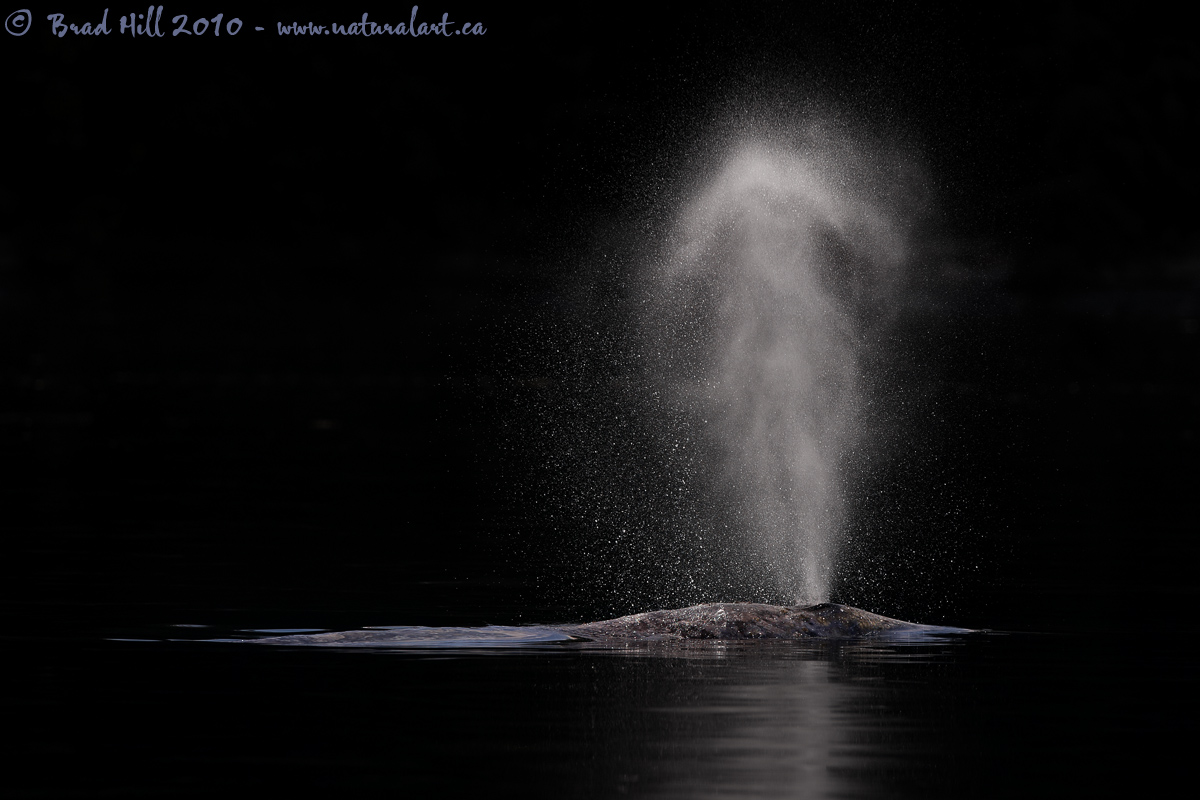
If you're wondering what this image actually is...it's a Gray Whale doing what Gray Whales mostly do when they're on the surface - simply exhaling (or "blowing"). These medium-sized whales are bottom feeders that tend to be less "athletic" on the surface than some other species of whales (such as Humpbacks) and actually finding an interesting way to portray them from the surface can be a challenge!
This shot is a bit of a study in minimalism (and it's a real monitor-tester!!). When we encountered the whale we had a patchy light cloud cover, with the sun mostly above the whale but a little behind it. I shot a number of images of the whale when the sun was behind the clouds and the images were...uhhhh...well, to be honest, quite boring! We DID have quite calm water at the time and I started thinking if the sun came out some back-lit fun could be easily had! So...when the sun did come out it illuminated the whale nicely, but threw the background into dark shade. Under these conditions, when the whale blew the plume was extremely bright and super-easy to over-expose (or blow out). So, I decided to "go creative" and intentionally under-expose the bulk of the image (by almost two stops) in order to retain all the detail in the water vapour. I knew at the time this would leave both the background and the water very dark, which was fine by me! I was planning on making that water and background even darker by post-processing anyway!
So when it came to processing the image, I selectively darkened the already very dark water and background - I backed off the exposure in those areas (only) another 1.5 stops. This had the effect of reducing the image to just a few elements (whale, spout, and a few reflections) and left just a touch of colour in the image, which is exactly what I wanted. Presto - all the distracting elements were gone and I was left with an extremely simple, but (at least to me) very compelling image. Does the image accurately reflect the initial scene? Nope, not much at all. But, all the "manipulations" done to it could have easily be done in a darkroom back in the "good old days" (aka the film era).
The take home lesson? One that I repeat a lot but I still think is missed by many of today's digital photographers: knowing what you can do with an image in post-processing can (and should) influence how you capture those images in the first place. The "Big Feedback Loop" (applying past post-processing lessons to future image capture sessions) is as important - or even MORE important - as the "Little Feedback Loop" we all perform when we review our images on the LCD screens of our cameras and quickly make adjustments to our cameras based on seeing those histograms!
Subject:Gray Whale (
Eschrichtius robustus) surfacing
Location: Off the northern tip of Vancouver Island), BC, Canada
Camera: Nikon D3s
Lens: Nikkor 400 mm f/2.8 VRII lens - handheld from inflatable zodiac. VR on and in "Normal" mode. Circular polarizer used
Exposure: 1/1250s at f5. ISO 360. -1.67 stop compensation from matrix metered exposure.
Crop: This is about 85% of original capture
All the contextual information surrounding this shot (field notes, all camera settings and processing details, conservation, etc.) can be found at:
http://www.naturalart.ca/galleries/mammals/other/detail_2.html.
Comments and feedback greatly appreciated...probably better to view larger version prior to doing so...
Cheers...
Brad
PS: I don't know how many of you caught the "unique" discussion under the heading of "Why Religion" in the general discussion forum last week (I kept my nose out of it). Anyway...in a related sense...I recently showed this image to a friend of mine (a marketing guy and a quick wit) and he SWORE he could see the Virgin Mary in the vapour cloud. While I'm suspicious of his motives, I was not offended. AND, I won't be offended if any of you do or don't see her in this image. AND #2, you won't see any reference to the Virgin Mary in any marketing materials that will ever be associated with this image (tho' I have to admit I think my friend was on to something!)


Comments
24 commentsbtw- don't know about the virgin, but I do see a happy, floppy-eared dog in the spray.
Max
Congrats
D&L
I agree that the subtle reflections and ripples are totally necessary (and I thought they added a little extra visual interest).
But about your more important point: funny...I TOLD my friend it was a dog, but he wouldn't go for it. Less marketing potential!
Cheers...
Brad
L.
I like this minimalist image. Works for me. I used to be in the camp that one should do everything on the camera and not manipulate the image too much but my view is slowly changing as I am coming around to seen photography as an art form and the end result is not complete until it is processed to reflect what I want to express.
Love the minimalistic approach, the deliberate underexposure works very well, i might be tempted (though Im looking at a crappy uncalibrated monitor right here, so take it with a grane of salt) to lighten the spary just a tad more.
Btw, Did you happen to try a b&w conversion of this one? I think it would work very well with this scene
Cheers!
You said
I hear this view quite commonly. While I have quite strict limits on the type of image adjustments I'll make (e.g., to my mind the cloning tool is primarily for removing dust specks on the sensor), I've never been of the view that everything has to be done in-camera, because...
1. The basic assumption of this view is that the camera is recording the scene accurately in the first place. While our cameras are fantastic devices (and getting better all the time), they still are a long way from being perfect, and they certainly don't record every scene (and especially those with "tricky lighting") as seen in the field.
2. The minute one choose a different lens, shutter speed, aperture, ISO, or "over-rides" a suggested exposure, he/she is actively altering the scene "in-camera". Add to that the new controls on digital cameras (customizable tone curves, adjustment to sharpening, WB, etc.), and there's ALREADY a lot of image alteration going on "in-camera".
3. Historically photography has always had an "in-camera" and "in-darkroom" component - altho' today admittedly the darkroom equivalent is far more accessible to "the masses" (which is arguably a good thing). And, historically, some of the most successful photographers were masters of the darkroom. One name will suffice as an example: Ansel Adams.
There's no argument that there's a "slippery slope" component to image correction/adjustment/manipulation...and where it begins. Each photographer has to decide what's acceptable to them and what's not (and, I think, be prepared to change with the times as technology evolves). To me the most important element is disclosure - what I find unacceptable is when an image is obviously heavily manipulated yet the photographer claims up and down it's EXACTLY as how they saw it (the old "you weren't there, you can't say the colours weren't that bright" argument). While I think this situation is pretty rare, I think of it as simply dishonest...
Cheers...
Brad
PS to Jorne: Hmmm...not sure I agree on brightening the spray. The minute the subtle differences in tones go out the door there, the Virgin Mary, floppy-eared dog, AND the Easter Bunny go too!
No nits from me on this well seen and executed image. Powerful work.
Ah yes, "The Good Old Days", but then again "They never were" my father used to say. I think you make a very good point here. Throughout my 35+ years in the industry there have always been Shooters and Photographers. Please, don't get me wrong, I'm not trying to slight "Shooters". I know some very successful Shooters. I've always spent as much or more time in Post Production (darkroom and now computer) as I have behind the camera. Seeing a scene in the viewfinder and knowing where you will be going with it, or knowing that it is a work in progress, to me, is the art of being a photographer. A giant step beyond shooting the image.
I've seen a marked increase in photographers over the years and it seems, to me at least, the numbers continue to increase as technology moves forward. Hardware and software are just the tools that keep our vision evolving.
As always, Thanks for bringing more to the table than just great images.
My education continues.
Thanks for sharing.
Neil
Neil: thanks for your kind words. And, I like the dichotomy you present with your description of "Shooters" vs. "Photographers". Like you, I think there's nothing wrong with someone being a shooter and I know of many pros who have actively decided to stay as shooters through the digital revolution. Personally I think it has hurt their progress a little, but at the end of the day that's their decision and only they know where there "comfort zone" resides and how much they want to push it.
Jorne: While I haven't done a B&W conversion of this shot yet, I will be in the near future. My gut feeling right now is that it might be a little too simple to take the further simplification of going B&W (in other words, I think the little patches of colour add an important element to this minimalist shot. Once I get around to doing the B&W I'll do a re-post, tho' I don't think a 720 pix version will do it justice.
Cheers guys...
Brad
Back to the shot....Excellent for my tastes. Love the darkness of the image and especially like the reflection of the spray. Just terrific work!
I don't like this as much as your Orca shot which you had previously posted but it is a close second. Simple, visually clean with a hint of color and nature providing all the details (both the lines of the animal and the physical characteristics of the spray). I think a lot of us ultimately strive to make a photo like this (with whatever species we choose) and you give a textbook example.
- Luke
I love looking at the work of you and the other "masters" on this site, but reading your description is the most inspiring part. I find it amazing that in (what I imagine to be) a short period of time, you were able to make the decision to underexpose, and did it so perfectly! For me, when I am shooting in the studio, or doing landscape work, where I have time, I am able to make good artistic decisions like this, but when I am pressed for time, particularly in wildlife shots, I find myself pressing the shutter without going through the rigorous thought process I usually follow. I know practice makes perfect, and I am getting better, but looking at shots like this, I realize that I have a long way to go!
As far as the post processing, I am in the boat that the photograph is art, so it is up to the photographer's discretion how they process it. I personally do little post processing on most photos, but in some cases like this photo, it really makes the image! Great Shot!
-Cam
The image is amazing...But can you see, as a "Shooter", why I'm hesitant to critique something of this caliber? My best shot is of my friggin' dog shaking water off! Your work is above and beyond, and all your comments are like mini-classes in photography. Thank you!
I also agree with your philosophy on manipulation most people know when they have gone to far and the truth has been lost.
Nice one
Some final responses...
1. To all: Thanks for your feedback - your comments definitely gave everyone a lot to think about! I have to admit, tho', I expected a little more creativity in what everyone "saw" in the vapour cloud, but I guess the Virgin Mary, a floppy-eared dog, the Easter Bunny, and the spray of a body fragrance isn't too bad!
2. Kurt...
You said:
I see this all the time myself and totally agree with the point you're making. To my way of thinking digital adjustments/corrections can just as easily lead to a more realistic image as an "altered" image...and there's no a priori reason to assume a digital image is any less "real" than a film image.
3. Jerry...
You said:
Will try - leaving on a 2-week trip tomorrow AM and still trying to get to Jorne's request for a B&W version!
You also said:
Hmmmm...seems to me you just made a worthwhile comment and added to the discussion!! Keep it up!
Cheers all...back about October 18...good shooting (& processing!) to all...
Brad
Ken Archer