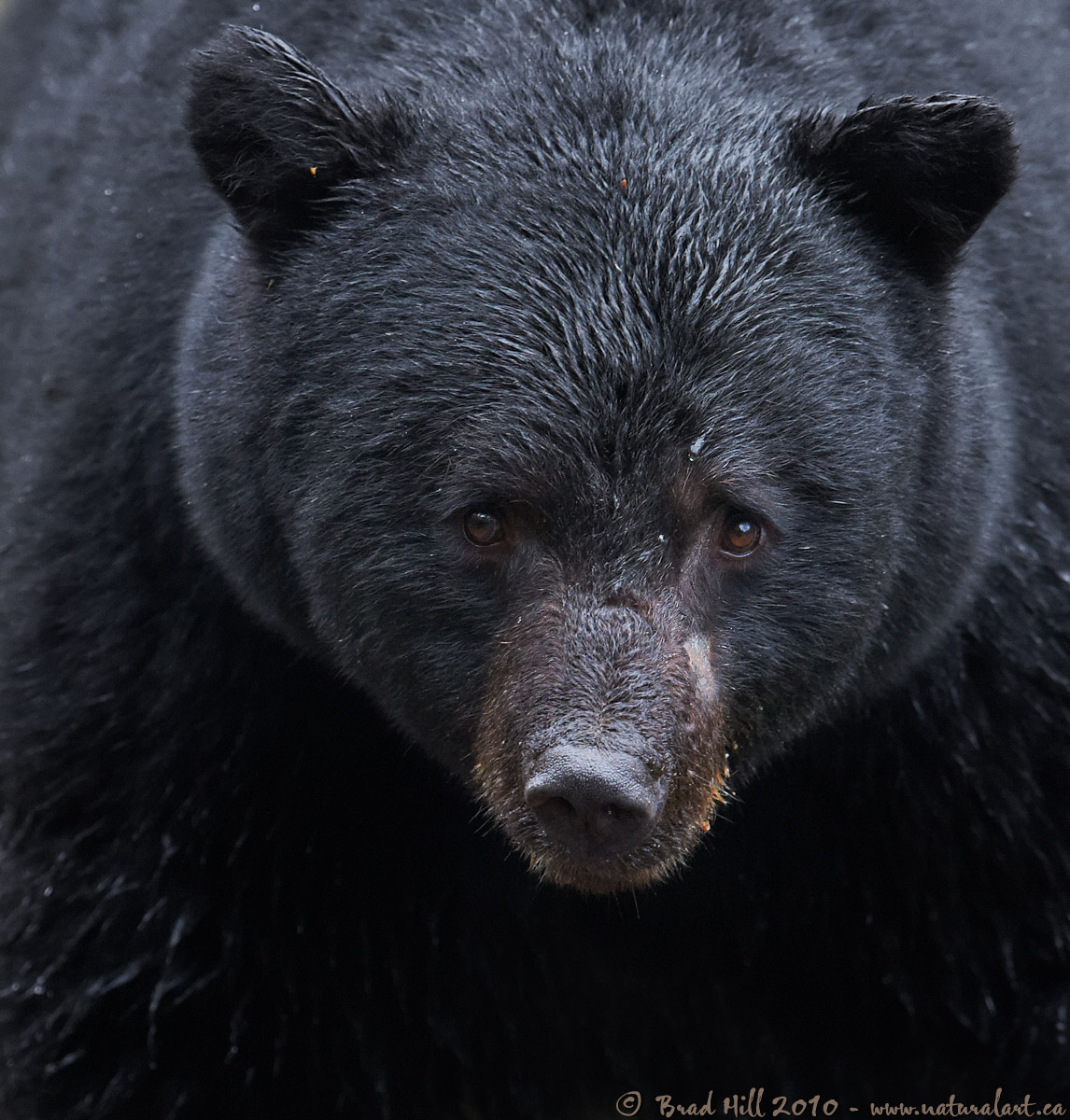
This shot from my recent (and annual) trip to the Great Bear Rainforest on the central BC coast. I've always found that capturing the eyes of a wild black bear in a way that shows some personality and "soul" quite difficult (compared to capturing the same with the eyes of a grizzly). So...capturing a tightly cropped shot of a black bear showing very "expressive eyes" was real high on my hit list for this trip. As it turned out we had very time to work with a black bear (maybe 10 minutes!!) but, as luck would have it, I happened to be in the right place at the right time (with the right lens on the right camera!) and as soon as I clicked the shutter I knew I had the shot I wanted. And, although several of my fellow photographer's disagreed, for some reason this bear's eyes conveyed a sense of sadness to me. Don't ask me why...it's just the feeling I got at the time of the image capture and returns to me every time I look at the image...
I've discussed the issue of "animal eyes" before, but since then we've acquired a lot of new regulars in the Fauna Gallery...so...
It's pretty much universally accepted among wildlife photographers that effectively capturing an animal's eyes, especially when they contain those bright sparkles known as "catch-lights", can be a big asset to a wildlife shot. But where should the animal be looking? I know of photographers that love to have the subject staring directly at them - I've heard it referred to as "full eye contact" and "direct eye contact" and even "perfect eye contact". But...I know of image BUYERS that immediately reject shots where the subject is staring directly at the photographer for exactly that reason - the animal is staring directly at, and thus interacting with, the photographer. In other words, the animal's behaviour is being directly affected by the photographer and is, thus, "not natural". Interestingly, in the case of THIS image I'm fairly sure that bear was NOT looking at me, but rather at something directly between us (and JUST below the field of view).
Then there are the situations where the animal's eyes are fully visible yet clearly not looking directly at the photographer - close, but not quite. And then there's the "eye-visible-but-looking-into-the-distance" style where the animal can appear to be looking almost pensive.
My view on "the best" eye direction? I have to admit I have no clear-cut favourite eye-direction myself - I find it varies with what I'm trying to accomplish with each image. I have some mammal portraits where the subject is staring so intently at me it appears to have a deep intelligence - I know of no other way to convey this feeling without having the subject looking directly at me. But, I have a number of other shots where the subject is looking into the distance in what looks to be a contemplative stare. And, I even have a few shots where the eye direction says a lot about the relationship between multiple subjects. The eyes can say an awful lot!
The take-home lesson? Probably just that if you have the chance (when you're working closely with a wild subject) try to capture several different types of eye contact - not JUST that full-on stare (and certainly DON'T reject a full-on stare if it's given to you - or in your direction. Capturing multiple types of eye contact could make the difference between selling an image (or just being happy with it!) and having it end up in the "reject" pile!
All comments and feedback appreciated. I'm particularly interested in what type of eye contact you prefer to shoot in your images or see in a wildlife image. As always, probably better to take a look at the larger version first...
Subject: Black Bear (
Ursus american kermodei) portrait
Location: Northern BC Coast (Great Bear Rainforest), Canada
Camera: Nikon D3s
Lens: Nikkor 600 mm f/4G ED-IF AF-S VR lens - supported on tripod. VR on and in "Normal" mode.
Exposure: 1/160s at f5. ISO 3200. -0.33 stop compensation from matrix metered exposure.
Crop: WAY more than normal (for purposes of discussion)...this about 40% of original capture ONLY
All the contextual information surrounding this shot (field notes, all camera settings and processing details, conservation, etc.) can be found at:
http://www.naturalart.ca/galleries/mammals/bears/detail_65.html.
Cheers...
Brad

Comments
19 commentsAlso, you said:
After seeing the title, I looked at the image wondering why it also gave me that feeling. In under a minute, I decided the following features lead to this anthropomorphic declaration.
1. Drooped left ear
2. Raised left eyebrow
3. Uneven Snout (sloping from right to left)
When you think about making a "puppy dog face" which is often synonymous with sadness, ears tend to drop, lips pout and eyebrows arch.
This does look great providing the large crop and high iso, the d3s seems like a great cam! Did you have a chance to test your D7000 yet on this trip?
Cheers!
I looked back at some of my photos of last year and the ones that people have commented the most about are probably the ones that have the bears looking in the direction of the viewer. For myself, I like to vary, I like the ones that the animal doesn't stare right at you and just going along, minding its own business.
I still love this one shot as presented.
I like the almost directness of the eyes; I wouldn't have been bothered by a totally direct look. While it may have originated as an interaction with the photographer, it ends as an interaction with the viewer. I think that is also an honest way to portray the interaction. Animals from the smallest butterfly up react to human presence, even when it isn't obvious. To portray it otherwise is disingenuous.
Once again, thank you for your dialog and your all too rare images posted here.
As for eyes, I personally prefer the ones, where subject is looking towards the camera, but not exactly into it and sometimes that far away look.
Sometimes, looking into the camera works very well because the viewer too experience the same thrill, which was experienced by the photographer. This is more true in case of predators.
Jagdeep Rajput
A few specific responses:
1. Luke: Wow, I didn't think to run the image through the "Acme Emotional Analyzer 3000" (is it available as an iPad or iPhone app??), but I can't disagree with your reasoning on the "sad" response.
You also asked about the high ISO and if the darker tones helped. Nope - if anything, shooting a black subject at high ISO's produces MORE colour noise. The highly textured surface of the bear's fur helps (i.e., it shows much less noise than a creamy smooth background), but ultimately the low noise here (and there was no noise reduction performed in post-processing) lies almost exclusively with the quality of the image sensor. With this camera dynamic range reduction with increasing ISO is often more limiting than noise - in this case I had to be very careful to not blow out the highlights on the nose pad of the bear (at ISO 3200 it blows out much easier than at ISO 200!). By the way, I often find thet cameras often struggle with WB after ISO 2000 or so. In this case the WB of the camera shifted towards the cool end of things, with the result that the bear had a blue tint to it. But this "problem" was easily solved in post-processing with a selective desaturation of the blues in the bear's coat.
2. Jorne: You asked about the D7000. I don't have mine yet - should get it in about a week and I'll start putting it through its paces then. I'm hopeful it will perform as well as it's specs suggest, but you never really know until you do some real field shooting with it...
Cheers...
Brad
I guess my AEA 3000 needs to go back to Acme for calibration (third time) because it said this was a studio shot, with an umbrella catch light in the left eye, negating any emotional response from the device.
I always see more emotion in the eyes after the fact in post than I do at the time of shooting. If I'm seeing the eyes in the viewfinder, I'm completely involved in the moment, concentrating on composition and execution of the exposure. My emotions are the "fly in the ointment", especially in very close encounters, that I'm focused on controlling. I like any and all eye contact.
Nice Work!
Neil
Ken Archer
On this image I like the closeup of the image and obviously the look the bear is giving but seeing the massive bulk behind the bear and the big head gave me a sense that this must be a very big black bear. Amazing creatures and I never get tired of looking at your bear images, great stuff.
Beautiful photo! Thank for kicking off the discussion on eye contact. In this case I see intelligence more than sadness (maybe we all see ourselves.
The eyes are a huge part of any image and I don't think there is a "correct" answer. I tend to like true candid shots where the subject is unaware that the photographer is present, but there are plenty of exceptions.
Peter
D3s in your hand is producing amazing frames.
cheers