Hey all,
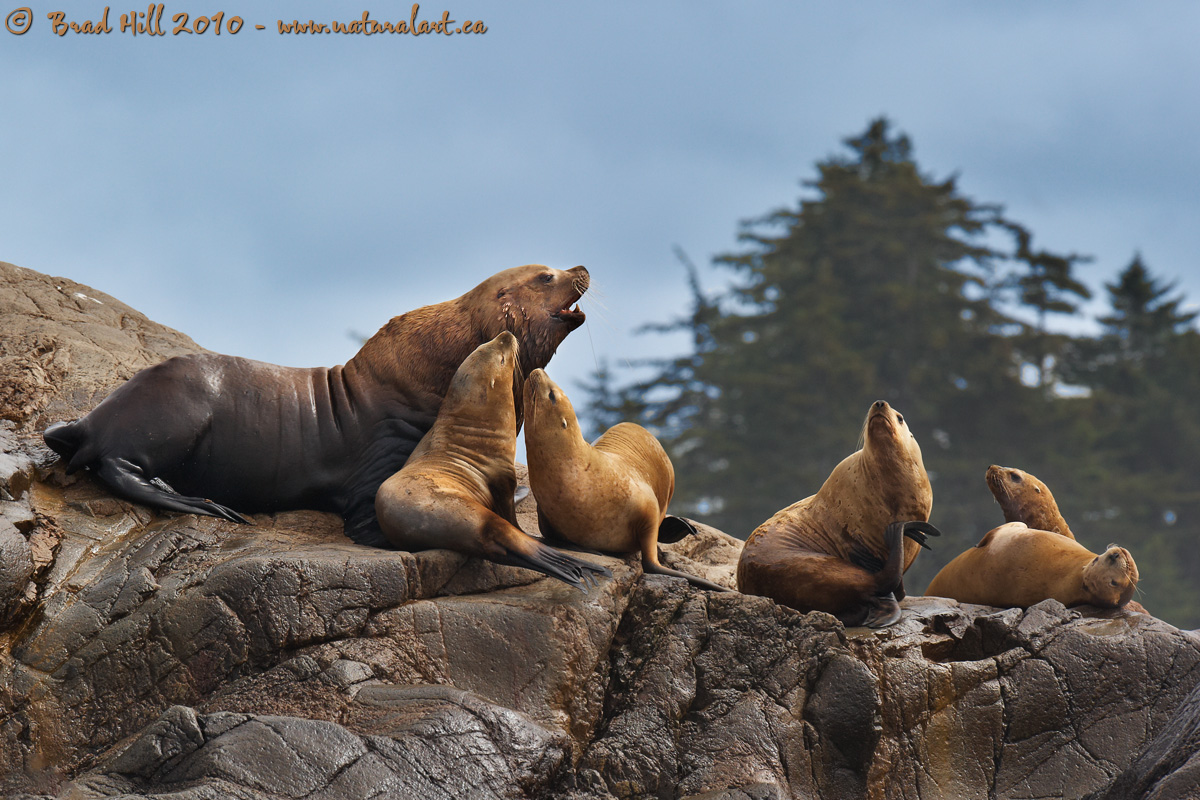
This is an image of a dominant male Steller's Sea-Lion bellowing and - at least outwardly - drawing the attention of a number of friendly female sea-lions. I've shown this image to a number of friends of the male persuasion and commonly get a response something like "...wow, I wish I could get THAT kind of response when I talk!". But if you look closely at the breeding system of Steller's Sea-Lions the saying "be careful what you wish for" definitely comes to mind...
Steller's Sea-Lions have a polygynous breeding system where a single, dominant male will have a "harem" of females. To acquire these harems males must claim a piece of rock against competing males, and pitched battles can take place during the "territory acquisition phase". AND, the male must continuously defend the territory during the several month breeding period. One consequence of this is that the breeding males will go months without feeding (and guys, there's no beer during this time!!), which is a major energy drain to the males. To make matters more challenging, the males defend the rock, not the females - and those females are free to go between territories and mate with whoever strikes their fancy. And what happens when the breeding "urge" begins to wane in the males? Well, the females then begin to actively solicit the attention of the males (as seen in this image), just to keep them in the "breeding way" (and without food - or beer) for even longer! Hmmmm...it makes one wonder who's actually calling the shots on these rocks, doesn't it?
What's the net effect of this prolonged period of breeding and fasting by the males? By the end of the mating season the males have lost hundreds of pounds and acquired a lot of battle wounds. Any effect on lifespan? You betcha - males live an average of 12 years, females up to 30 years!! So guys, next time you think of envying those "lucky" male sea-lions and the attention they get from "all their" females, you might want to think again!
Is there any point to all this rambling - any photographic lesson? Sort of - a little bit of an animal behaviour thing and a little bit of a "lying with photos" thing. While in the field I've seen countless situations where photographers have looked at - and snapped an image of - an animal in a specific situation and immediately concluded a LOT from that single instant in time (kind of like how the exhausted male in this image "has it so good"). When it comes to wildlife this can be REALLY misleading. And...even with ANY subject - and without ANY manipulation in Photoshop - it can be really easy to misinterpret what's going on from seeing only a single instant in time. Rant over!
Subject: Steller Sea-Lion (
Eumetopias jubatus) colony
Location: Off the northern tip of Vancouver Island), BC, Canada
Camera: Nikon D3s
Lens: Nikkor 400 mm f/2.8 VRII lens - handheld from inflatable zodiac. VR on and in "Normal" mode. Circular polarizer used
Exposure: 1/1600s at f7.1. ISO 640. -0.33 stop compensation from matrix metered exposure.
Crop: This is about 90% of original capture
All the contextual information surrounding this shot (field notes, all camera settings and processing details, conservation, etc.) can be found at:
http://www.naturalart.ca/galleries/latest/detail_6.html.
Comments and feedback greatly appreciated...probably better to view larger version prior to doing so...
Cheers...
Brad
PS: If anyone is interested - I've been shooting with a new D7000 for around a week and have posted my "First Impressions" of it on my website. Just go here:
D7000 - First Impressions
Comments
10 commentsCheers
RickT
You said:
Agreed. But I'm not 100% sure we should be envious of him either!
Cheers!
Brad
I just watched an episode of "Great Migrations" that show the battles of Elephant Seal bulls for breeding rights... the scars they come away with is unbelievable... blood everywhere. Imagine going through all of that and losing? No thank you...
As for the image...
1. You make an excellent point about misconceptions derived from one image, which can be extremely important when doing photography for conseravtion purposes. It's easy to spin it either way, and equally dangerous.
2. I congratulate you for getting the eyes of all of the sea-lions (even if there is no catchlight on some, the eyes can be seen) However, I'm a bit miffed on the BG... it looks washed out and almost as if there is a halo around the sea-lion/rock/trees. My guess is it was foggy in those areas which is creating the effect... it reminds me a bit of your mountain lion in a tree image which lacked in complete quality due to a P&S being used. Not to say this isn't a quality image....
There was fog, mist, and ocean spray in the background. All natural...no halos from tone-mapping or other digital manipulation.
Cheers...
Brad
Ken Archer
I'm seeing many frames within this frame.
Jagdeep Rajput
Microscopic nit: I'd clone out the oof branch sticking out of the male's back.
I like the texture of the rock and how all the heads of the females are angled toward him. Nice 3-D look to this one as well.