Being a decidedly NON-aquatic mammal myself, I'm always amazed by the environmental extremes that our distant marine cousins endure on a day-to-day basis. But, I suppose, their amazing adaptations probably put them in as much comfort as I am in my cabin as I write this! But I'm not envious of having the several inch layer of blubber that provides the warmth needed to live the aquatic life...
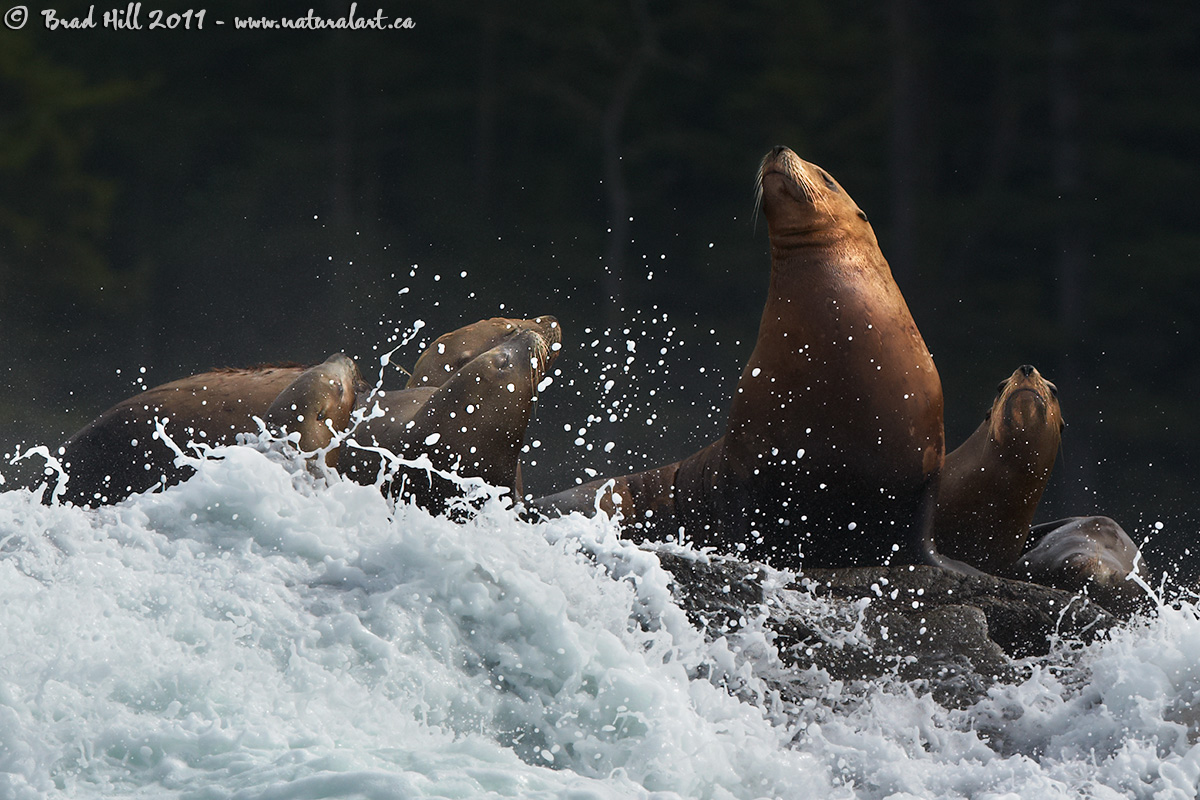
This was a really fun shot to capture. We were pitching up-and-down and side-to-side in a small Zodiac and there was a real "ride 'em cowboy" thrill associated with the outing. The only real "tricks" associated with the image capture were ensuring one used high enough of a shutter speed to counteract the effects of shooting from such a non-stable platform and exposing the image in a way that retained the critical highlights in the white, foamy water.
I struggled with how to crop this image for web presentation where the maximum pixel dimensions are 1200 pixels on the long axis. My preferred crop for PRINT use on this image is about 95% of full frame and includes two more sea lions on the right side of the frame than the crop here does. While the two additional lions don't add a lot to the image (and some would argue they detract from it), the larger crop has a nicer diagonal feel to it and, at least to me, feels (and almost smells) saltier and "more coastal". But…when I took my preferred "print crop" and reduced it to 1200 pixels the image just didn't work for me. The main reason for this (for me) is that while the primary subject (the uppermost sea lion) still stood out nicely, what I considered the secondary subject (or supporting actor!) in the shot - the sea lion to the immediate left of the primary subject that is partially obscured by water droplets - just wasn't predominant enough in the image. So…I settled on this crop for web use - it represents about 65% of the original image. I've long thought that there is rarely "one crop that fits all uses" and that to make images look their best one has to consider the medium that is being used to display the image - what works best for a print is often NOT what works best for online use.
Subject: Steller Sea Lions (
Eumetopias jubatus) on haul-out rock
Location:Northern tip of Vancouver Island), BC, Canada
Camera: Nikon D3s
Lens: Nikkor 400 mm f/2.8 VRII lens - handheld from Zodiac inflatable boat. VR on and in "Normal" mode. Circular polarizer used.
Exposure: 1/1600s at f7.1. ISO 250. -0.67 stop compensation from matrix metered exposure.
Crop: This is about 65% of full frame image
All the contextual information surrounding this shot (field notes, all camera settings and processing details, conservation, etc.) can be found at:
http://www.naturalart.ca/galleries/detail_2.html.
Comments and feedback greatly appreciated...probably better to view larger version prior to doing so...
Cheers...
Brad

Comments
15 commentsThe full colony was somewhere around 400 animals - extremely impressive (but incredibly smelly!
Cheers...
Brad
Great image and now I'm off to read the details on your site
BTW, this might be one of my favorites of your work.
The circular polarizer was used to kill reflections (and thus "hot spots") on the fur of the seals PLUS on the wet rocks. In this shot the rocks are hardly visible, but this is only one shot of a sequence and in shots before/after this shot more wet rocks (and potential reflections) were visible.
RE: Your comment: "BTW, this might be one of my favorites of your work."
Thanks Lon - appreciated! Personally I really liked this shot as soon as I saw the raw file and it is DEFINITELY climbing up my list of personal favourites. But I honestly wasn't sure how much of my own feelings were simply due to the memories it conjured up (it was just so much fun shooting this!!) versus the quality - or lack thereof - of the shot.
Cheers...
Brad
Ken Archer
I do prefer the first post.
Mauro
Ron Huff
Cheers, Luca