Flap Necked Chameleon C
by Stu Porter
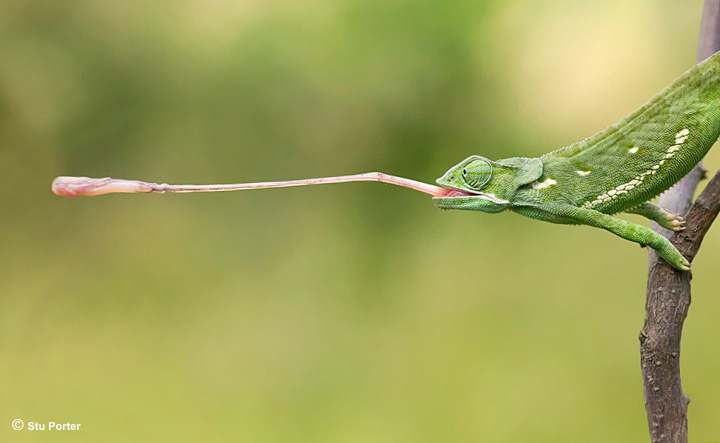
These Chameleons are quite common in the Lowveld area of South Africa. Although you may encounter them in the wild, a feeding shot is very difficult. This specimen was photographed in a captive situation at a Reptile Park near the Kruger National Park. The curator of the park stood out of view with a cricket strategically placed on a stick.
The tongue action is extremely fast, but quite easy to predict as both eyes focus on the prey for a second or two before the tongue is shot out. A number of attempts were needed to capture the tongue in full stretch, even with 10fps, !!
Canon 1d MK4
120-300mm Sigma 2.8
1/5000 sec
f5,6
ISO 4000
Manual mode
The noise level at 4000 ISO was not that bad but noticeable, so I put the image through a Topaz Clean filter

Comments
8 commentsWow! Shot at 4000 ISO!!! Anything above 500 ISO on my 7D and I know I'm going to have serious noise issues ;^. In order to save for the 1D MK4 I'm gonna' need to have to start earning money again, so I'll have to make the most of my 7D 'til then ;^)
Very much looking forward to seeing more of your images, all the best :^)
Ashley
Fascinating shot, that tongue looks like the leg of a wader. The framing doesn't really work for me though - it's nice to see the whole tongue, but the way the body and the branch are cropped looks a bit awkward.
Did you get any with the bug?
The tongue action on these guys is very fast ! , they say it can accellerate at approx 25 body lengths per second ! so even with my 10 fps it was up to lady luck. It is one of those situations where you cannot predict the shot but have to rely on the animals behaviour to give you a small clue and a rough starting point. I only got 2 shots out of the whole sequence, the one I posted first and then one with the tongue coming back with the cricket (new post) in fact one of my clients got the best shot of all taken with a 5D and he only took a single shot ! so 10fps is not everything - especially in the Chameleon world :)
thanks again
Cheers, Stu
All the best,
Ashley
While I appreciate how you've overcome the technical challenges (with perhaps a tad of luck!) in capturing these images, I have to admit I'm most amazed by this amazing behavioural (and morphological) adaptation than anything - really a fantastic thing to "see" in action.
I find the second image even more compelling - seeing the successful result, along with the curve in the receding tongue, adds much more visual interest for me.
Well done on these - great addition to the gallery!
Cheers...
Brad