At Peace in the Great Bear Rainforest
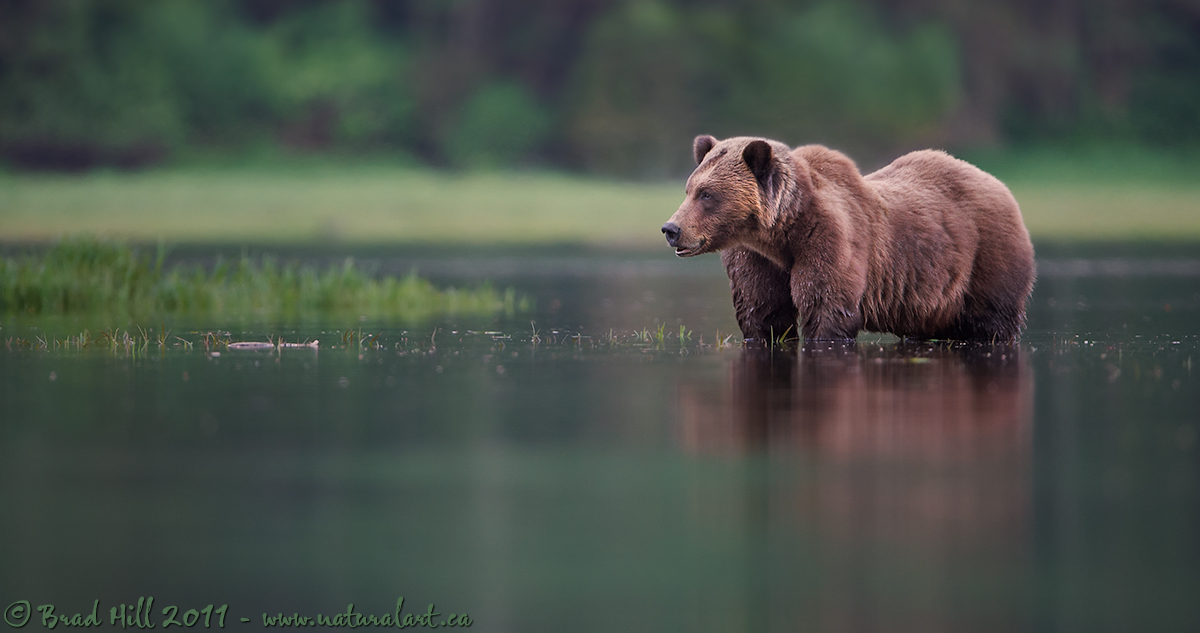
Sometimes the simplest looking images are the toughest to pull off! To me this shot just screams "Great Bear Rainforest" and goes a long way towards explaining why I return to the Great Bear Rainforest on an annual basis. As the largest remaining tract of temperate rainforest left on the planet (and virtually the ONLY one with all "original" members of it's historical ecosystem still present) it's just so spectacular and there's ALWAYS something new to photograph there.
I've had this shot (or one similar to it) sitting in my head for a LONG time - but it took several trips into the rainforest (over several years) before I actually got the opportunity to capture it. Between getting the soft light right, having a bear in the right spot, having the tide sitting at just the right level, and, of course, having the right gear ready to go...well...if you're persistent, eventually the planets have to align - right?
This was one of those
very fortunate times when what I was
forced to do (by the physical/technical constraints) perfectly matched what I
WANTED to do with a shot. In this case, that basically meant shooting with the aperture on my lens wide open. I HAD to do this simply by the low levels of light - combined of course with my need to find as much shutter speed as possible - I shot this image while hand-holding a 600mm lens from a floating Zodiac and you don't want to pull that trick when shooting at a shutter speed of 1/30s! I WANTED to shoot wide open to throw virtually everything in the image out-of-focus except the subject - I wanted the foreground and background as soft as possible to make the bear stand out (or "pop") AND to give the image a dreamy feel.
Subject: Brown Bear (
Urus arctos) wading in estuary at high tide just after sunset
Location: Khutzeymateen Inlet (Great Bear Rainforest), BC, Canada
Camera: Nikon D3
Lens: Nikkor 600 mm f/4 VRII lens - handheld from floating Zodiac
Exposure: 1/200s at f4. ISO 1600. No compensation from matrix metered exposure.
Crop: This is about 95% of full frame horizontally - cropped to pano equally from top & bottom.
If anyone's interested, I discuss some of the issues of using a thin DOF while shooting animalscapes right here on my website:
http://www.naturalart.ca/galleries/latest/.
(just click on the "In the Field" tab under the image to see the discussion).
Comments & critiques welcomed. Probably better to view larger version first...
Cheers...thanks for looking...
Brad

Comments
31 commentsCouldn't be better..
Sandy
Glad you like the image - I only re-discovered it a few days ago (it's from 2009). One of those images where the preview of the raw image (in Lightroom and Bridge) looked awful but the minute I put it in my raw converter it was "ahhh...I remember loving this through the viewfinder...".
Anyway...you ask:
Yes, but only very light sharpening...
Cheers...
Brad
Ken Archer
Jagdeep Rajput
Max
Just some responses...
Ajit - you asked:
Hmmm...doesn't look bang in the middle to me - I'd say upper right!
Max: you said:
A 600mm tilt-shift lens! Man, I don't even want to THINK about what that would cost! Ouch!
Cheers...
Brad
BTW What's your thoughts on horizons cutting through the subject? Just curious on peoples take on this.
TFS
Steve
Ron Huff
Beautiful.
Phil.
1. Thanks to all! This image worked pretty well for me and it's nice to see that others like it too...
2. Steve - you asked:
I can't say I have a "firm" guideline - it varies with a lot of factors. Obviously I don't like to see a sharp horizon bisecting the head of a subject, but if the background is quite soft and out-of-focus I think it doesn't necessarily "kill" an image. In this image, for example, two lines (I hesitate to call them "horizons") intersect with the bear's head, but based on the feedback on this image I think it's safe to say that for most it didn't harm the image too much. I think sometimes as photographers we can get a little too fixated on "rules" or guidelines that can get in the way of appreciating (or even noticing) the gestalt of an image - sort of a "can't see the forest for the trees" thing. I think if about 99% of the images published in National Geographic got posted here first they'd get panned - yet obviously someone likes them (and someone else is making money selling them!).
Hope that answers your question...cheers...
Brad
PS: Don't get me wrong - I think there's value to discussing things like "horizons cutting subjects" and also in seriously critiquing images...but I think at the end of the day we have to remember that "dissecting" images based on arbitrary "principles" that are ultimately rooted in personal aesthetics is just an exercise...