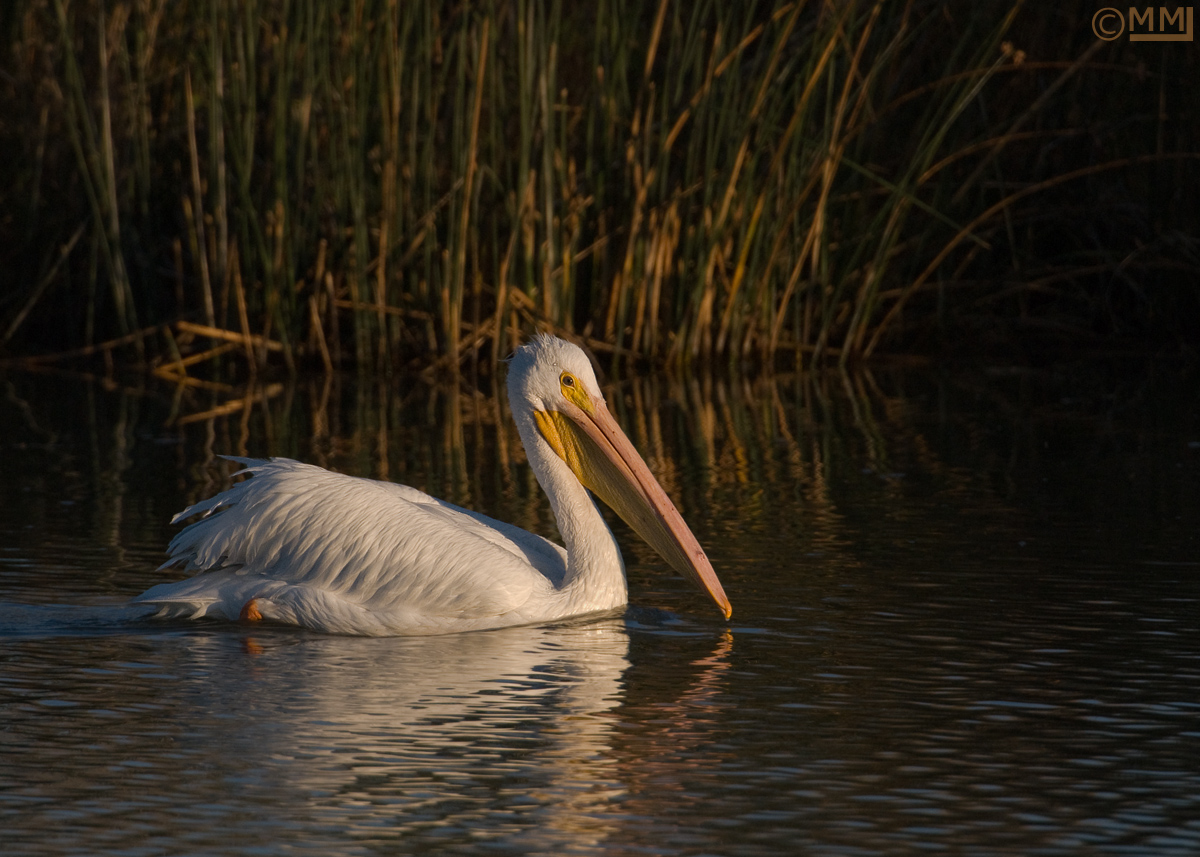
American White Pelican
by Mia McPherson
Pelecanus erythrorhynchos
I love how this pelican looks like it is in a spotlight because of how the early morning light fell on the bird combined with the dark green and golden rushes in the background.
This was taken in northern Utah. Nikon D200, f7.1, 1/1000, ISO 400, -1.0 EV, 200-400mm VR with 1.4x TC at 400mm, natural light, 74% of original frame, not baited. I did not artificially darken the background in this image I just had a very good setting and light. This pelican was floating by in and out of the shadows so I had to keep adjusting the EV, if I had not gone to -1.0 this pelican's whites would have been blown out. Larger version provided for evaluation of sharpness and details. Minimal post processing including rotation adjustment and smart sharpening.
As always, I sincerely appreciate your comments & critiques, thank you for looking.

Comments
22 commentsNice!
Sandy
Without a doubt this is a beautiful image with superb lighting :^)
I do have a question for you if you will:
Although I've had a couple of people address this issue for me, I'm still not completely sure I understand how this works. Working on the assumption that you were shooting with aperture priority, if I'm reading this scenario right, by adjusting your EV down to -1.0 you effectively increased the shutter speed, is that correct?
In upward of 80% of my photography, my main challenge always seems to be in acquiring a fast enough shutter speed while on aperture priority, as most of my subjects seem to be in low light settings, so invariably I chose to take the exposure compensation up to +2/3 or, sometimes, even more to allow more light in the image.
The left and right lobes of my brain have been battling this one out for a while now; logically speaking, decreasing the exposure compensation in darker lighting situation sounds counter-intuitive to me, all the same, the concept does seem to make a little sense to my creative mind, although I don't seem to be able to put my finger on a precise reason why.
Any thoughts or suggestions on this would be greatly appreciated, thanks in advance :^)
Ashley, thanks for your comment and question. I do shoot in Aperture Priority almost all the time. I didn't use -1.0 EV compensation though to increase my shutter speed, I used it to help control the whites of the pelican that had bright morning light on it and a dark background behind it. My choice of EV compensation controlled the whites well and probably made the background a little darker than it actually was, but I don't find that objectionable for this photo and it may have added a little more to the dramatic lighting. Without using negative EV compensation that big pelican would have had most of the whites blown.
Yes, using negative EV did increase my shutter speed, but I sure wouldn't have needed it for a pelican floating by. I have seen images where someone has used negative EV compensation to gain speed that then made the subject dark and when they process the file and lighten the subject it ends up introducing excess noise. I think it is better to increase ISO or change your aperture to gain shutter speed. Just my opinion.
I like photograph in low light and challenge myself to do well at it. I've quite a few low light images in my NPN gallery. I also believe in processing them for what they are, low light images and not try to make them something they aren't. I also do not use flash on birds so that can make it even more of a challenge.
Your 7D handles higher ISO's better than my D200 so you should be able to gain shutter speed quite easily .
Proper exposure is proper exposure, no matter how you get to it. I've learned through 40 years of experience with Nikon cameras that I can generally trust the Nikon meter to determine the correct exposure. I also know when to make adjustments from the meter reading as Mia has done with this image - dialing in some amount of negative compensation to keep the whites in the image from being overexposed. This is unrelated to the metering mode used: exposure compensation works the same in either aperture priority or shutter priority. Like Mia in this case I shoot in Aperture Priority mode almost 100% of the time. I usually keep the aperture wide open (or stopped down 1-1.5 stops) to minimize depth of field and to maximize shutter speed (determined by the camera meter for the aperture I've set and the amount of light). If the resultant shutter speed isn't fast enough for the conditions (and I know that by seeing the shutter speed reported in the camera viewfinder) then I open the lens farther if possible, or I increase the ISO, or I don't take the shot. I would never mess with exposure compensation to increase or decrease shutter speed as it changes exposure while changing shutter speed.
The problem with shooting in shutter preferred mode is that the camera can run out of aperture if the shutter speed you set is too fast when the lens reaches the maximum aperture value. What happens then depends on the camera and the options you've set. Since I've never had to deal with a Canon camera I don't have a clue what it does in this case.
There's a basic contradiction in this statement. Using plus compensation will increase exposure, making the image brighter overall, but it will reduce shutter speed for the set aperture. If you need more shutter speed to freeze motion or because you are trying to handhold the lens then using plus compensation just makes the problem worse.
Low light settings in no way imply the need for positive exposure compensation. Your camera light meter should be reading the scene and (in an automatic mode like aperture priority) creating a combination of SS/fstop/ISO that accurately exposes the scene, regardless of whether you're in a bright or dark scene. The camera, in finding the correct exposure, is already choosing to let in more light in a dark scene and less in a bright one.
The need for exposure compensation comes into play in situations like Mia describes (and illustrates) in this image, where your subject requires a different level of exposure than the scene as a whole. Mia's bright subject requires a lot less light (and therefore a narrower aperture or higher ss or lower ISO) than the dark bg, and since she is most concerned with exposing the bright subject properly, she used negative compensation, letting in less light and preventing the whites from being blown.
I'd strongly recommend reading a book on exposure and working this all out in your head so that you don't miss opportunities in the field.
One of the reasons I've been looking for ways of increasing shutter speed in low light conditions without vamping up the ISO, is that contrary to what most believe (and I'm assuming you haven't actually had practical use with a 7D yourself Mia, though please correct me if I'm wrong in this assumption!), the 7D, as good a camera as it is in every other respect, does not handle noise issues well at all with ISO settings above the 4-500 mark.
I know I'll also have noise issues to deal with when shooting in shutter priority (as I do quiet often now, while not raising the ISO to more than 400) and, now that I have this confirmed, should I also lower the exposure compensation, but I've acquired a greater level of consistency with sharper images shot in shutter priority than I have in aperture priority even when I vamp up the ISO; in other words, in both cases I'll be having to deal with noise in PP, but at least in shutter priority I'm more confident of freezing the subject and attaining a greater level of sharpness and detail ... as long as the image doesn't come out too dark.
Please don't see this as me trying to contradict what you're saying Mia, as that's certainly not my intention and, in truth, knowing that seasoned photographers like you, who create such excellent work, are always working with aperture priority makes me feel that for all I've said I'll still be better off practicing in aperture priority as much as I can, which I will ... although until I've figured this out better I'll probably still opt for shutter priority in a pinch for reasons stated above ;^)
I really can't help you with the issues you are having in shutter priority because I use aperture priority almost all of the time. Aperture Priority works for me and I think that it shows in my images. Manual works for some people, shutter for others. Basically I believe people use what they are comfortable and proficient with and quality images can be produced from any of them. In any case, practicing is critical for becoming proficient enough with all the technicals for producing quality images consistently and always advise photographers to "practice, practice, practice".
Many thanks Richard and Brian for your additional input.
For the record, I've read more than 15 different books (a few of them more than once!) specifically on the subject of nature and wildlife photography and, though through studying these and practicing the things I've learned I've definitely improved my technical skills, the one area that always seems to confound me in practice is handling exposure in pretty much any light situation other than that given by relatively strong but diffused daylight that filters through an overcast sky.
Much of what you guys and Mia pointed out I do understand, but trying to get my head around some of the finer aspects still appear to be a little beyond me, and trying to articulate these things in particular, so that any of you might be able to address them for me properly, is also something of a challenge and frustration, as last thing I want is to drive any of you nuts by repeating the same things and having you think, “Why can't he get this through his thick skull?!?!” ;^.
I will be investing even more time in studying the chapters on exposure in the books I have and experimenting in the field; one thing I am confident of is that one day, in the hopefully not too distant future, all this will suddenly click into place.
Sincere thanks again for taking the time to try and help me understand all this better, and if I'm not completely there yet in my understanding, please note that this is down to the way my brain works, not in the way the three of you have endeavoured to explain things ;^)