Intrigued
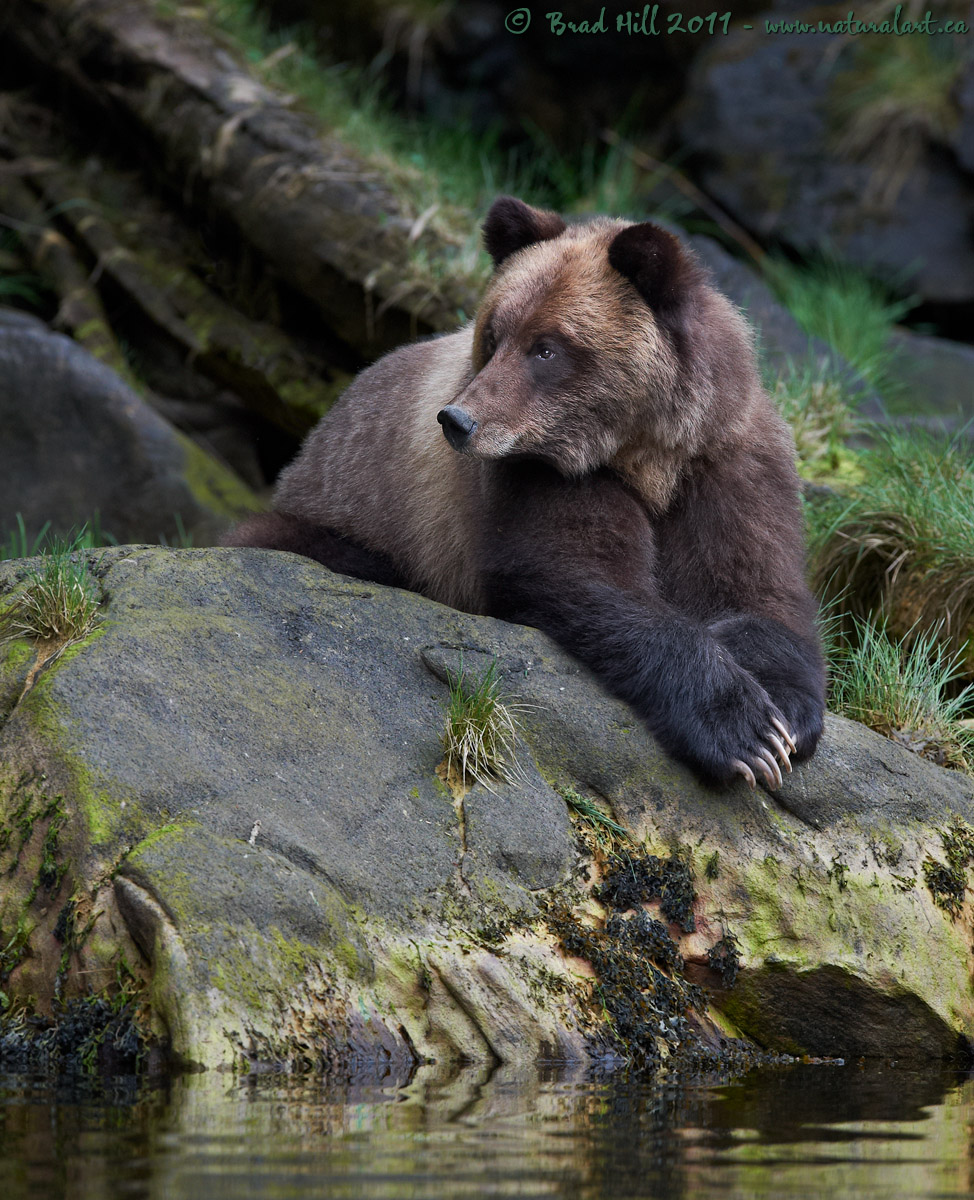
During my visit to the Khutzeymateen Inlet in the spring of 2011 we had a lot of gentle, "cooperative" bears to work with (along with a few "testier" individuals of course!). I found this female grizzly amazingly attractive (settle down Willy - I mean "attractive for a bear!") - just a fantastic range of browns on its body and with those tones arranged in a very pleasing manner (great markings!). Plus it had the most compelling eyes...!
This image was shot after sunset - we were watching the bear work the shoreline and then it decided to come to rest on a rock not far in front of us. For the bulk of the time the bear was resting on its big paws and dozing off - which clearly told us the bear was VERY comfortable with our presence. At one point, though, the bear sensed something new in its perceptual world and quickly raised its head and appeared absolutely intrigued by "something" in the distance for a few seconds. I found the pose irresistible and snapped off a burst of shots. To me the natural composition worked very well - everything from the leading lines (towards the head) provided by the background logs through to the beautifully "adorned" rock (and of course, the soft water in the foreground.
My input into the production of the image? I mentioned above this image was shot after sunset - so think low light. While I generally subscribe to the "always minimize ISO" philosophy this is one instance where I actively decided to let the ISO climb up to moderately high levels (ISO 2000). Because I was using a fast prime lens (400mm f2.8), I COULD have opened the aperture up wide and shot this image at quite a low ISO (500 or so) while still maintaining a hand-holdable shutter speed. But, to my eye, the success of this image was totally dependent on keeping the ENTIRE bear and the ENTIRE rock in sharp focus - which meant stopping down (in this case, to f5.6). And, the only way to do this while keeping the shutter speed hand-holdable was to "give" on the ISO. And that, in a nutshell, is the reason I REALLY like shooting with cameras with good high ISO performance - they allow you to really "own" your aperture and depth-of-field and thus give you so much more creative control over your final image.
Another comment on this image: with today's best cameras it is possible to shoot far more scenes in dim or near-dark conditions. If you "let" your camera's light meter "do it's thing" (especially when using Matrix or Evaluative metering modes) the end result will often be a scene FAR brighter than you observed (i.e., they can pretty much turn twilight into daylight, and the camera WILL do this if you let it). So...if you want to maintain the soft, low-light look you often have to UNDER expose the image (either in-camera or during raw processing).
A final point: During my Khutzeymateen Photo Tour (where this image was captured) I used it to demonstrate some post-processing techniques to the participants. When I was done someone made the comment "I'd clone out that stick near the butt." I have to admit that while I take great care to create "clean" captures, I don't think in terms of removing things in post-production, Nonetheless, I decided to follow the "advice" on this image and something HAS been digitally removed (NOT using the clone tool!

). Which leads to:
FEEDBACK REQUEST: Besides general feedback on the image, I'm particularly interested if:
1. You would have noticed the digitally removed "objects" in the original capture and that they would have negatively impacted on your thoughts about the image, and...
2. Do you think the average layperson (not the hyper-sharp image critiquers we have here) would have thought less of the image if I had not removed the "offending" objects??
Honesty appreciated - there is NO right answer to this one!! Original image (without objects removed below). I'm only curious about the aesthetic issues here, not the philosophical ones (but free to say whatever you want!).
Subject: Female Brown Bear (
Urus arctos) intrigued by something!
Location: Khutzeymateen Inlet - Great Bear Rainforest, BC, Canada
Camera: Nikon D3s
Lens: Nikkor 400 mm f/2.8 VRII lens - handheld from floating Zodiac
Exposure: 1/250s at f5.6. ISO 2000. No compensation from matrix metered exposure.
Crop: About 85% of full frame
As usual, more info about the image (including more processing details, etc) available here on my website:
http://www.naturalart.ca/galleries/latest/detail_3.html.
Cheers...thanks for looking...
Brad

Comments
19 commentsCheers...
Brad
To answer your questions:
1) I could not see any digital alterations on the first image but I am curious how it was done (if not clone tool, maybe healing brush)?
2) I do not think the average person would of even noticed, my eye went right for the bears head (eyes, muzzle) then down to the paws and around the rest of the image. For me the branch was not that distracting.
More to the topic at hand, you more than did her justice. Great capture, great decisions in the field, and wonderful pp as always.
Yes, I definitely would have noticed the stick and if I were so privileged to call this image mine I would have immediately cringed at that element, particularly because of how stunning your subject looks and the desire to not have anything detract from that. I likely would have tried burning the highlights and mids on it before removing it as Mark suggested (I assume he meant burn not dodge?) before cloning it out, but I definitely prefer it absent.
Great light and texture on the rock, too, and nice portrayal of her environment.
Really nicely done.
Still a fantastic image.
First of all, like the pose, the low-key effect and the mood !
As for this much and this kind of the cloning, I'm as comfortable as this Bear is.
As for your second question, I believe it might have been noticed by negligible percentage of general viewers.
Jagdeep Rajput
Gorgeous image BTW. The pose is great, as is the bear's coloration.
Sadly neither removals would be acceptable in 'high end' comps.
Overall, like the image, good results in daunting light situations. one cool & relaxed bear.
Steve
Seriously, the immaculate condition of her coat along with the pose, the look, as well as the natural surroundings and good choice of DOF all make for a truly wonderful and memorable portrait :^)
As to my answer to your questions, I reckon you know me well enough by now to know my thoughts on this ;^) Yep, of course I'm solidly in the camp supporting the decision for that eyesore of a twig being removed, I also like that you removed the light piece of grass from her right paw and, if this were mine, I would have gone a touch further by removing the two tiny white flecks from her left ear, which only become really noticeable in the larger version.
Can I detect any of your handwork in the two (if there are more, can't seem 'em!) removals? Nope, not a trace.
Loverly image Brad, my favourite of all the Bear shots I believe I've seen of yours thus far. Looking forward to seeing more soon :^)
While I agree the bear literally needed the stick pulled out of its a**, I'd say 1 out of 100 nonphotographers would notice. The problem I have found with print sales, is everyone is professional photographer these days. So there I have seen an increase in the number of clients/lookers looking for more distractions/imperfections.
Thanks for the feedback - appreciated. And the consensus seems to be that most prefer the "cleaned up" version, but think that most non-photographers would likely have never noticed the stick (or bit of grass) in the first place! Given that photographers almost never buy images anyway (not totally tongue-in-cheek) I think there's a message in there somewhere!
A few specific responses:
1. Jim H: You said/asked: "...if not clone tool, maybe healing brush?" Strategic exposure adjustments supplemented with two small "dabs" of healing brush (but NO cloning!)
2. Steve K: You said: "Sadly neither removals would be acceptable in 'high end' comps." I normally don't make such removals anyway (and feel compelled to disclose it if/when I do), but I have to say that what competitions allow or don't allow is of little concern to me (I'm not one to stand in line to give away the rights to my best images for free).
3. Tony G: You said: "The problem I have found with print sales, is everyone is professional photographer these days." In today's world of digital photography there has been a reduction in the barriers of entry to those wishing to join in the "fray" of monetizing their images and it could be argued that this has depressed the market somewhat. And get this - I actually heard a rumour that even some executives in the oil drilling industry are moonlighting as "professional" photographers - can you believe it??? The nerve!
Cheers...
Brad
PS: Sorry Tony - I COULDN'T pass up that golden opportunity - and I know you wouldn't have either!!
Reason I ask is that I've frequently pondered what would be the right thing for me to do once I'm ready to start selling my own work, and I've yet to decide what's the best route to go. While I certainly don't wish to deceive anyone, I also don't want to blow my chances of making a sale because I offered too much information on what I may have done in post processing with a particular image that might cause a potential buyer, who at first glance liked the picture enough to want to own it, to change their mind thinking, "This is too 'doctored' for my taste."
This is a GREAT question. You have to make the decision about where you stand on this yourself, but here's what I do: All images I sell (be they Limited Edition Prints or stock images or used for any other form of sale) end up on my website. The sale of ALL Limited Edition prints are accompanied by a Certificate of Authenticity which lists the URL for the location of the image on my website. Additionally, at all galleries where my images are on display (with the exception of an exhibit I was just involved in that toured Japan, which I had no control over) each image has the the URL for the image on my website. So...if they go to my website, they will find the following style of information IF an image has any "manipulation"performed on it (and I DON'T tend to be one who regularly clones anything on my images:
"Alert - Digitally Manipulated Image: This image clearly crosses the line from simple digital correction to digital manipulation. During post-production I digitally removed (NOT using the clone tool!) a branch near the butt of the bear and 1 piece of grass off the bear's fur."
Example: For this image, go here:
http://www.naturalart.ca/galleries/latest/detail_2.html
Click on the "In the Field" tab below the image and you'll see that message.
Of course, if I'm at a gallery show where my images are being shown and someone asks me I readily disclose exactly what was done to the image - after all, I HAVE to be honest because they can check on my website!
If they don't check my website? Well, I can only go so far in being honest and provide full disclosure - it's not like I feel compelled to chase them down and tell folks if they don't ask!
Note that this is the standard I impose on myself and I feel good about it - but I do NOT feel it is my place to even imply others should do the same. In a way, though, it is DOES become a part of your brand statement...and in this day and age branding is pretty critical.
I hope this helps - thanks for the great question and my response is NOT intended to offend anyone else who feels differently about the amount of liberty they should be able to reserve for themselves as an artist.
Cheers...
Brad
The removal of the branch does improve the image and I also feel that most people would not notice it anyway. Certainly most would not notice the blade of grass.
She was obviously tired of posing for the photographers by the time we got there
Great capture and thanks for the details,
André
And just to defend what little honor I have....my print sales rival my day job's pay, so I wouldn't call it moonlighting. Man I really need to get back up there, see the bears again and have Tom to help rake you over coals for our amusement.