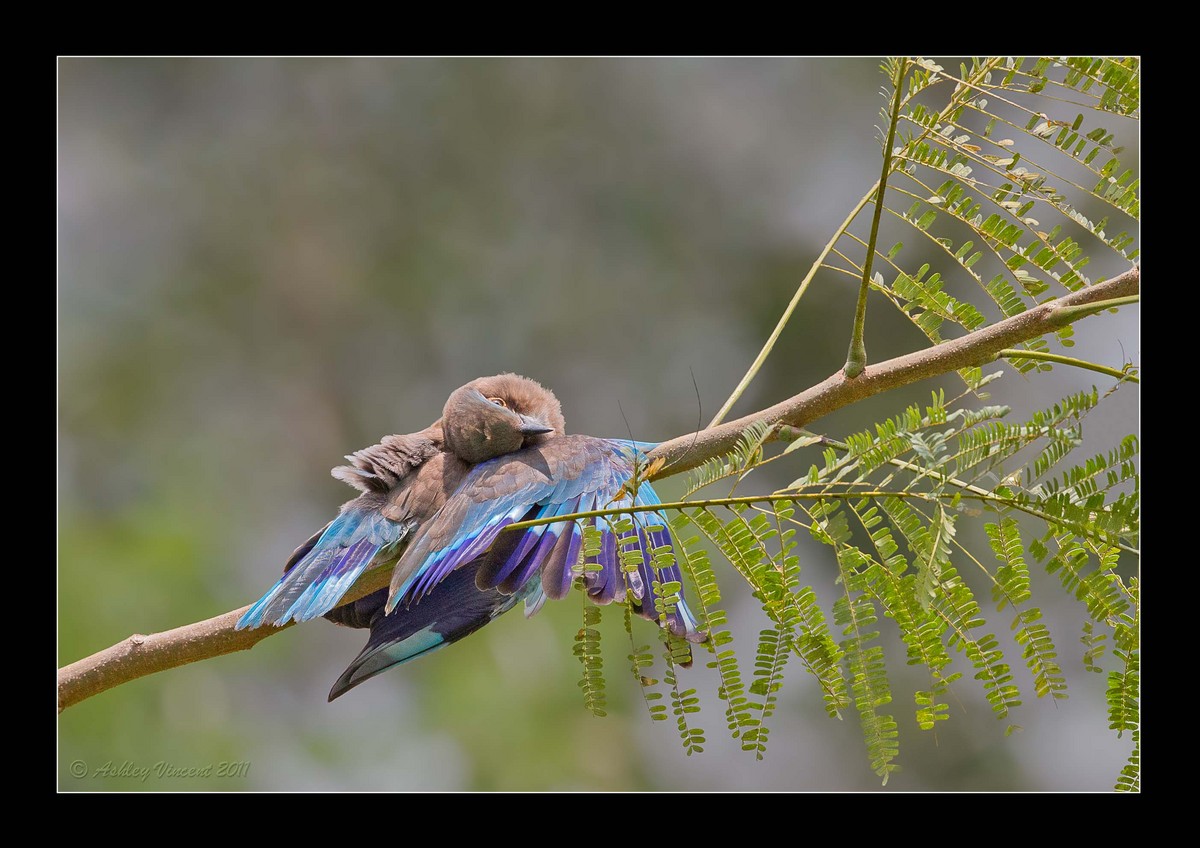
Trying to Blend In
by Ashley Vincent
Canon EOS 7D, EF 500mm f/4L IS USM, Aperture Priority @ f/7.1 (1/1600 sec), 0 EV, ISO 800, Tripod, JPEG from RAW, Cropped 50% from Full Frame
Subject: Juvenile Indian Roller
Situation: Aside from the obvious benefit of getting to know your chosen subject's behaviour better the longer amount of time you spend with them, which further increases one's fascination and overall appreciation, another benefit I've discovered as a wildlife photographer is having the opportunity to capture images that more casual observers will seldom if ever get to see.
Over the course of few days back in April, I had the pleasure of spending a good number of hours with this particular juvenile Indian Roller, who was mostly hanging around for one of it's parents to return with something acceptable to eat. As with other juvenile bird species I've come across, this one didn't seem bothered at all by my relatively close proximity, so I had plenty of time while waiting to see if it would offer me some other kind of pose that would result in something slightly more captivating than the one we all know as “Bird on a Stick” ;^)
Naturally I was more than happy with this display, although for the life of me I've no idea what it was trying to do; it might having be attempting to rub it's eye or perhaps scratch it's head with it's shoulder, then again, it may have been trying to catch a few rays from the sun and improve on it's tan. But the impression I came away with that pleased me the most was thinking it was trying to blend in with it's surroundings as though to make itself inconspicuous and hidden from sight, but with only one thin leafy twig to work with it was no easy task – LOL :^)
I don't always make a point of explaining what I did to an image in post-processing, however, in this case I'll make an exception. I had a great time taking many shots of this behaviour and was sure most of them would come out great, but I was less than thrilled when I saw them in large on my computer. This one you see here was my favourite, due to the fact I could see one of the subject's eyes, so I decided to work on the image to make the most of it's potential best I could.
I can't recall how long I spent on this one, but it was a considerable amount of time to spend on any one image, although once I'd begun I just couldn't give up. The most challenging part was making a selection to isolate all those tiny leaves, which I needed to do to make sure the NR I wanted to apply would only be on the background; painstaking work I have to say. I've since purchased a software programme from Topaz called ReMask, which would have made comparatively easy work of such a selection.
Anyhow, as you can see from the original version I'm posting below, I ended up doing a lot of work on this to create the most pleasing image to my eye, which included cloning light patches in the background that I found too distracting (though no doubt there'll be some of you who'll disagree), sharpening up the subject and perch as well as the leaves, and lightening up the eye.
I know this kind of work goes way beyond what many people feel is acceptable, however, my aim is to create the most compelling impression of what I saw, which I'm not always able to do with my camera alone and the situation as it was, so I'm more than happy to use whatever tools I have to burnish an image I particularly like in post-processing.
I'd be willing to bet that most people who only get to see the finished version of this image above will really like it for any number of reasons, but the percentage would drop dramatically were they to see the original and realise how much processing I put into it, which I actually think is a shame.
Anyhow, I've opened myself up completely on this one and I'm more than then willing to accept your critique, criticism and candid opinions, thanks in advance :^)

Comments
13 commentsLarge view looks excellent, wouldn't change a thing
Count me in the number who like it for a number of reasons including the diagonal perch, complementary BG, vivid colors of the spread and visible feathers of the wing and tail, and the unusual posture.
cheers
Rob
May