Gorilla Blackback
by Arthur Tiutenko
Hi,
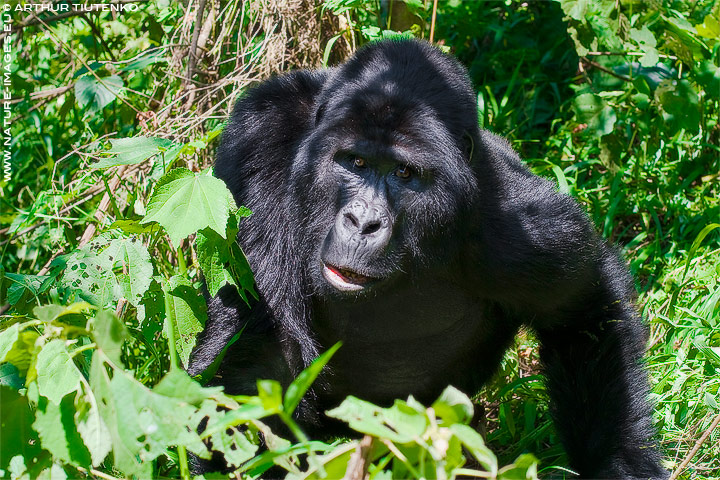
I'd like to show you some images of apes that I have brought a year ago from Uganda. This one is a male Mountain Gorilla (Gorilla beringei) from Bwindi Impenetrable Forest.
Although I am not a new NPN member, I haven't posted any images here for quite a long time. Actually I have been more shooting and processing photos than presenting them for the last two years. :-) Now it's a kind of comeback for me.
Shooting data: 50 mm, f/5.6, 1/200s, handheld, no crop.

Comments
12 commentsIn these high contrast situations, it is usually worth experimenting a black and white conversion
Making it black and white may be a good idea. Normally I don't make B&W images of nature subjects. Therefore I didn't think about it in this case. Now I am curious and am going to try it.
it's nice to meet you also here.
For photographing mountain gorillas going to Dem. Rep. Congo should be a better option. Gorillas in Uganda have become the main tourist attraction. A photographer is there just a normal tourist in a group of 8 persons that is allowed to spend only one hour with a gorilla group. The groups are always completely booked - usually many months in advance, i.e. there certainly will be not less than 8 people. In DRC groups are much smaller - often there are maximum 3 people. I even know someone who was brought to gorillas alone. I didn't know about gorillas in DRC before this trip. This is why I went to Uganda.
A bigger image of this gorilla male is here .
I hope to see more of your work here soon as well as comments.
Unbelievable how close they come to you, and this you captured well with the 50mm.
Personally I like a light drizzle when photographing gorillas. They like secondary growth and are therefor often visited when they are eating at the forest edge or forest clearings.
You have to be a little lucky and find them early in the day when the light is still fairly ok.
Visiting gorillas in DRC is possible, but certainly more of an adventure. One can never be sure where the rebels are.
Rebels are not the only problem, last week one black back gorilla was killed by poachers in Bwindi.
Photographing gorillas is just like any other subject, one need s to spend lots of time with them to get the right conditions. Since a 1 hour visit cost US$500, most people visit them only once, which reduces the changes of getting the "perfect image".
That area at Nkuringo village in Bwindi has a very dense but low vegetation. The rules demand that visitors keep a distance of at least 5 m from gorillas but it isn't possible to avoid gorillas coming to you in those dense bushes. They even come so close that a wide angle lens is sometimes even better. I used two cameras: one with 70-200 mm zoom and another one with a 50 mm prime. I also had a 300 mm prime but made only one shot with it.
Not only the high cost per hour but much more the organisation usually isn't suitable for a photographer. Gorilla trekking is an excursion for tourists which is certainly not tailored to the needs of a photographer: people with cameras competing with each other for better view at animals, bad light, people in view field, hurry, tripod not allowed... Unfortunately there are no alternatives as far as I know.