Rhinos!
Well...not technically (by NPN definitions) wildlife, but they have good mammalian names...
The glamour seabirds for most wildlife photographers include the three species of puffins found on the coasts of North American - the Horned, Tufted, and Atlantic Puffins. Personally, I find those dudes a little on the gaudy side - who the heck designed those over-sized and far-too colourful bills??

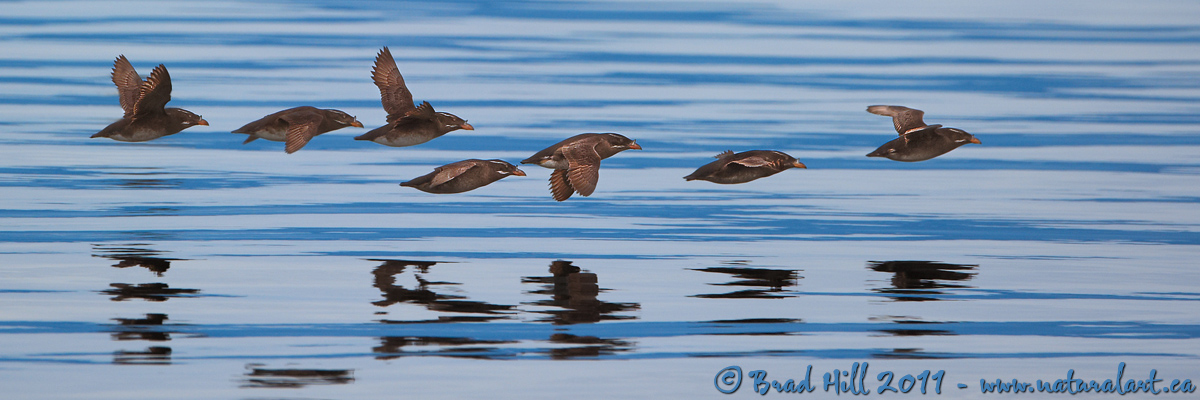
But...if you're looking for a REALLY cool seabird, look no further than the Rhinoceros Auklet - these little beauties are closely related to puffins (and quite similar behaviourally) and whoever designed them managed to strike a MUCH better balance between striking and subtle! The title of this image is based on what we'd loudly call out each time we saw a flock of approaching Rhinoceros Auklets - "Rhinos!"
During an aquatic mammal photo tour in the summer of 2011 we had - as always - some gaps in the action between sightings of whales, otters, and sea lions. During that time the rhinos provided us all with a really fun distraction as they zoomed by at about a gazillion miles per hour. This is one of my favourite captures of Rhinos in flight - it was amazingly nice of the rhinos to line up for me with no overlap, give me a bunch of different wing positions in single frame, and fly over water calm enough to cast some cool reflections. And, I love the ONE discordant reflection - not sure why that bird decided to cast such a differently positioned reflection (it wasn't closer to me than the others), but I'm glad it did!
Subject: Rhinoceros Auklets (
Cerorhinca monocerata) in flight
Location: Johnstone Strait region of Vancouver Island, BC, Canada
Camera: Nikon D3s
Lens: Nikkor 600 mm f/4 VRII lens - supported on Gitzo 1348 tripod with Wimberley head
Exposure: 1/3200s at f5. ISO 640. +0.33 stop compensation from matrix metered exposure.
Crop: About 80% of the frame horizontally - tons cropped from top!
As usual, more info about the image (including more processing details, etc) available here on my website:
http://www.naturalart.ca/galleries/latest/detail_2.html.
Comments & critiques welcomed. Probably better to view larger version first...not much detail is visible in the standard sized version...
Cheers...thanks for looking...now I'll go back to the Wildlife Gallery!
Brad

Comments
11 commentsCharlie
Thanks for the comment, but I don't follow your point about how cropping hurts image quality. If your original capture is sharp at 100% then you can crop and or cut res down to a 1:1 pixel ratio (image pixels:pixels on display device) with virtually no impact on image quality. In this image - as cropped but before resolution reduction - I had roughly 4000 pixels across the horizontal axis and then I reduced the resolution down to 1200 pixels (for the large version). If anything, this will increase the apparent quality of the image - both by increasing apparent sharpness and reducing any noise that was there (and there was virtually no noise in the original capture). Now, if I had cropped a portion of the image that was only 800 pixels across and then increased that up to 1200 pixels using ANY interpolation method (including Genuine Fractals) then there WOULD be a decrease in image quality.
If you meant that the cropping hurt the composition, well then that's a totally different (and subjective) matter - if that was what you did mean then just "unread" the paragraph above!
Cheers...
Brad
Thank you for the info on this bird .
Brad, I absolutely love the rippled water and position of the birds. Great job getting all of them sharp and the color of the water is pleasing as well. Great comp and really like this image a lot.