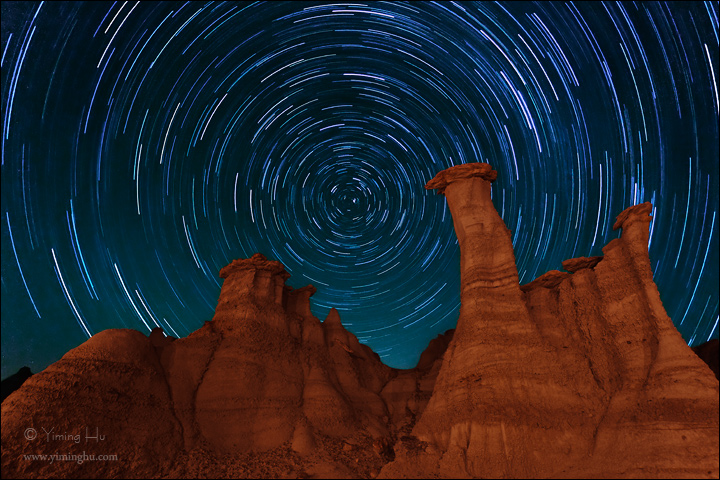
I am pretty sure that these bright circles in the sky will make Stan’s head spinning very fast

.
I actually conceived this picture in my mind a few years ago but I never got a chance to shoot it. So last month when I saw these fantastic hoodoos that match the foreground that I'd been dreaming for, I just had to pull the trigger.
The star trails were the result of stacking seven 20-minutes-exposures together. To illuminate the foreground, a Canon 580EX speedlite with double CTO gels was fired strategically about a dozen times.

Comments
17 commentsYiming, its actually one of the cleaner star trails images I have seen. Good technique.
Seriously, it's pretty cool--i'd just personally call this good photo art but not good (ie, successful to me) nature photography, because I can't relate to it as nature in any shape or form. But I'm not blasting creativity, I applaud that aspect of it, I just making a point about what nature photography means to me--relating to nature. I just get a little puzzled why one would go through the trouble of using a Speedlite very meticulously when you could have saved yourself a lot of time and potential pitfalls by simply combining two separate shots in Photoshop (a la "Photo Art")--because the result would look exactly the same to me. It's really about the result and not the method. I think often times we get too caught up in the methodology because that's all the behind-the- scenes stuff that makes it so fun, not necessarily seeing some jpeg in an internet gallery. I'm guilty of doing that for sure. But really for all the talk about being 'true to your artistic vision' and such is all meaningless if you aren't making a statement that other people can appreciate. You're obviously a talented and experienced photographer--so im pretty sure you understand what i'm getting at, regardless of whether you agree with me or not. I bet even Joe would probably agree with some of what im saying here (in private, after a few shots, but probably not publicly
Stan: points taken. Yeah star trails are not something can be observed directly by human eyes, but neither are long-exposure-silky-waterfalls (oops) or frozen actions or macros or black-and-white photos
The reason a speedlite was used is for better image quality, not for playing with methodology --- I am the kind of guy who would rather just open the shutter and go back my tent to sleep and let the camera to do the rest of the work
With a speedlite, the exposure was finished in a minute or so. Because of the short exposure time, the resulting foreground image was very clean, free of any visible noise. Moreover, the foreground part is done now.
I could have used a small camp light (or waited for the moon coming out), and got the shot (foreground + star trails) in a single long exposure --- I've done that before. The problem is that with an exposure time of 1-2 hours or more, the image will be too noise for my taste, even with the long-exposure-noise-reduction feature turned on.
What about using double exposure? I have to leave the camera there, wait until the next morning and do the second exposure. Too much work...
So, it's still about the result.
From personal experience, blending two exposures for night photographs is a huge pain in the ass, and the results are rarely as nice as this. Your point on the noise issue is spot on.
Very very nice work. You've created something unique and it's a beautiful and creative nature photograph.
I understand we all have opinions...but man...sometimes we need to just enjoy ALL types of nature photography for what it is...the personal interpretation and sharing of a human's view of the natural world around them...an opinion of course. ;]
Yiming, thanks for the response, I appreciate what you are saying. I'm just posing the question: why go outside at all? The version I 'created' in less than 20 seconds in Photoshop for the silly NPN article wasn't real at all--I dare say if i spent maybe 2 minutes instead of 20 seconds on it, I probably could have convinced most people that they were real star trails. That's an interesting thing to consider, if you ask me.
Stan: 20 seconds? Man you are good in Photoshop
To answer your question, we may also ask ourselves: why do we have to spend weeks in deserts to chase some killer clouds? You could easily merge two photos in your library together. Why do new photographers risks their lives in the line of fire? A staged photo costs you much less and the result might be more eye-catching?
In the end, we choose to become nature photographers instead of painters or fake-photo-manipulators
i like it
Here comes a million year old question that has not answer: is photography art or record? If it is a record, this one does not fit the bill. If it is art, then your imagination is your only limit. I am not avocating changing what exists in the nature, such as moving some clouds over the hill. But we all make long exposure to make water look silky, right? That kind of water is not the same as our eyes can see, but it fits our artistic intention.
love the debate too. nice to see differing perspectives.
Gary.