The Rare & Elusive Harboreal Seal
While the artistic merits of this image may be debated, its uniqueness definitely wins out and ensures the image will never be found in my trash bin. As I write this entry in mid-November of 2011 media enquiries from around the globe to use this image in various print and online publications are already pouring in...
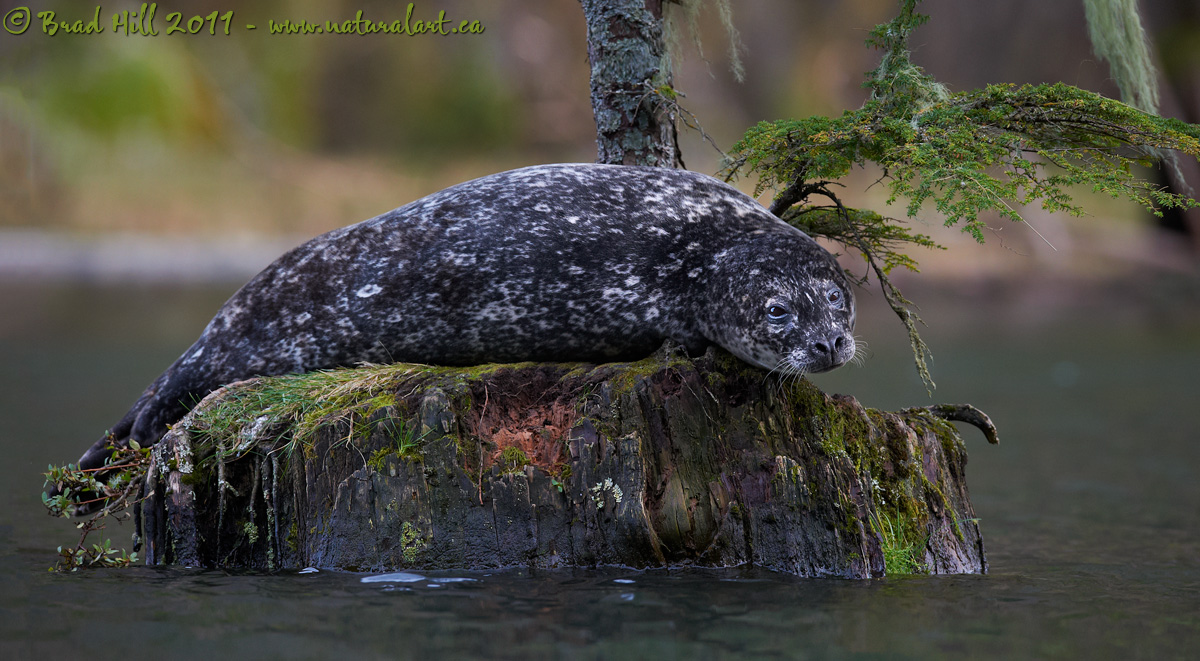
You are looking at what may be the ONLY image in existence of the very rare and highly elusive Harboreal Seal. Once thought to be simply a sub-species of the common and widespread Harbor Seal, recent DNA and observational evidence has pointed it to being a unique species (and will likely end up with the latin name
"Phoca arboreal is"). This species is totally absent from the fossil record and until a small, relict population was recently found in the region of the rugged BC coast known as the Great Bear Rainforest its very existence was in dispute (and it was considered by some to be only mythical, not unlike the Sasquatch).
Information about the Harboreal Seal is as patchy as their luxuriant coat. They appear to be relatively poor swimmers and this specimen seemed to be stranded on a large stump (on what could be its nest) by an unusually high tide. Their highly modified flippers show several modifications for their arboreal lifestyle - not only are the flippers elongated to almost the length of an arm (unfortunately not visible in this shot), but they also have greatly enlarged claws, which presumably assist in the climbing of trees. Scat analyses have shown even more evidence of their divergence from the Harbor Seal - they rarely, if ever, eat fish and appear to subsist on a mixed diet of berries, squirrels, songbirds, and - oddly enough - hummingbirds. Hunting/foraging behaviour has never been observed, but the sight of a Harboreal Seal rapidly skittering through the branches of trees in hot pursuit of a hummingbird must be nothing short of an amazingly and jaw-dropping spectacle.
Subject: Harboreal Seal (
Phoca arborealis) on its nest?
Location: Location With-held (sorry!) but somewhere in Great Bear Rainforest, BC, Canada
Camera: Nikon D3s
Lens: Nikkor 400mm f2.8 VRII lens - hand-held from floating Zodiac. VR on and in "Normal" mode.
Exposure: 1/320s at f5. ISO 2000. -0.33 stop compensation from matrix metered exposure.
Crop: Minor - this is about full frame horizontally (some cropping from top)
More details about this fascinating species, including details on future expeditions to locate and further substantiate its existence may be found on my website here...
http://www.naturalart.ca/galleries/latest/.
Comments welcomed - probably best to view larger version prior to doing so.
Cheers...thanks for looking...
Brad
PS: Additional information about this species is not available at this time...more sightings and in-depth study is needed to learn more about it.

Comments
11 commentsYe of little faith! One possible reason for your lack of success in searching for additional information on this species may by your misspelling of its name - it's "Harboreal", not "Harborial". But a more likely reason is the necessary caution and conservative nature of the scientific community as a whole, and taxonomists in particular. In the next 18 months to 2 years you're far more likely to encounter information on this species in more - quite unfortunately - tabloid-like publications. But pictures don't lie, do they? And I can guarantee you there are no digital manipulations to this image beyond simple exposure and contrast adjustments...
Cheers...
Brad
I think the fur patterns and detail around the face are quite interesting. A handsome character for sure.
Max
If you've ever seen a harbor seal hunting the image of one chasing hummingbirds isn't so absurd. They are actually really quick and agile. Hope you don't mind me sharing a video I shot about 9 years ago of harbor seals hunting at night.
http://www.baue.org/images/galleries/v/videos/furrydeath.mov.html
Very cool video - thanks! And I don't mind you putting the link here one bit!! One can see how the Harboreal Seal and Harbor Seal must have shared a common ancestor not too many million years ago. Now I'm even more excited about returning to the Great Bear Rainforest in the hope of finding a Harboreal zipping through the trees the way "your" Harbor seal absolutely ripped through the water! Gotta love these two species!!
Thanks a bunch...
Brad
I quite like the comp, although on my screen the overall impression is that the scene is slightly dark. Great job getting the eye and whisker detail.