Probably the brightest meteor ever captured on film! And moreover I witnessed the whole thing in all of its beauty!
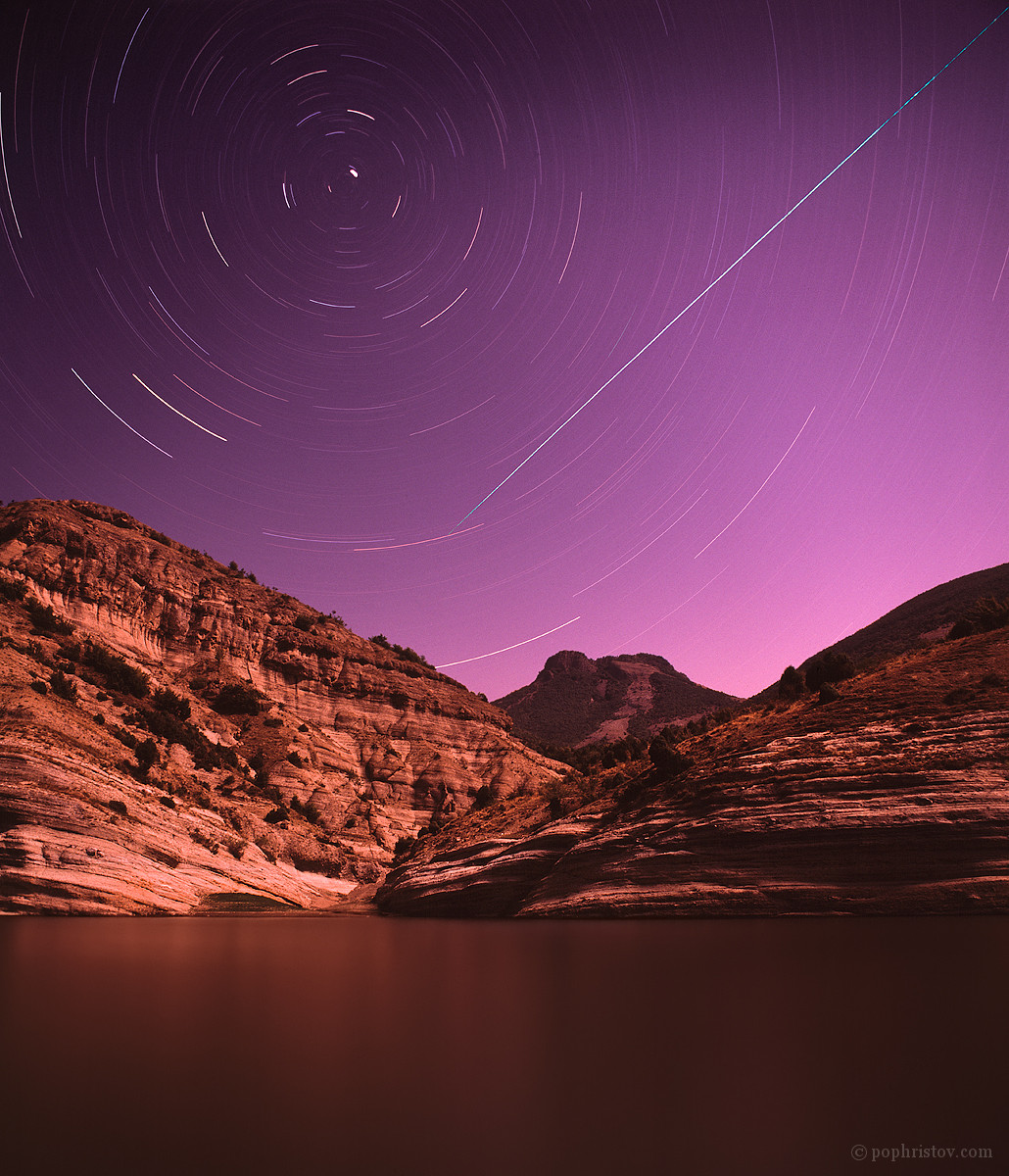
With the camera already exposing, I was laying on my back gazing at the clearly visible Milky Way above me. Then, suddenly, from the far right of the sky, a green fire exploded! The meteor crossed the whole sky lighting it up in emerald green until it finally burst in red and orange flames. In that moment I knew, the last path of the meteor crossed the frame of my camera.
Soon after that, clouds quickly invaded the sky forcing me to stop the exposure. The film had been exposed for about two hours but there was no moon to light up the canyon. I was very frustrated about it but still pretty excited that I had the meteor exposed. So I decided to make another exposure just for the canyon. While waiting for the clouds to clear out I shot the frames of my first experimental timelapse -
http://vimeo.com/pophristov/arda-timelapse
Exactly as they appeared, suddenly the clouds gave away the celestial kingdom to the bright moon which had already climbed high, perfectly lighting up the canyon. And, of course, I started another exposure this time capturing star trails with the moonlit canyon.
For all of us stargazers, meteor sights are nothing unusual or extraordinary. They can be frequently seen and of course not only during meteor showers. I’ve seen bright meteors before but nothing like this! The mere fact it was exposed so well on 100 ISO film and f/5.6 makes it a very special and unique sight. As a comparison, you can check out the 22 meteors (
http://www.facebook.com/photo.php?fbid=144370555603764&set=a.144370485603771.19510.141186739255479&type=3) I captured with a digital camera ISO 3200 f/2.8. These are stacked exposures covering about 4 hours during the Perseid meteor shower. You can clearly see the difference in the brightness and length having in mind that the lens of my medium format film camera is even wider than the lens of my DSLR.
The image you see here is a combination of the first and the third exposure. Both shot on Provia 100F color reversal film with Mamiya RB67 medium format camera. The star trails exposure was 1.5 hours. Moon was about 70% illuminated.
Location is Arda river in Eastern Rhodope Mountain, Bulgaria. This spot can be reached only when the river level is quite low. Here's another image from the same location -
http://www.naturephotographers.net/imagecritique/ic.cgi?a=vp&pr=173059&CGISESSID=6f67550966e6d624702ed69aa78fe857&u=7900
Thanks for viewing!

Comments
5 commentsJaymes
Chris