Emergent Ocean Orchid?
Bit of a documentary posting today...shot under kinda dodgy conditions (light rain, flat overcast sky), but a neat thing to see up close...
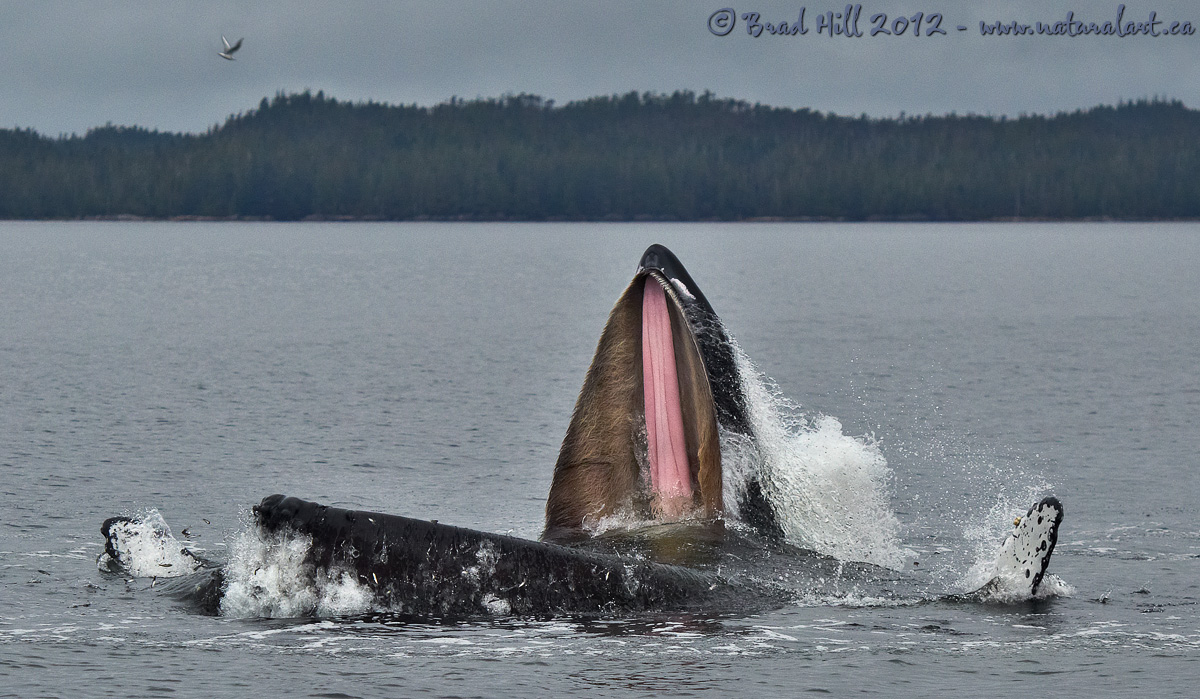
Nothing can change a dreary, rainy day in the waters of the Great Bear Rainforest faster than having an "Ocean Orchid" sprout out of the waters right beside your boat! And that's the first thought I had when this humpback whale rose up and gulped a huge mouthful of tiny fish and whatever else was in the water right then...that for an instant it looked like a giant flower blooming! In this case, though, the pinkish band that looks like a pollen guide is actually part of the palette found on the roof of its mouth.
Humpback whales have the proportionately longest pectoral fins of any cetacean (whale) - in this image they're seen emerging from the water on the lateral sides of the mouth and appear to be being used to help form a "cup" or "scoop" to help channel the water and fish that will be filtered through the baleen plates into its mouth. The two most popular theories to explain why such large pectoral fins are advantageous to humpbacks are that they may provide for higher maneuverability or that they might be important in temperature regulation (through providing for increased surface area) when migrating from warm to cold waters. While these theories may seem logical, one wonders why increased maneuverability or temperature regulation might not be advantageous to other whales that migrate over a similar range, such as gray whales. Perhaps what we're looking at here - the use of the pectoral fins as an aid to the unique way a humpback feeds - might just be an equally plausible explanation as to why it's advantageous to humpbacks to have those huge pectoral fins.
Subject: Humpback Whale (
Megaptera novaeagnliae) feasting on teeny fish
Location: Waters of Great Bear Rainforest, BC, Canada
Camera: Nikon D7000
Lens: Nikkor 70-200mm f2.8 VRII lens @ 112mm (168mm EFL) - hand-held from deck of sailboat
Exposure: 1/1250s @ f4; ISO 500. -0.33 stop compensation from matrix-metered exposure setting.
Crop: Very minor horizontally - this is about 90% of original image
No long diatribe today, but you will find quite a bit more about the processing of this image (it was quite a tricky one to pocess) AND a environmental rant (that wouldn't be appropriate for posting here on NPN) right here on my website...
 http://www.naturalart.ca/galleries/latest/detail_2.html
.
As always...comments and critiques welcomed - probably best to view the larger version prior to doing so!
Cheers...thanks for looking...
Brad

Comments
9 commentsKen Archer
The pink band adds some glamour to the image and flying bird is a nice touch too.
Jagdeep Rajput
Hmmm...odd. I don't what you're seeing - I don't see noise in the sky. I checked the original full res image and any noise in the image is very minimal and uniform throughout - perhaps if it is there in these versions it was exacerbated during final sharpening for web? Just a guess. D7000 isn't in the same league as Nikon's (or Canon's for that matter) full-frame cameras WRT noise, but when shooting at ISO 500 it's normally a non-issue. Guess it's a mystery!
Cheers...
Brad