The Compound Eye
by Howard Cheek
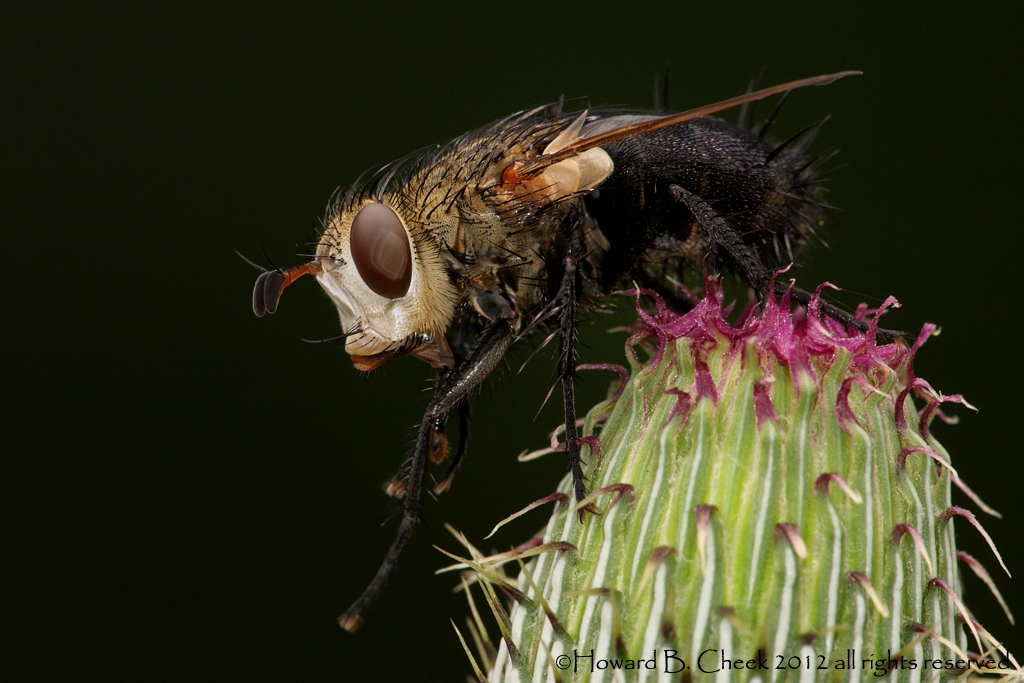
Large Flesh Fly (Flesh flies usually have a striped thorax, but not always) on a thistle bud, mostly cloudy.
F/16, 1/100th, ISO 640, 1D M3, Sigma 150mm + Kenko 1.4x ext & fill.
Monopod for support.
Here's some info on the compound eye if you're interested:
Compared with single-aperture eyes, such as the human eye, compound eyes have poor resolution so they are not good at making out detail. On the other hand, compound eyes have a very large angle of view and the ability to detect fast movement and, in some cases, the polarization of light. Insects that can fly well, such as honey bees and flies, or that catch prey, such as dragonflies or preying mantis, have specialized zones of eye facets. These zones are organized into a fovea area that gives acute vision. In the acute zone, the eye is flattened and the facets are larger, which allows more facets to receive light from a spot and thereby achieve higher resolution.
Compound eyes generally allow only a short range of vision. For example, flies and mosquitoes can see only a few millimeters in front of them with any degree of resolution, although within this short range they can see detail that we could see only with a microscope.

Comments
8 commentsThe technical and artistic merits are obvious, Howard, but I also have to say how much I appreciate the narratives you include with your photos. They put the NATURE in Nature photography, and you should be highly commended for this aspect of your work, too. Kudos!
P.S. (non-photographic comment) The only thing that might be a bit confusing about your narrative is the use of the term "ommatidia" without defining it. I think it would be more clear if you just called them "eye facets" or included a parenthetic definition. Ommatidia -- plural of ommatidium -- are individual units, or "facets" of compound eyes.
God has created a universe to behold and glorify. Well done my friend.
In watching the mantis that I just posted, it could clearly detect the motion of a katydids 4 - 6 inches away with it's compound eyes and it "watched" me like a hawk whenever I moved the camera...about 6 inches away also. Makes me wonder if the size of the compound eye affects how far it can see?
Thanks, Dave Thomas, Leesburg, VA