Earlier this year I was on assignment for National Geographic Traveler in India to shoot for an article on tiger safaris. I was there for a week and visited both Bandhavgarh and Ranthambore, their most famous tiger parks. It turned out to be a very frustrating experience - too many (poorly behaving) tourists, and only on our very last game drive did we see a tiger. One tiger. After sunset. On the road. Hardly the ideal conditions for a good photograph. But it's all in the game.
That said, a tiger safari can not be compared to a safari in Africa. In Africa there's an abundance of predators, and the habitat in some countries in particular makes it relatively easy to spot them - no wonder the Masai Mara is so popular.
Unfortunately, there is no abundance of tigers. As a matter of fact: they're highly endangered. Worldwide there are more tigers living in captivity than in the wild, and their numbers are still declining. This is the direct result of poaching, which is caused by the ever increasing demand for tiger parts from China and Vietnam.
Chances of actually seeing a tiger in the wild are therefore small, and seeing one in good photography conditions are even smaller. Tiger conservation on the Asian continent is struggling, numbers are still decreasing rapidly, and necessary measures, like properly fencing and protecting the national parks, are not taken. It's no wonder I was not very lucky with my tiger sightings.
But even though my first and only tiger encounter was short and far from ideal, I was impressed with this incredibly pretty cat and I was determined to get better shots. I got into contact with several tiger conservationists, and they pointed me in an unexpected direction.
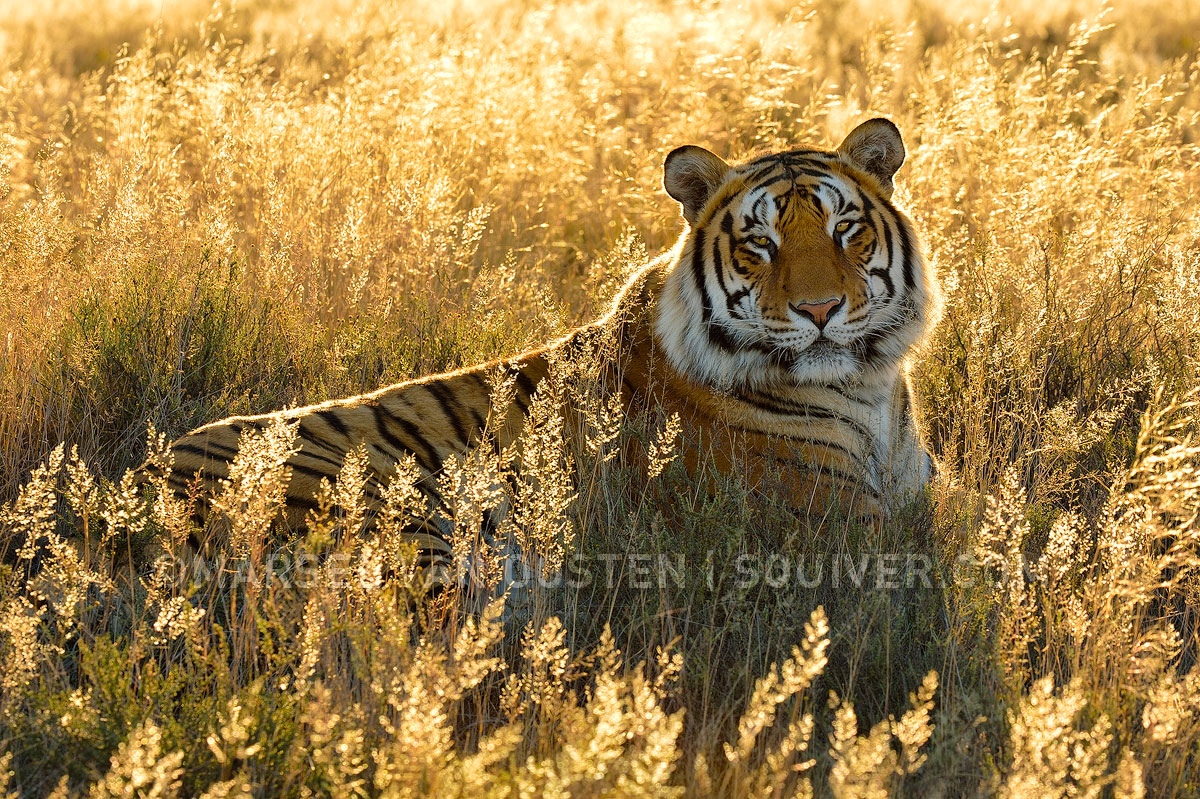
A few months ago I visited a revolutionary tiger conservation project in South Africa - yes, South Africa. Huge stretches of farmland in South Africa have been bought and a new game reserve has been created - one where tigers can roam in the wild, hunting on their own, living free while protected by a huge fence; to keep the tigers in and the poachers out.
In the beginning the project was criticized by old school conservationists and nature fundamentalists who questioned the value of the project, but soon the first litters were born and in December 2010 there were already 16 tigers in the sanctuary, and it is currently the most successful tiger conservation project in the world when it comes to rapidly increasing numbers of tigers.
When you're serious about preventing a species from going extinct, you have to think out of the box, and this is a good example.
Not so long ago, government officials admitted that all the tigers had disappeared from Panna, one of India’s leading reserves, when just 2 years ago there was still a healthy population of 24. Even more recent the major tiger parks were temporarily closed for tourism in an effort to blame the tourists instead of poachers, organized crime and corrupt park officials. As long as there's an ever increasing demand for tiger parts from China and Vietnam, the tiger will continue to be poached - it's as simple as that. More tigers means better chances that they will survive.
We visited the South African tiger reserve earlier this year, spent a few days with the tigers, and we were very impressed. The park is huge - the tigers have loads of space, they can hunt for themselves, and they are well protected from the outside world by a state of the art fence. We saw them playing, stalking wildlife, fighting, and mating - more tigers in the making.

Daniella put together a really cool video of our tiger adventure. It's on
our blog and worth checking out.

Comments
10 commentsI really like the backlighting and the beautiful surrounding grasses. What a magnificent beast.
Thanks for sharing this wonderful image and, more importantly, your views and information on tiger conservation. I don't mean to in any way demean the image (and it does really draw attention to this post) but to me the most important part of the post is what your wrote above. Thanks for taking the time and effort to do that - it's valuable information and a great example to others (including how good photography can be put to a great use).
Cheers...and keep fighting the good fight!
Brad
-Cam
Thanks for posting this image and story.
I agree with Brad, wonderful write-up and thoughtful presentation of facts and concerns.
Panna was an unfortunate incident, but then there are many other places in our country where Tigers are doing well, but yes they are not found in abundance anywhere, they are solitary animals and need around 30-40 sq km area to survive in the wild. With a country competing with the most populous country in the world, we are doing good, not that we cant do better :)