Hedge Trimming, Humpback Style!
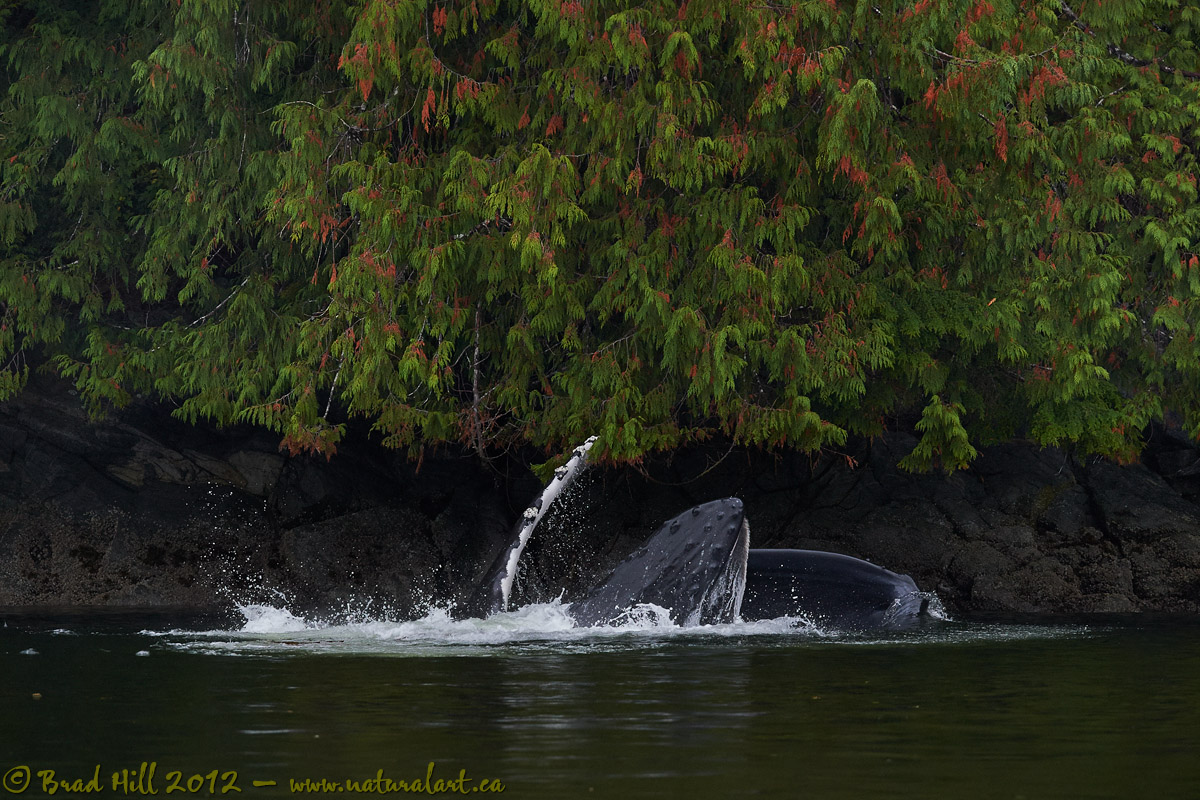
Most folks who have spent time in heavily forested coastal regions will have noticed how the trees (and their boughs) all grow down to a very uniform distance from the waterline...as shown above. Most who have thought about it probably assume that this straight line of vegetation growth above the shoreline is related to the high-tide line. Well...here's an alternate theory: humpbacks trim the "hedges" back with their pectoral fins! After all, seeing is believing - right?

This shot is of a humpback whale feeding via bubble-netting - you can see the faint outline of the circular bubble-net on the surface of the water. Because most folks don't see humpbacks on a daily basis it can be a little hard to figure out exactly what body parts you're looking at. So...the large "bucket" on the right side of the image (where the water is draining into) is the whale's lower jaw, the wedge-shaped and "bump" covered section is the whale's upper jaw (complete with baleen plates), and the nearly vertical thin white thing is the whales pectoral fin (you should be able to see barnacles on it on the large version of the image). This particular whale was bubble-netting alone right along the shoreline - so close that some of the bubbles actually came up right on the rock wall in the background.
The tricky thing about capturing this shot was getting the exposure right. The scene was very dark - the skies were heavily overcast, the water was very dark, and the whale black. Many photographers - including some pretty experienced ones - instantly react to a scene like this by thinking they need to over-expose the shot (compared to what their camera's light meter is suggesting to them). Well...if you're like the majority of photographers and are using some form of multi-segment metering system (like Canon's evaluative metering and Nikon's matrix metering) this would be the exact WRONG thing to do. Your camera's light meter is always suggesting an exposure that pushes scenes toward neutral grey. So if your goal is to record scenes as they were seen in the field (and you're using multi-segment metering), you must under-expose scenes that are darker than neutral gray, and over-expose scenes that are brighter than neutral gray. In this case if one used the exposure their light metering was suggesting, those bits of white on the pectoral fins and the white in the splashing water would have been totally blown out (over-exposed). The situation would have been worse if one over-rode the exposure and over-exposed the scene. To get this exposure "right" I had to under-expose the scene (compared to the matrix-metered "suggestion") by 1.67 stops!
The take home lessons? First...whales like well-trimmed hedges! Second...the world's simplest exposure guide: under-expose dark scenes; over-expose bright scenes! And experience and practice will teach you how much you should under- or over-expose each individual scene.
Subject: Humpback Whale (
Megaptera novaeagnliae) gobbling herring and other bits (possible including squirrels in this case!)
Location: Great Bear Rainforest (central BC coast), BC, Canada.
Camera: Nikon D4
Lens: Nikkor 400mm f2.8 VRII lens - hand-held. VR on and in "Normal" mode.
Exposure: 1/1250s @ f4.5; ISO 1800. -1.67 stop compensation from matrix-metered exposure setting.
Crop: Minimal - this is at least 90% of the full-framed image
Additional details about the image (including processing details) available here:
http://www.naturalart.ca/galleries/latest/.
Comments and critiques welcomed - probably best to view the larger version prior to doing so!
Cheers...
Brad

Comments
11 commentsAs far as the photo is concerned I think it is unique because I have never seen a photo of a whale in this environment. From an aesthetic point of view I really like the greens and reds in the foliage. As usual, the technical aspects and processing are great.
Below the surface the rock wall is absolutely vertical and only a foot or two off-shore the water is hundreds of feet deep. We've seen a lot of humpbacks using this region for bubble-netting and often it's right against the shoreline (like this). It's possible that the whales are using the underwater cliff/wall as a barrier to help "corral" the fish and prevent them from escaping (that's what they appear to be doing, tho' this is speculation based solely on what we see on the surface.
On a VERY positive note - over the last 10 years the humpback numbers in this region (with the Great Bear Rainforest) have been soaring. They are becoming as big a draw as the bears themselves. It's impossible to say if this is simply because of more whales moving into this area from other areas (due to the abundant food) or if overall numbers of the whales are increasing (or both). I hope population numbers are on the rise...
Cheers...
Brad
Sweet Photo Brad
Ken Archer
And, could you reveal whether you shoot in Manual mode or do you have any other preference?
You say/ask:
Actually, my REAL mantra is "simplify and isolate"...but that's a different subject!
RE: Over-exposing bright scenes as in the Antarctic: Yes, if you're relying on any form of multi-segement metering you almost always have to over-expose snowy/icy scenes. I know some others who will take gray cards with them and take spot readings off them (in lieu of using multi-segment metering and compensating) - and that can obviously work too. My own experience of shooting in the arctic that normally an over-exposure of about 2/3 of a stop often works well so that might represent a good start point. But definitely watch your histogram. Oh...and if you're an adherent of the "shoot to the right" approach to raw image capture (I'm not), it can be particularly important to over-expose bright scenes...
RE: shooting in manual mode: Nope. I live in Aperture priority mode 99% of the time.
Cheers...
Brad