Interactions
by Pramod Viswanath
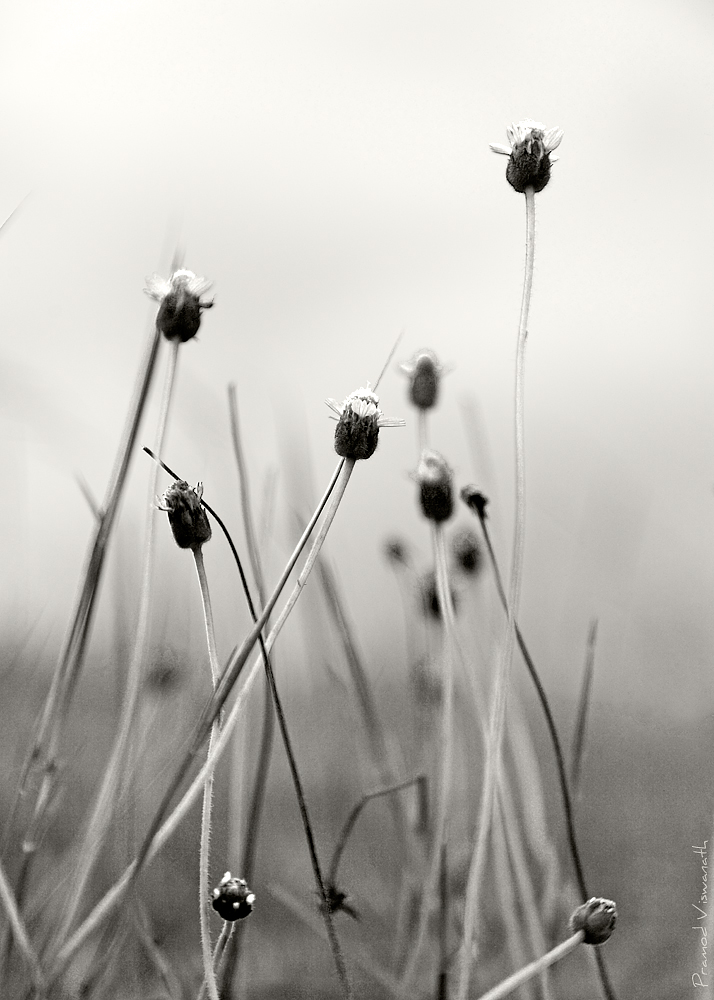
I closely attribute this image to 2 kinds of interactions that we as humans do:
1. Social interactions
2. Team work
Some thoughts behind the title:
At times the relationships turn sour, at times it blends with the background. At times it is budding, sometimes it just dies. No matter what, we are never free from the obligations and gratitude. That is what makes us humans.
In the end, these interactions when zoomed out and viewed from a distance, it would indeed translate to some kind of universal harmony and a small spec of art of everybody's life on a huge canvas called creation.
Thanks in advance for your thoughts and views.
PS: View the bigger size image for better impact.
Canon 5D2 | Canon 24-105 F4 L IS | Handheld

Comments
6 comments"Interactions" is a perfect name and implication for it. And I did take your suggestion and view the larger image, by the way :)
While I know that you, as the artist, have an idea in mind as you have stated, I would rather just tell you how my mind has assimilated and interpreted your image, if that is OK with you :)
The first thing that I am aware of is the gradation from darker at the bottom to lighter at the top. And then I see these vertical lines rising. It was then I knew that this was life rising towards the light, like hands reaching upward. Why? Because that is the direction of the sun which is the source of all our energy, except the remaining geothermal energy from the earth's core. But for the most part, our light and our life comes from the sun, our sun.
Back to your thought of social interactions and teamwork. You could look into the writings of someone like Ayn Rand, and/or the writings of Father Pierre Teilhard de Chardin to see the two ends of the spectrumctive on these themes, or if you want to go even further, you could see the Lankavatara Sutra or "Descent in to Sri Lanka to go into the ultraviolet regions.
But the themes you have captured in your image, Pramod Viswanath, are very profound, in my opinion.
More generally (and this is really the only reason I find myself engaged in photography), in many cases, we photographers are explorers. While it may seem to us that we are exploring something "outside", something in the world, in many cases, as I think is true for your image, we are actually exploring something that transcends the immediate subject; something I would not want to characterize as either "inside" or "outside". Something that at some point lifts off and departs from language entirely.
the image is not strong enought for the theme
Albert Darmo
the image is not strong enought for the theme
Albert Darmo
=======================================
I am not sure how to quote someone's post prior, but hopefully, if I last in this form, I'll find how how to do that. But I have quoted this one the best way I can above. I fully understand the disjunction Albert Darmo writes about. I just wish to add the following...
I want to say somehting I deeply believe in: When we compare the strength of an image against the intended theme of that image, that comparison, to me, goes to a fundamental issue, that being what an image really is and where it occurs as an image in the first place.
I will argue that while we may think that an image is something "out there", it is really something we ourselves create within our own minds. Before that, it is simply light. It is focused by the lenses in our eyes onto our retinas, and then the nervous impulses get transferred to the brain, and the image happens some point thereafter. And after that other things happen in terms of meaning, etc.
And so then, if you will take that predicate for just a moment, then I think everything comes down to how much force we want to impute into the interpretation; i.e., It's not the image; in fact, In some very real sense, there IS no image apart from us, the perceivers of what we take to be the image.
So the very proposition that would stand the strength of an image against that of the theme it purports to represnet is, I think, fundamentally at odds with the truth; that being that the same mind is responsible for both; both the image and its meaning; the same mind.
And ultimately, there isn't a duality; there is only one thing. That is the problem I have with what Albert Darmo is suggesting. Unless, that is, I am misunderstanding something.
I'm not really connecting with this. I like the monochrome aspect of it but I can't seem to get a handle on the composition and maybe that's intentional on your part.
pat