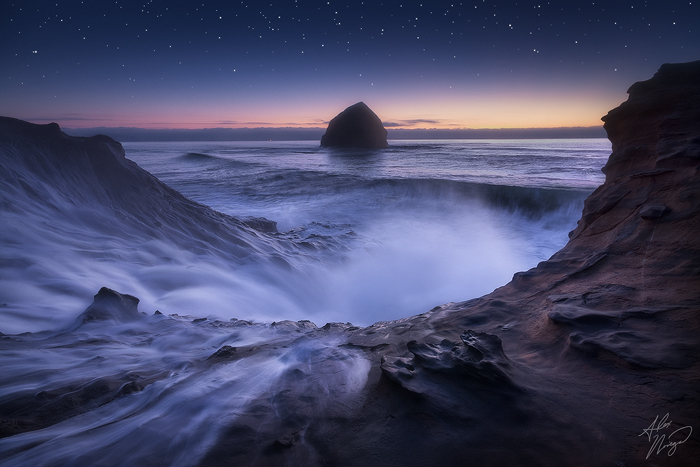
Receding waves on the sandstone formations of Oregon's Cape Kiwanda at twilight. Larger version on a dark background at the Purchase Print link. Scroll down to see the web sharpening on the stars removed.
Three exposures -
Landscape+water: 2 seconds, f/11, ISO 100
Sky (for dynamic range): 1/2 sec, f/11, ISO 100
Stars (1/2 hour later): 30 sec, f/4, ISO 1600
Canon 40D, Sigma 10-20mm
Before anyone says anything about the sky color, check out this informative screenshot of one of my RAWs that I hastily put together, which I believe is justification/exemplification of my approach to lingering post-sunset color in my twilight images:
check it out here.
That having been said, I could probably push the yellow/orange area of the sky more toward red/magenta, and darken it a bit further.. but meh. The main thing to keep in mind is that the warm/cool division in the sky is NOT where I blended two exposures - the white dots of the stars were merely overlaid via the Floris Van Breugel lighten-blend-mode method. The sky color is natural, and indeed occurred after stars had already appeared over my head.
I'd also like to discuss (read: talk at you about) the exposure time in relation to the darkness of the scene. I couldn't give up that water texture in the FG, or the wave, both of which were captured in the same 2-second exposure. I had some foggy 30 second exposures and they're really just nowhere near as interesting. The thing is, when you're there and night is falling, you don't see long exposures with your eyes - you can still see the waves approaching and crashing and receding. I wanted to convey that. It's really only photographers that get put off by the water not being a longer exposure, since photographers know that you generally need longer exposures at that time of the evening. Not a matter of realism though, since you can totally see the action yourself at the scene. Just imagine I had a D800 and shot it at ISO 1600-6400 to freeze the water action later in the evening with acceptable quality, instead of a 40D that forces blending exposures for results like this because it's unacceptable at those ISOs.



Comments
19 commentsYour link appears to be broken..
The glow/warmth is significantly toned down and cooled down from the raw sky exposure, which was taken as stars were appearing overhead. Perhaps I should push the orangeish tones more toward magenta/red and darken that area, but these are basically untouched colors other than the overall white balance. No added glow or color in that area.
That's kind of why I posted that link that ended up breaking - to demonstrate that, in fact, there can be a ridiculous amount of post-sunset color/light left in the sky as the stars appear.
Beautiful image and well crafted.
aF