Little over a week I will be leading our annual photo tour to Japan again, where we will photograph whooper swans, the endangered red crowned cranes, Steller's sea eagles, and the photogenic snow monkeys, We've been going there for many years now, and it's one of our personal favorite destinations.
The snow monkeys are a real joy to watch, not only because they're constantly active in and around the natural hot springs and that there's a lot of interaction between monkeys to observe and photograph, but also because they resemble humans so much and you can really tell how they're feeling and what they're thinking. Well, almost. The young monkeys are particularly enjoyable to watch because they're very lively and curious.
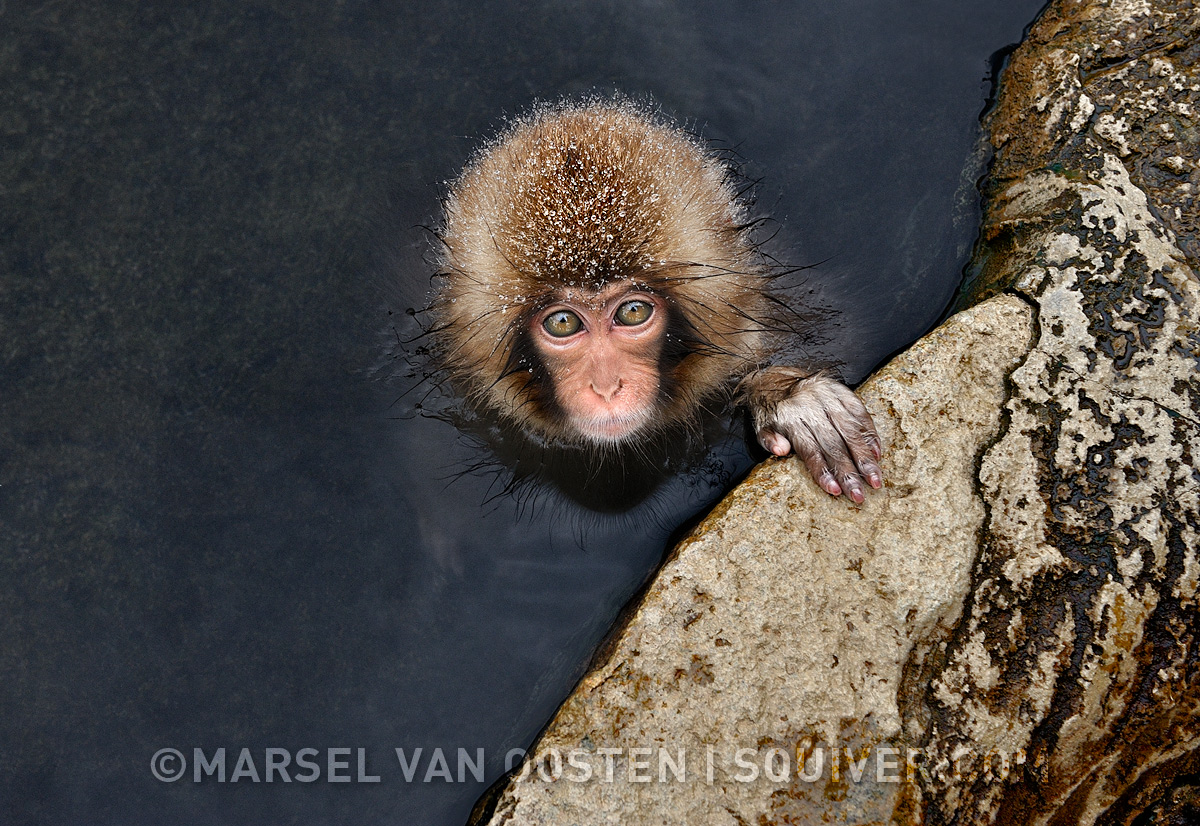
If you talk to any wildlife photographer, they will tell you to always shoot at the eye level of your subject - never shoot down. They're usually right, but rules are meant to be broken, and that's what I did here.
I deliberately chose a very high viewpoint to look straight down at this young snow monkey in an attempt to make it look even smaller. An advantage of this approach was that when the monkey looked up at me, it was looking in the direction of the sky, and that's where all the light comes from - natural fill flash for those big eyes.

Marsel

Comments
14 commentsAlso, I too would be interested in camera settings.
Luke - no worries, I appreciate all feedback, even when I don't agree with it.
Breaking the rules inevitably means that some people won't like it, but that's fine. When I was still working in advertising, our motto was that it's better to create something that 50% of the people love and 50% of the people hate, than to create something safe that 100% of the people think is ok. Ads that you love or hate you will remember, the ones that are ok you will forget.
Hope that makes sense. Thanks for your feedback!
Marsel
It's probably for that reason that I'm not as fond of the crop. To me, the complementary brown shapes of the monkey and the rock dominate the image, so all that blue water to the left just feels like empty space to me. I think my preference would be to crop the left quarter of the image, which would place the monkey in the upper left of the frame and focus attention even more on the visual relationship between the monkey and the stone it's grasping onto.
Max
Granted, the monkey's face draws the viewer in quite well as is, but I think a small amount of edge darkening would still be beneficial. Not overly done for sure - just a tad!
Cute shot. The dark and highly contrasting water, diagonal flow of the supporting compositional elements, standard but excellent placement of the head and hands, all add up to a strong image. The high cute factor and strong appeal of that human-like hand don't hurt a bit either!
While you comment on "breaking the rules" with respect to shooting angle, in reality I think you have conformed to far more compositional guidelines than you have violated here. Nothing even remotely wrong with this - we're always facing compromises in the field and commonly have to choose which "rule" we have to let go (often so others can be "fulfilled"). I think you absolutely made the right creative choices here and using a non-traditional shooting angle doesn't harm the shot at all.
Cheers...
Brad
PS: An afterthought: While I think you made all the right choices here - and that the image works very well - for me the shooting angle did not do anything with respect to conveying how small the monkey was. The lack of size referents (larger mom, tacky inclusion of a lens cap for scale) leaves me with no clue at all how big the subject is or if it's even a young monkey (that would require species-specific knowledge by the viewer). But to me this doesn't detract from the image at ALL...it still works just fine! Oh, and kidding about including the lens cap!
Jagdeep Rajput
Max - I understand your point. The problem is that I have a so called empty space fetish, so it will be hard for me to crop it off.
I see what you mean, but I would never do that in a shot like this - the edge darkening would just feel like vignetting, at least for me it would. I do use vignetting every now and then, but usually only in shots that are more 'cluttered'. Hope that makes sense.
Brad - you're right, my view point doesn't show how small the monkey is. I should have phrased it differently. The high viewpoint makes the monkey look smaller than from eye level, or even lower. Shooting a subject from a view point, lower than eye level, tends to make it look bigger and more impressive, and a high viewpoint does the opposite.
In movies important and dominant characters are often shot from a low angle to emphasize their status, and people that are victims, submissive, or just weaker than the other character in the same scene are often shot from an angle higher than themselves. Or they put them in a chair.
But I agree that to really show how small something is, you need a sense of scale. You joke about the lens cap, but for my most popular snow monkey shot ever, I did just that.
Lon - thank you for your feedback. It's weird, because I seem to disagree with all the suggestions. Also yours.
So to recap - thank you very much for your comments and feedback, it is greatly appreciated. I may not agree with it this time, but I'm sure next time I will.