First Contact
When I look at my image processing queue for this week I think my posting theme in this gallery is going to end up being "high ISO shots"

!
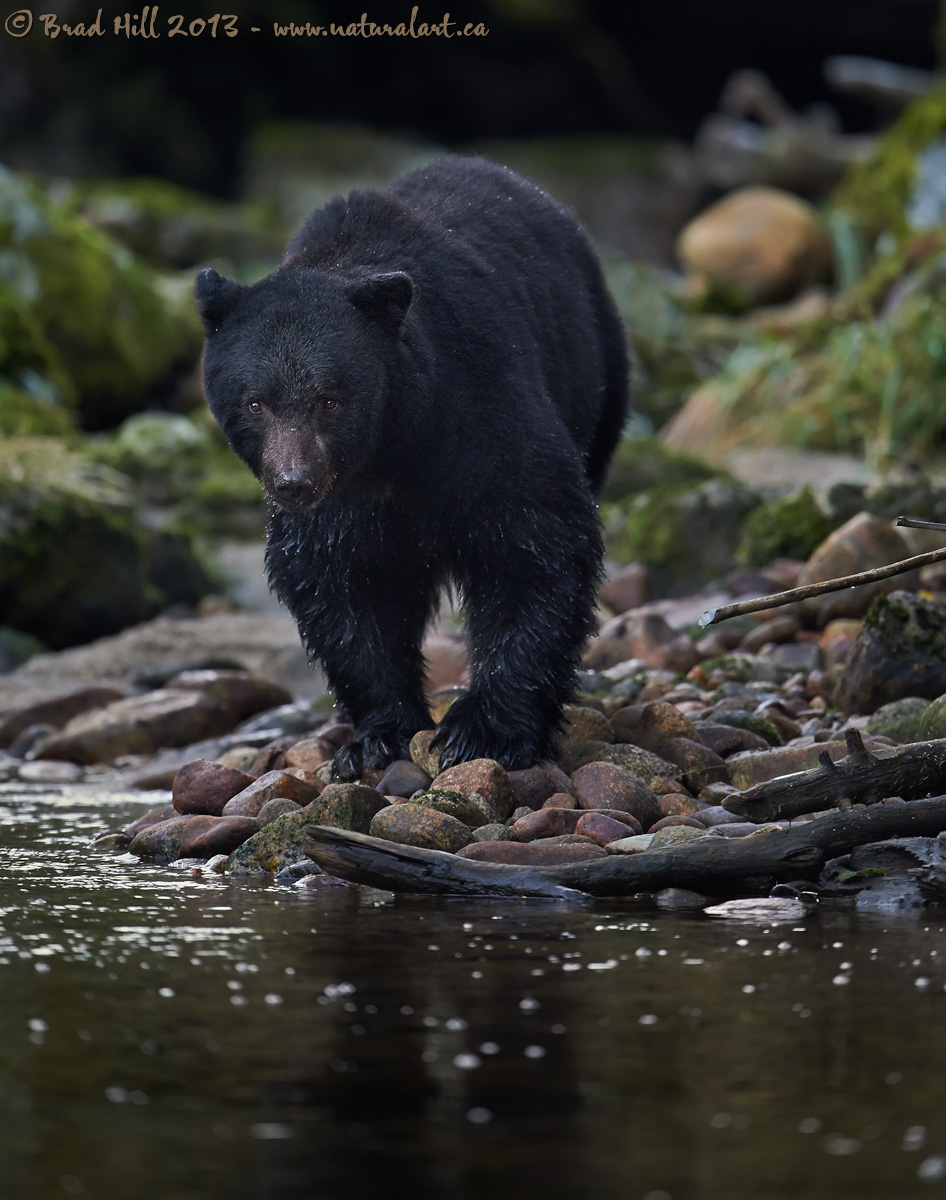
This shot captures the exact moment this bear discovered he had two-legged visitors on (and IN) his favourite salmon stream - his first contact (at least for that day). The bear absolutely locked his eyes onto me and he remained motionless for a good 30 seconds before apparently deciding I wasn't worth any further bother. I have no clue at all what was going through the bear's mind while he was staring at me - perhaps he was just trying to figure out what I was (I was kneeling and looking through a 600mm lens - from his end I must have looked like some weird thing with one massive eye).
Most wildlife photographers will agree that effectively capturing an animal's eyes is almost always a good thing and it almost always helps make a wildlife image work. But if you ask a group of wildlife shooters where those eyes should be looking - well, you're likely to get a large range of answers. Some prefer that the subject is looking anywhere BUT at the photographer (because if they are looking at the photographer then the scene is not of a "naturally behaving" animal - it has been influenced by the photographer). Some like it when the animal is looking towards the photographer, but just a little away from them. And others like it when those eyes drill right through the photographer (like in this shot).
My view? This is one where I don't take a strong position - overall I usually do prefer if the subject is not focused on me (i.e., it isn't staring directly at ME), but in some situations I think it can work just fine. I personally like the intensity that is added to this image by those piercing eyeballs. I do like the overall scene depicted here, but I don't think the image would have the same appeal for me if the bear was looking elsewhere.
BTW: Lighting illuminating the bears eyes is all natural (no flash fill) and no selective image editing was done on the eyes (they're just reflecting ambient light that in turn is reflected off the creek).
Subject: Male black bear (
Ursus americana kermodei) drilling his eyes into me
Location: Great Bear Rainforest, BC, Canada
Camera: Nikon D4
Lens: Nikkor 600mm f4 VR lens - Tripod mounted on Gitzo 1348 carbon fiber tripod with Wimberley Head. VR on and in normal mode.
Exposure: 1/640s @ f4; ISO 6400. -0.67 stop compensation from matrix-metered exposure setting.
Crop: Full frame horizontally - cropped from top only...
Additional details about the image (including processing details) available here:
http://www.naturalart.ca/galleries/latest/detail_2.html.
Comments and critiques welcomed - probably best to view the larger version prior to doing so! I'm particularly interested in getting a bit of a poll going about how people feel about the eye position of their wildlife subjects (i..e, at the photographer vs. elsewhere).
Cheers...
Brad

Comments
13 commentsCheers
Rick
Thanks for your feedback...and totally OK to be non-committal (I was!).
It's a kermodei - 100% certain. All black bears in this portion of the Great Bear Rainforest are of the kermodei sub-species, regardless of colour. The popular term "Kermode" for the white-phased form is a bit misleading - it implies that all Kermodes are white, but if one follows standard naming practice the term "Kermode" should apply to every member of the kermodei sub-species, not just white bears. Only about 10% of the kermodei sub-species are white bears.
So...you'll never hear me call a white-phased black bear a Kermode - I always refer to them as "Spirit Bears". And...just to confuse things even more...you can find Spirit Bears anywhere black bears are found - it's simply a coat colour and controlled by recessive genes. There have been some in SE BC (near Alberta border) in recent years - and they AREN'T of the Kermode sub-species, so they're NOT Kermodes! Head spinning yet??
That's when you get when you talk to a biologist!
Cheers...
Brad
PS: it's not a young bear - fully grown and one of the most dominant bears on the island it lives on...bit of a cantankerous dude too...he demands respect (and I'm not one to deprive him of that!).
This photo has very pleasing colors and is technically excellent. I'm not sure about the vertical format, truth be told I just don't like verticals very much unless the situation screams for it. The oof water at the bottom emphasizes the low pov, but beyond that? Absolutely nothing wrong with the vertical, just my personal bias acting up. But, a horizontal with more room to the left of the bear showing the creek would be my first response.
Love your exposure control here, particularly the blacks and shadows throughout.
Thanks for the feedback - some interesting issues raised. Given Don's comment (thanks for that Don) I'll respond to a few of the points brought up (and give you a scary look inside my head while I was shooting this).
1. Gary...you say: "I'm not sure about the vertical format, truth be told I just don't like verticals very much unless the situation screams for it."
While I shoot a lot of verticals - which isn't necessarily good in an image-distribution world increasingly dominated by landscape-oriented display devices - I have no a priori preference for vertical vs. horizontal formats. When the subject is small in the frame I let the dominant lines and natural axes in the frame drive my choice of orientation. But once the subject is close enough to dominate the frame, its orientation to camera (coming straight at me vs. broadside) plays an increasingly strong role in determining whether I go vertical vs. horizontal. In this case, because the bear was coming straight at me it is "naturally" vertical. Combine that with the faint reflected lines of the bear's legs in the water and my view is that the dominant axis here was vertical - and to frame this shot horizontally would have been fighting against that axis. I was careful to include enough of the stream "wrapping around" the bear to leave that streamflow/eyeflow intact. For me there was no doubt I should shoot this in vertical format.
2. Lon...on the "dark" nature of this shot (and the amount of OOF water):
Given that you have about a 1.5 stop range in the brightness of your audience's viewing devices (minimum), it's always risky to post dark shots. On this shot my goal was to reproduce the scene as accurately as possible - it was a darned dark scene (ISO 6400). I liked the natural moodiness of the scene and I really dislike artificially brightened shots. Ironically - when I got this one just to the point I wanted it (brightness wise) on my calibrated working monitor, it appeared a tad dark on my laptop, and too bright on my iPad! But at the end of the day I wanted the scene dark...because it was...
On the amount of OOF water. You know I rarely tolerate OOF objects in the foregrounds of my images. Water - being close to featureless if relatively smooth - is one of the few OOF foreground elements I'll work with (because I don't find it overly distracting and "disharmonious"). I included this amount of OOF water to give the shot some depth - that is, to keep the subject further back in the frame to ensure the image wasn't flat (or two dimensional). And, I liked the subtle reflections of it's legs (which in my opinion add to the shot).
No worries if others would have done this differently - format-wise, exposure-wise, or anything else! If we all did the same thing soon all our images would look the same and it would be really, really boring. And, personal style simply wouldn't evolve (which is always a fear of mine in forums and galleries like this - there can be too much "group-think" and a slow homogenization of what is considered a "good" image).
Cheers...
Brad
Ken Archer