Gallery: Macro & Close-upPosted February 7, 2013244 views12 comments
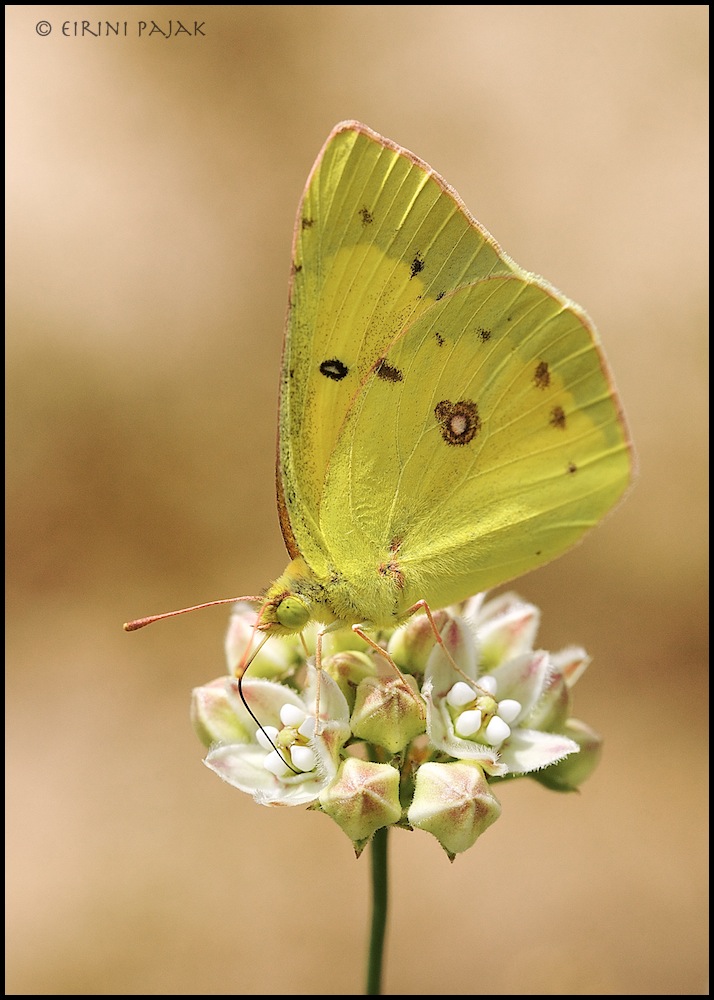
I took this last summer. If you know exactly which kind it is let me know...
ISO 320, f8, 1/1250
5D2 100mm Macro
Comments, criticisms welcome.
Comments
12 comments
Comment posted by Howard Cheek on February 7, 2013 at 6:55 PM
Great point of focus and sharp details where it counts Eirini.
I especially like the light here, very natural looking colors too
Registered on July 24, 2008, 1201 Posts, 10758 Comments
Comment posted by scott lanz on February 7, 2013 at 9:14 PM
So, you've been holding out on this one since last summer, Eirini??? This is superb, IMO. Beautiful subject, excellent light, perfect pose, a pretty perch, super bg, excellent subject detail. Did I leave anything out? One thing I find particularly interesting are the wings on the subject. I was just looking at Carolyn's post in flora and the discussion about the insect scars on the leaves and whether to clone them or leave them. This one looks like it has insect scars on its wings, no doubt to help look like leaves and help it hide from its enemies. I'm glad you did not clone them out. Excellent image.
Registered on November 14, 2003, 840 Posts, 12902 Comments
Comment posted by Rob Graham on February 8, 2013 at 12:09 AM
Beautiful, Eirini. The soft light is nice, as are the colors and details. I like how you caught it feeding. The butterfly matches a photo of a Southern Dogface, but that is just a guess.
Registered on August 22, 2006, 842 Posts, 2824 Comments
Comment posted by John Neukirch on February 8, 2013 at 8:09 PM
Incredibly elegant and very pleasing color combinations. What focal length lens and was it a macro? The detail in the head region is superb, the wing is a little soft which is totally understandable if using a macro at f8. An exceptional image.
Registered on July 9, 2012, 207 Posts, 1476 Comments
Comment posted by Carolyn Derstine on February 8, 2013 at 8:57 PM
Very lovely, Eirini! I believe John described it as "elegant" which I think says it well. I love the soft colors and how the colors of the flower coordinate so nicely with the color of the butterfly. Fantastic details, great background, and a fine comp. Top notch image!
Registered on February 16, 2011, 610 Posts, 3684 Comments
Comment posted by Ian Hutchinson on February 9, 2013 at 2:25 AM
Hi Eirini, a nice shot the only problem with it for me is the harsh sunlight, other than that nice shot.
Dont know what its called in the USA but in the UK it's a Clouded Yellow, Colias croceus. More than likely it's a Male.
Cheers
Ian
Registered on September 8, 2012, 9 Posts, 38 Comments
Comment posted by Daniel & Loana on February 9, 2013 at 11:21 AM
Great details and colours. I like the perch a lot!
D&L
Registered on October 7, 2008, 166 Posts, 3044 Comments
Comment posted by Balan Vinod on February 9, 2013 at 11:52 AM
The light and DOF here is right on targer Eirini, The pov is perfect ..well done
Balan Vinod
Registered on March 20, 2006, 889 Posts, 2312 Comments
Comment posted by Lucy VanSwearingen on February 13, 2013 at 9:34 PM
Don't know how I missed this one...........kudos for the wp and the double pick in flora!
Registered on May 23, 2009, 800 Posts, 2042 Comments
Comment posted by Wayne Jones on February 13, 2013 at 9:38 PM
Congrats on the WP, Eirini. Wonderfully detailed shot! Focus on the important parts is exceptional; the light emphasizes the texture and veins of the wings, and the background is natural and perfectly blurred.
ID: If you found this in North America, it is either an orange sulphur (Colias eurytheme) a clouded sulphur (Colias philodice) or a hybrid of the two. If the yellow on the upper wing had some orange (other than spots) it is obviously an orange sulphur. If not, it was probably a clouded sulphur, ... that is, unless it is kind of worn, or one of the pale forms. In addition, there is some sexual dimorphism, which makes ID even harder. Such confusion is more common in the insect world than most people realize.
Most people who claim to know exactly what species is in a single photo without seeing the upper surface of the wings probably are either not that familiar with the species, or are guessing to some extent. After all, the colors and patterns are quite variable; and even the butterflies themselves don't know the difference! The yellow, orange and white variations of both species commonly mate with each other, and reportedly even produce hybrid offspring. (Some people have said that the black area on the margin of the upper surface, showing through when viewed from below, is even with the row of dark spots on the clouded sulphur, but extends well in toward the body on the orange sulphur. However even this is variable, and the one you photographed shows some characteristics of both forms.)
Registered on April 18, 2007, 953 Posts, 6435 Comments
Comment posted by Albert Darmo on February 15, 2013 at 12:04 PM
Hi Eirini A very fine allround capture congrats on the WP
Albert Darmo
Registered on November 25, 2008, 1386 Posts, 11978 Comments
Comment posted by Bill Fach on February 22, 2013 at 11:12 PM
Eirini: Great capture and not even a stack! Really good plane of focus management and just a superb final result. Congrats on the WP. >=))>
Registered on November 1, 2003, 1805 Posts, 26981 Comments

Comments
12 commentsI especially like the light here, very natural looking colors too
Dont know what its called in the USA but in the UK it's a Clouded Yellow, Colias croceus. More than likely it's a Male.
Cheers
Ian
D&L
Balan Vinod
ID: If you found this in North America, it is either an orange sulphur (Colias eurytheme) a clouded sulphur (Colias philodice) or a hybrid of the two. If the yellow on the upper wing had some orange (other than spots) it is obviously an orange sulphur. If not, it was probably a clouded sulphur, ... that is, unless it is kind of worn, or one of the pale forms. In addition, there is some sexual dimorphism, which makes ID even harder. Such confusion is more common in the insect world than most people realize.
Most people who claim to know exactly what species is in a single photo without seeing the upper surface of the wings probably are either not that familiar with the species, or are guessing to some extent. After all, the colors and patterns are quite variable; and even the butterflies themselves don't know the difference! The yellow, orange and white variations of both species commonly mate with each other, and reportedly even produce hybrid offspring. (Some people have said that the black area on the margin of the upper surface, showing through when viewed from below, is even with the row of dark spots on the clouded sulphur, but extends well in toward the body on the orange sulphur. However even this is variable, and the one you photographed shows some characteristics of both forms.)
Albert Darmo