Nature Photographers Network
This is the preserved archive of the original Nature Photographers Network. The community continues at naturephotographers.network.
Osprey Behaviour
‹ PreviousAvian GalleryNext ›

Osprey Behaviour

by Tom Lusk

Gallery: AvianPosted April 16, 2013182 views11 comments
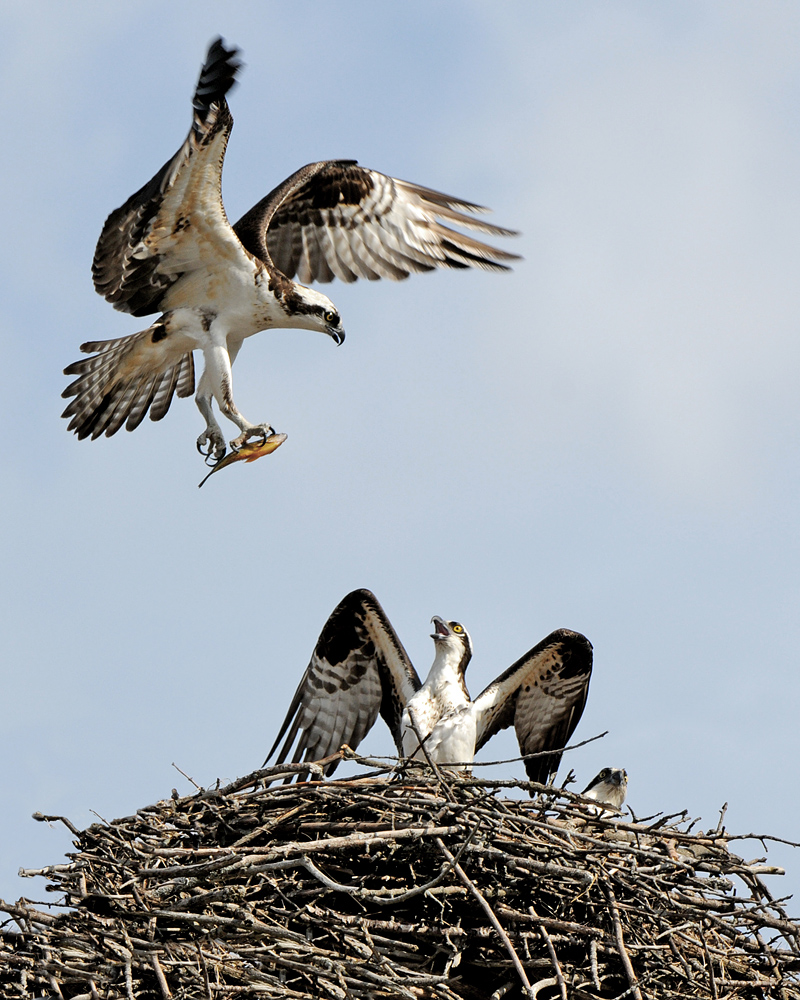
The Ospreys returned to my area in the past two weeks. Yesterday I witnessed this scene, that I thought was a little strange.

There were five adult birds apparently sharing this nest. Two or three would leave the nest at a time, then return with fish for the others. :confused:

I've never seen this behaviour before. Would the surplus birds be last year's young?

Nikon D300; 290 mm; f6.3@ 1/1250th; ISO 320; HH; Cropped to vertical.

All comments and suggestions most welcome - especially as to the behaviour shown. Thanks for looking.

Comments

11 comments
Comment posted by Gary Gulash on April 16, 2013 at 9:32 AM
Tom, high housing costs and the trend has become for young adults to stay at home longer, usually in the basement though. :biggrin: Sorry, couldn't resist. I'm actually looking forward to some serious responses to your question as I don't know the true answer. The angle is a bit steep here, but that's par for the course considering how high they perch these nests. Excellent sharpness and great timing to catch the incoming bird, with fish! :toast:
Registered on January 28, 2005, 879 Posts, 12098 Comments
Comment posted by SandyRichardsBrown on April 16, 2013 at 11:58 AM
We saw this often in Florida recently. The sub-adults, who are fledged or nearly fledged, are the same size as the adults, so it looks as if there are 3-5 adults in some nests.
As with human critters, the kids often refuse to leave the nest until thrown out, and are very vocal in their demands for continued feeding. Usually, only the adults leave and return with food. The kids just sit there begging.

This is a fine image - just what I was looking for, but failed to get in Florida. Nice dtail, very sharp, true colours, and great ation.

In and around Sanibel Island, every post, tower, tree, and many rooves have osprey nests. No lack of food around here, so they thrive.

Sandy
Registered on November 24, 2003, 3937 Posts, 12909 Comments
Comment posted by Tom Lusk on April 16, 2013 at 12:52 PM
Gary: Thanks for your comments. The problem I'm dealing with (as far as my human offspring goes) is that once they leave, there is no guarantee they won't move back, and bring a friend, or a dog, or...

Sandy: It will be approx. 2 months before our local young-of-year Ospreys fledge (usually late June into early July). The ice just recently left our local lakes/rivers.
Registered on September 17, 2005, 312 Posts, 600 Comments
Comment posted by Dottie Short on April 16, 2013 at 1:56 PM
Great shot! I fascinated by the construction of the nest.
Registered on April 12, 2010, 61 Posts, 375 Comments
Comment posted by Kurt Bowman on April 16, 2013 at 3:34 PM
Really like the action and behavior in this Tom. I have no idea about why so many adults would share a nest.
Registered on June 19, 2008, 1005 Posts, 8028 Comments
Comment posted by Max Waugh on April 16, 2013 at 5:36 PM
Very nice interaction here, Tom. While the flying bird's pose isn't quite perfect, the "anxious" pose and great view of the nesting bird really makes it for me. Nice work.

Max
Registered on September 26, 2008, 428 Posts, 2329 Comments
Comment posted by Ken Archer on April 17, 2013 at 3:47 AM
Not sure what kind of behavior you are photographing here, because they all look like adult birds to me. This is a great action shot for sure. Excellent Work Tom :cool:

Ken Archer
Registered on October 28, 2004, 222 Posts, 6683 Comments
Comment posted by Claude Dagenais on April 17, 2013 at 7:18 PM
Probably an available female and a number of bachelors(LOL) :toast:
Registered on April 10, 2013, 56 Posts, 571 Comments
Comment posted by Mike Ramy on April 19, 2013 at 12:25 PM
Tom,
Way to go on this capture, good detail and action.
As far as the behavior you witnessed, this is referred to as a ‘Winter Roosting Flock’. Osprey are primarily solitary birds except during the breeding season. The situation with winter hanging on so long into spring as delayed their breeding season this year. Osprey will roost in small winter flocks of up to 10 birds in one crowded nest and the area around the nest. As breeding season approaches, the males perform a soaring aerial "Sky-Dance," with dangling legs, often clasping a fish or nesting material in his talons, the male alternates periods of hovering with slow, shallow swoops to impress the available female. The males will perform this display for as much as several minutes, he utters repeated screaming calls while gradually descending in an up and down fashion into the nest. I believe this is what you witnessed in this situation, hope this helps.
:wavey:
Registered on June 16, 2012, 567 Posts, 2809 Comments
Comment posted by Tom Lusk on April 19, 2013 at 3:45 PM
Mike:

Thanks so much for the explanation. In most cases, wouldn't the pair that had successfully nested at a specigic site in past years end up with the nest?
Registered on September 17, 2005, 312 Posts, 600 Comments
Comment posted by Mike Ramy on April 19, 2013 at 5:55 PM
Tom,
You are correct however, although most Ospreys mate for life this does not always hold true. The nest will belong or be dominated by the male year after year and is added on to each year and can become quite large. The winter roosting flocks will consist of Ospreys ranging in age and all intruders will be eventually run off by the dominant male for that nest as the breeding season starts and his mate is choosen and/or becomes available. If the dominant male is killed, a nest may sit empty for one or two years until it is reclaimed by another male. The Osprey with the fish in your image is a young female evidenced by the ring of brown feathers under the neck.
Registered on June 16, 2012, 567 Posts, 2809 Comments