More Blue Bells
by John Clulow
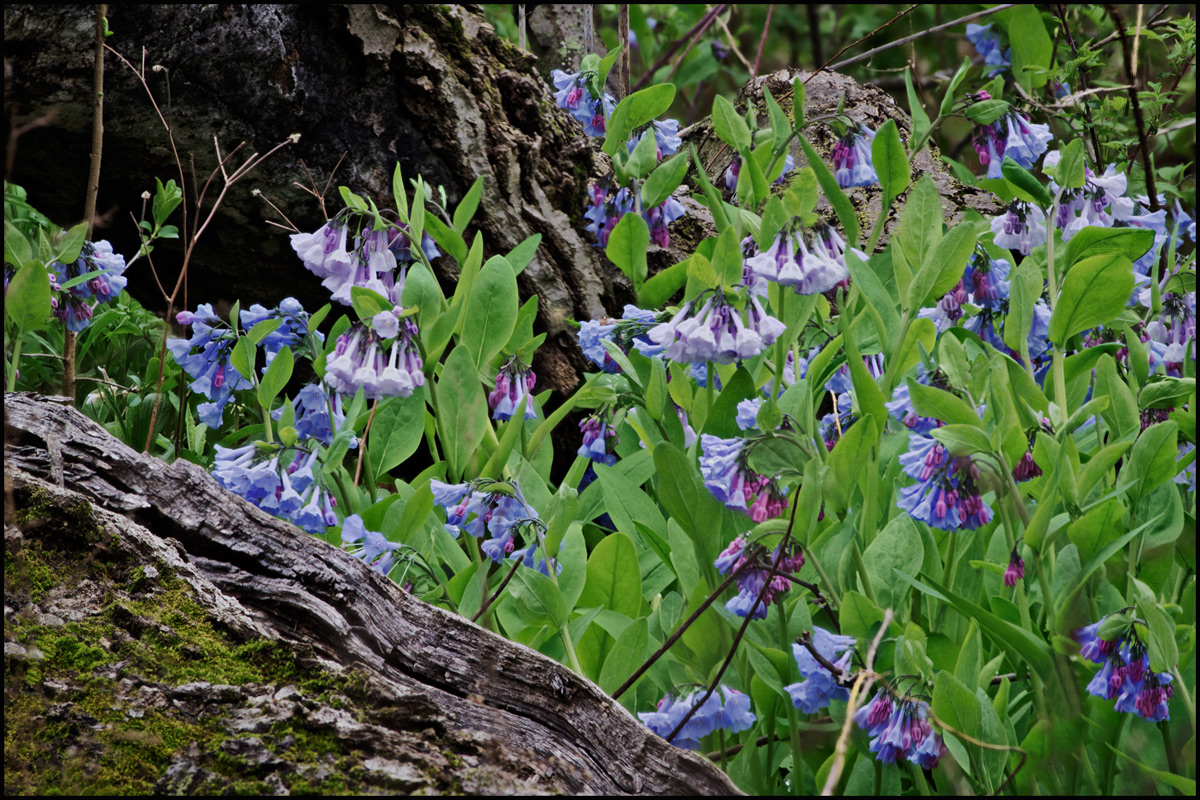
This is another impression I had Saturday while photographing the blue bell field at Morton Aboretum near Lake Marmo. In this one, I used a focus stack of 22 images with PMax in Zerene and I did a little tweaking of the fimal composite using luminosity masks.
Again, these are occurring on the context of a course in composition, so they are somwehat experimental in nature, and I would very much appreciate your critique. In addition, it should be interesting to compare it with the classroom critique this Thursday.
Pentax K-5, Pentax 300mm tripod, ISO 100, 1/30s, f/8.0; PMax result for 22-image stack

Comments
3 commentsPhil: Although I appreciate your comments, as I do all comments, I do think differently regarding a few points. First, the decaying log/stump, for me, as the photographer, is an essential element, having to do with a contrast illustrating the cycle of life in the woods, not something I would want to delete in order to increase the prominence of the flowers as the point of the image I am trying to make has to do with the balance between the two. Otherwise, I would excluded the decaying log/stump from the composition.
Secondly, I disagree with your generalized implication that the sole purpose of focus stacking to produce a well-focused image with a great un-focused bokeh in the background. It is true that it can be used very effectively that way. However, I'm sure you would agree that, like any method, the variety of potential artistic intents is not limited to a single objective.
Finally,with 300mm focal length a distance-to-subject of approximately six feet, a subject distance of about a two feet in depth, and a focus stack that includes 22 images required for the image posted, the suggestion you made that stopping down from f/8 to, say, f/22 or even f/32 could be substituted for focus stacking and achieve the same objective reallly doesn't work if you do the calculations.
But I do appreciate the recommendation and will consider trying stopping down further in the future in situations like this to make apples-to-apples comparisons.