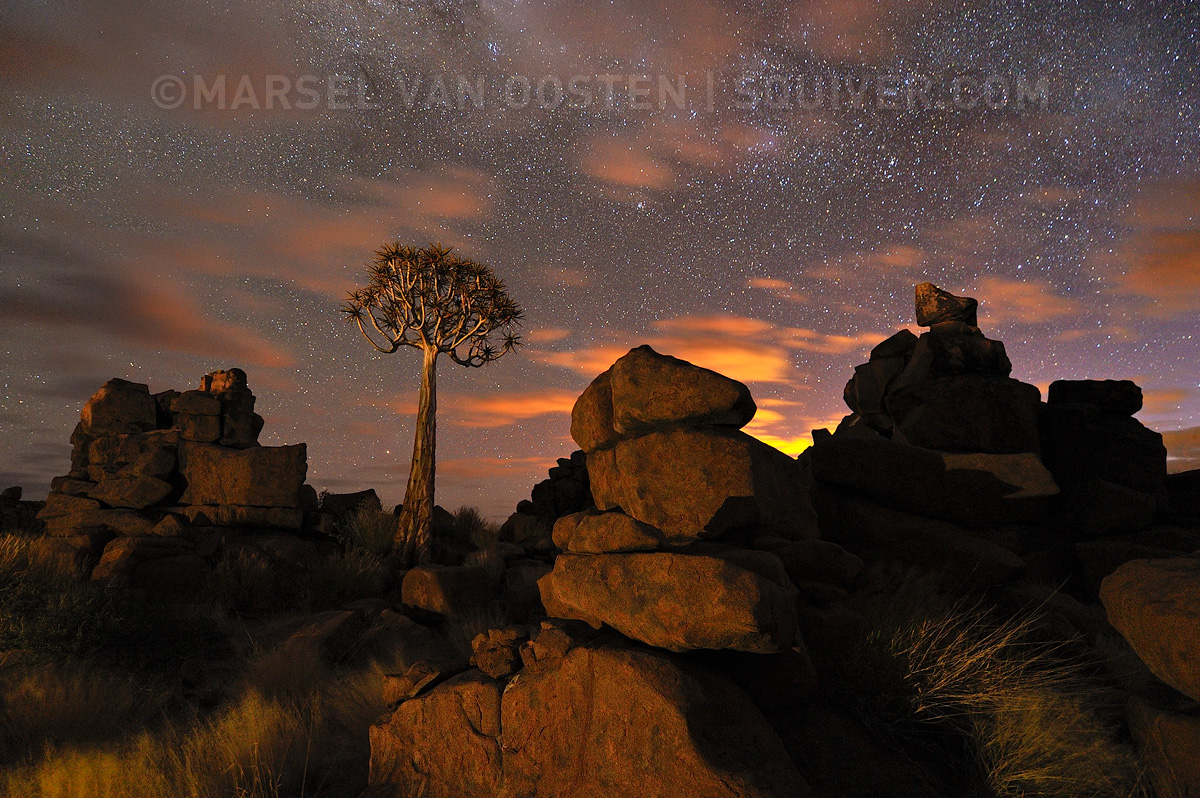
The image you see here is basically a still from the time lapse video that won First Prize in the Travel Photographer of the Year Awards, only this was shot before I actually started the whole sequence. At the time I wasn’t sure if the clouds were going to increase, ruining my chances for getting stars. So I had to wait to see what was going to happen, and I decided to take some shots while waiting.
When I looked at the first results, I was surprised to see so much color in the clouds. There was a town some 15 kilometers away and my camera’s sensor had picked up all the light pollution that my eyes couldn’t see - a nice surprise. After a while, the clouds thinned out and disappeared, so I could continue with my plan.
My Nikon D3s was mounted on a dolly that was programmed to slide to the right during the night, while taking pictures of course - most time lapse videos are basically moving stills, and that's something that I did not want. For lighting this scene I used two small lights that stayed on during the entire shoot.
The winning time lapse video was just one minute long, but last month we finished the edit of a longer version. You can watch it here:
Namibian Nights Timelapse Video (Extended Version)
Marsel

Comments
16 commentsmost time lapse videos are basically moving stills,
I have a different take on that; personally i think the dolly shots (which are ubiquitous and cliched in timelapse) are wayyyy overused and defeat what i personally find to be the beauty of timelapse. They create motion in 'real time' whereas the lapse itself is time sped up, and i think the two effects are in a sense counter-productive. But i acknowledge that im in the minority on that--i can live with that!
While I agree that you see a lot of dolly time lapses now, when I started this project (in 2010) that was definitely not the case. Still, I think the essence of video is movement, so if I were to do another time lapse like this, I would certainly work with a dolly again - static scenes are simply far less interesting to look at, especially if you put multiple static scenes together.
As for the movement - the dolly moves more or less at the same speed as the stars, at least, that's what I tried. In the beginning I experimented with slower and faster speeds, but I didn't like the results when the two speeds were too different. Both the movement of the stars and the dolly are sped up.